
The Truth About Cardio After 40: What Science Actually Says
For most of my 30s, I ran. Nothing dramatic, five mornings a week, two or three easy miles before the house woke up. I liked the routine. I liked that it never asked much of me beyond showing up, and that the number on my watch always told me I’d done something.
Then I hit my early 40s, and the miles stopped meaning anything. My waistband told a different story than my running log did. The softness around my middle wasn’t responding to the running. If anything, it seemed to be getting worse the more consistent I was.
So I did what felt logical: I ran more. Pushed the pace, added a day, told myself if three miles weren’t working, four or five would. I kept that up for a month, maybe two. Nothing moved. My body simply refused to cooperate with the plan that had worked for a decade.
It wasn’t until I started reading into the actual physiology of exercise and hormones after 40 that I understood what was happening underneath all that effort. The cardio that had served me reliably in my 30s had become, in a specific and measurable way, something my body was working against.
This isn’t an anti-cardio article. I still walk every day, and I believe in the real health benefits of cardiovascular exercise. But the relationship between cardio and belly fat after 40 is far more complicated than most fitness content lets on.

A Quick Gut Check Before You Keep Reading
If two or more of these sound like your last few months, this article is for you.
- Fatigue that doesn’t resolve with a rest day
- Belly fat that’s holding steady or growing despite consistent exercise
- A resting heart rate that’s noticeably higher than it used to be
- Trouble sleeping even though you’re physically worn out
- Irritability that seems disconnected from anything specific
- Strength or endurance quietly declining over weeks of training, not improving
What Cardio Actually Does to Your Body
Let’s start with what cardio genuinely does well, because it does plenty.
Cardiovascular exercise improves heart health, lowers blood pressure, supports lung function, lifts mood through endorphin release, and has solid, long-standing evidence behind it for longevity. None of that is in question here.
For fat loss specifically, cardio works through a simple mechanism: it burns calories during the session itself. A moderate 45-minute jog might burn somewhere in the range of 350 to 450 calories, depending on weight and pace. In a calorie-deficit context, that contributes to fat loss the same way it always has.
So the question for women over 40 isn’t whether cardio burns calories. It does. The real question is whether it’s the optimal strategy for changing body composition in a body that’s also dealing with shifting hormones, a more reactive cortisol response, and muscle loss that’s already underway. And on that question, the evidence gets a lot less tidy.
Why Chronic Cardio Backfires After 40
The muscle problem
Cardio doesn’t build muscle, and that’s the core issue. Women over 40 are already losing muscle mass faster than they did a decade earlier, largely because of declining estrogen. A body with less muscle burns fewer calories at rest, which means the workout that used to move the needle eventually stops working, not because you’ve gotten lazy, but because the engine underneath it has quietly gotten smaller.
The calorie compensation effect
There’s a well-documented phenomenon researchers call exercise compensation. Several studies, including work published in the International Journal of Obesity (King et al., 2008), have found that people who take on large amounts of structured cardio often, without noticing, reduce their activity for the rest of the day. Less fidgeting, more sitting, a shorter walk to the mailbox.
In practical terms: you run for an hour, then your body quietly conserves energy everywhere else. The net calorie burn ends up lower than the workout log would suggest.
The adaptation ceiling
Your body is remarkably good at becoming efficient. The same 5-mile run that burned 500 calories when you started training tends to burn noticeably fewer once your body adapts, simply because you’ve become a more economical runner. That efficiency is great for performance. It’s the opposite of helpful for fat loss.
The Cortisol Problem Nobody Talks About
This is the part most fitness content skips entirely, and for women over 40 it may be the most important piece of the whole conversation.
Long, sustained cardio sessions, particularly at moderate to high intensity, raise cortisol significantly. That’s a normal response. Your body reads sustained exertion as a stressor and releases cortisol to mobilize energy for it.
After 40, as estrogen declines, cortisol takes longer to come back down after each session and less of a trigger to push it up — the full mechanism is covered in Cortisol and Belly Fat After 40 →.
Elevated cortisol has a well-established relationship with visceral fat storage, the kind that collects specifically around the abdomen (Björntorp, Obesity Reviews, 2001). So there’s a real irony sitting at the center of this: the cardio you’re doing to lose belly fat may be one of the things keeping your cortisol high enough that the belly fat stays put.
The Numbers Worth Knowing
What My Smartwatch Showed Me
I didn’t figure any of this out from a research paper first. I found it on my own wrist.
By my mid-40s I’d started wearing a smartwatch mostly because I wanted a more accurate, real-time read on my heart rate than my old method of just checking my pulse after a run. My resting heart rate normally sat somewhere between 65 and 75. Then I noticed it climbing into the low 80s and staying there for several days at a stretch, even on days I hadn’t trained at all, before it would drop back down again. A few weeks later, the same pattern would repeat.
It made me uneasy. Nothing in my routine had changed, so I started wondering whether something was going on in my body that I simply couldn’t see. I didn’t connect it to cardio at first.
Once I did, the decision was straightforward. I cut back on running and started looking for strength work that actually fit my body, not just whatever I found online. Lunges, more deliberate band exercises, and I started tracking what I was doing instead of guessing. The pattern on my watch settled down once the running load came down with it.
What the Research Actually Shows
Strength training builds what cardio can’t, even if cardio still wins on raw fat loss. A widely cited 2012 trial in the Journal of Applied Physiology (Willis et al.) compared aerobic training, resistance training, and a combination of both in overweight adults. Aerobic training and the combined group actually reduced body mass and fat mass more than resistance training did on its own. But resistance training was the only intervention that meaningfully built lean muscle. A 2023 meta-analysis focused specifically on postmenopausal women, published in Frontiers in Endocrinology, found the same split: aerobic and combined training had the edge on fat mass, while resistance and combined training had the edge on muscle mass. That distinction is the whole point of this article. Muscle is the lever that keeps the rest of this equation from quietly working against you years down the line, and cardio alone doesn’t pull it.
Why “More Efficient” Isn’t a Compliment Here
Two things are happening at once as your body adapts to repeated cardio. First, the workout itself burns fewer calories over time because your body has gotten better at performing it. Second, exercise compensation kicks in, and daily movement outside the workout quietly drops to offset some of what you just burned. Neither shows up on the treadmill display. Both show up on the scale.
HIIT is a mixed bag for women over 40. Short, intense interval training is enormously popular, and there’s good evidence it works well for younger populations. In perimenopausal and postmenopausal women specifically, the picture is less clean. Some research has found that high-intensity training in this group produces a more pronounced, and slower to resolve, cortisol response compared with steady-state cardio, though the research base here is still thinner than it should be for such a popular recommendation.
Walking holds up better over time than it gets credit for. Walking simply doesn’t carry the cortisol cost that moderate-to-high-intensity cardio does. That alone is likely a big part of why women who lean on walking as their primary form of movement often see results that hold up better over the long run than what tends to show up with consistently harder training.
The Right Role for Cardio After 40
Cardio is a health investment, not your primary fat-loss tool. The cardiovascular benefits of regular aerobic exercise are real: heart health, cognitive function, mood, longevity. Those reasons alone make it worth keeping in your routine.
But cardio works best as a complement to strength training, not the center of your strategy. The body composition wins (fat loss, resting metabolic rate, less stubborn belly fat) are driven mainly by muscle mass, and muscle mass comes from resistance training. Cardio doesn’t build it, and too much cardio can actively work against keeping it.
The Cortisol-Conscious Approach
- 2 to 3 strength sessions per week (30 to 40 minutes each) as your primary exercise priority
- Daily walking (around 30 minutes, ideally after meals) for the metabolic and cortisol benefits
- 1 to 2 low-impact cardio sessions weekly (cycling, swimming, dancing) purely for cardiovascular health
- High-intensity sessions, at most once a week, and only when sleep and stress are genuinely well-managed
The Walking Advantage: Why Low-Impact Wins
I want to spend a moment specifically on walking, because I think it’s the most underrated form of exercise for women over 40, and the most consistently dismissed in mainstream fitness culture.
It directly improves insulin sensitivity. A short 10 to 15 minute walk after a meal measurably reduces the post-meal blood sugar spike, an effect documented in a randomized crossover study published in Diabetologia (Reynolds et al., 2016). Done after each meal, this becomes one of the most powerful insulin-supporting habits available without medication.
It keeps cortisol low. Unlike moderate-to-high-intensity cardio, a steady walk doesn’t trigger a meaningful cortisol spike, and there’s some evidence it can gently lower cortisol over time, particularly outdoors in natural light.
It burns real calories without the adaptation problem. A 30-minute walk burns a modest but genuine number of calories, and that burn doesn’t fade nearly as much over time as running does.
It’s also just completely sustainable. No injury risk worth mentioning. No real recovery time needed. No equipment. You can do it anywhere, at any age, for as long as you want to.
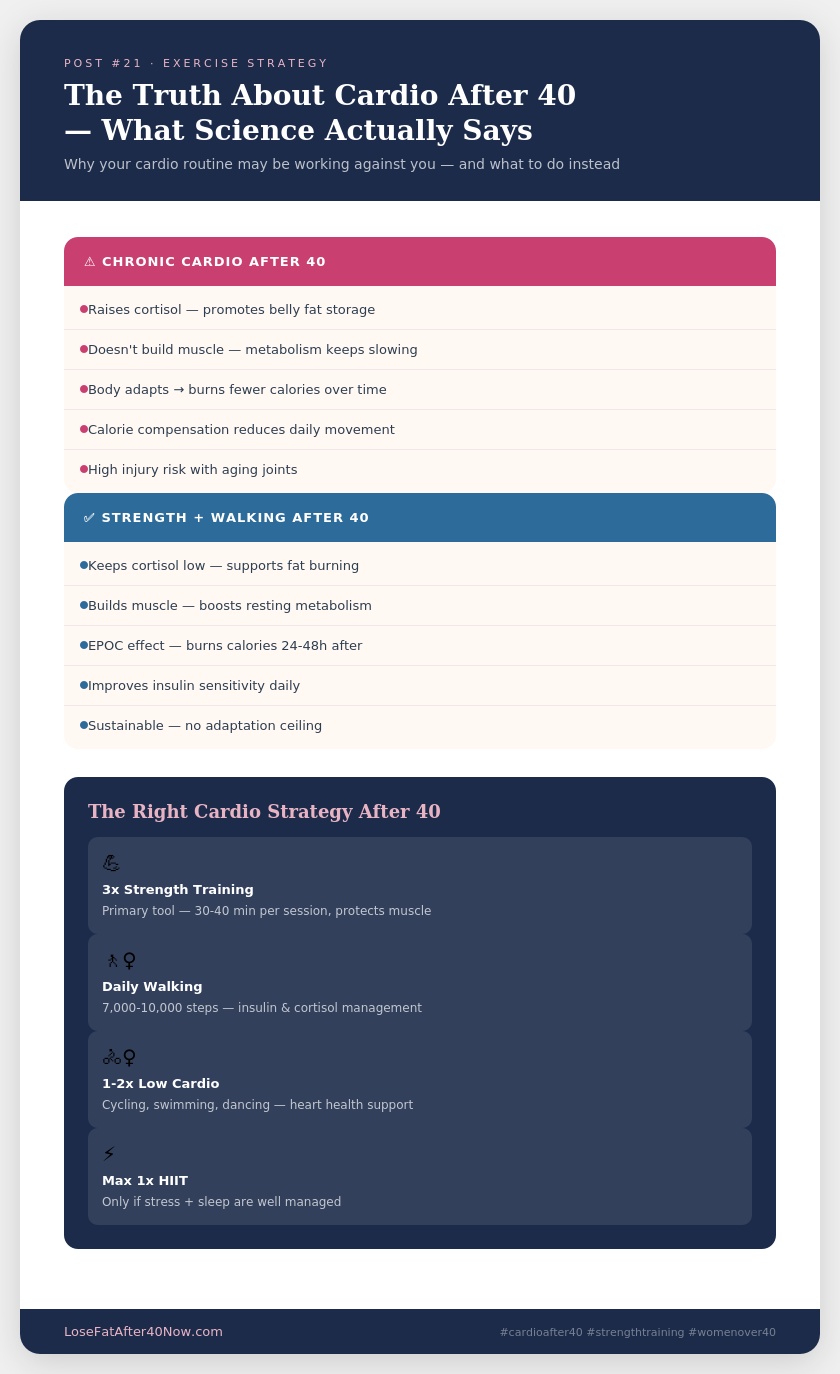
Somewhere between 7,000 and 10,000 steps a day, through a mix of intentional walking and ordinary daily movement, is one of the better-supported lifestyle habits for metabolic health in women over 40.
Building Your Cardio Strategy After 40
If the gut-check list near the top of this article hit close to home, here’s how to put all of this into practice.
| Day | Activity | Duration | Purpose |
|---|---|---|---|
| Monday | Strength training | 30-40 min | Muscle & metabolism |
| Tuesday | Walk + mobility | 30 + 15 min | Recovery + insulin sensitivity |
| Wednesday | Strength training | 30-40 min | Muscle & metabolism |
| Thursday | Low-impact cardio | 30-40 min | Cardiovascular health |
| Friday | Strength training | 30-40 min | Muscle & metabolism |
| Saturday | Long walk or swim | 45-60 min | Active recovery |
| Sunday | Rest or gentle yoga | 20-30 min | Full recovery |
Daily floor: 7,000 steps, separate from anything structured, treated as non-negotiable.
If you’re consistently noticing the signs from the list at the start of this article, easing off the cardio volume and adding recovery time is almost always the right move. Not pushing harder.
Go Deeper on the Topics in This Post
Frequently Asked Questions
Should women over 40 stop doing cardio entirely?
No. Cardiovascular exercise has real, irreplaceable health benefits. The shift that actually matters is in cardio’s role, from primary fat-loss tool to health investment and complement to strength training, with a preference for lower-cortisol forms like walking.
How much cardio is too much after 40?
Most of the research points to chronic high-intensity cardio beyond 3 to 4 sessions a week, sustained over months, as the threshold where cortisol accumulation starts working against body composition goals. Two or fewer higher-intensity sessions a week, paired with daily walking and regular strength training, tends to land in a better range.
What about running? Do I have to give it up?
Not necessarily, especially if you genuinely love it and it’s not producing signs of overtraining. But if running is your primary form of exercise and body composition is the goal, the evidence points toward adding strength training and trimming run volume, rather than simply running more.
Does cardio improve heart health more than strength training?
Cardio offers specific cardiovascular benefits strength training doesn’t fully replicate. That said, strength training meaningfully improves cardiovascular markers too, and current research suggests a combination of both is the better target for heart health in women over 40, not cardio on its own.
Cardio isn’t the enemy here. Chronic, high-cortisol cardio used as a primary fat-loss strategy after 40, while strength training gets ignored, is the actual problem.
The body you’re after at this stage gets built in the weight room, or the living room with a set of resistance bands, and it’s supported by daily walking. Cardio earns its place as a health investment and something you genuinely enjoy, not as the centerpiece of your transformation.
I ran for a decade and my belly fat stayed exactly where it was. I cut the running back, added three strength sessions and daily walks, and watched my own watch confirm what I’d already known from how I felt. That’s not coincidence. That’s biology.
Has your relationship with cardio changed after 40? I’d love to hear your experience in the comments below. I read every one, and the specifics help me write more useful content for exactly this stage of life.
Medical Disclaimer: This post is for informational purposes only and does not constitute medical advice. Please consult with a qualified healthcare provider before making significant changes to your diet, exercise routine, or supplement use, particularly if you have existing health conditions.

Grace Young is the founder of LoseFatAfter40Now.com. After years of following conventional advice that quietly stopped working, she went deep into the research on hormones, metabolism, and midlife physiology to find what actually does. Everything on this blog comes from that investigation, and from living it. Read Grace’s full story →