Daily Routine to Lose Belly Fat After 40 (Simple Habits That Work)
My schedule for that week looked responsible, maybe even careful: protein breakfast by 7am, strength training three mornings a week, a substantial salad at lunch, nothing after 8pm. I had it down.
But the waistline I was carrying at forty-four wasn’t reading my schedule.
A daily routine to lose belly fat after 40, I’d assumed, was a question of discipline and consistency. I had both. The belly fat moved slowly or not at all, which meant the problem wasn’t effort. Something in how I’d arranged my days was working against my own biology rather than with it.
Then I read Dr. Michael Breus’s research on circadian cortisol rhythms. Cortisol peaks naturally in the first sixty to ninety minutes after waking. I’d been drinking coffee within fifteen minutes of rising every single day for years. My reasoning was simple: it was 6am, I had a full day ahead, my brain needed to come online. What I didn’t understand: I wasn’t waking myself up with that coffee. I was amplifying a cortisol surge that was already happening, pushing it higher and longer-lasting than it needed to be. Chronically elevated cortisol is the most direct hormonal driver of visceral fat accumulation after 40. I’d been contributing to mine before breakfast.
The same logic runs through the whole day. This post maps the 24-hour hormonal schedule that shapes belly fat after 40, and what to do at each window to make the day work with your biology instead of against it.
The Daily Hormone Schedule Your Routine Has to Work With
Before 40, most women can ignore the timing of their habits and still see results from the habits themselves. Metabolism is more forgiving. The hormonal environment is more stable. After 40, estrogen decline changes the picture: cortisol becomes more reactive, insulin sensitivity drops and follows a sharper daily curve, and the overnight fat-mobilization window becomes more dependent on sleep quality. The body still runs on the same 24-hour hormonal cycle. The consequences of ignoring it just get more significant.
These four hormones are the operating system behind any effective daily routine to lose belly fat after 40:
Your Body’s 24-Hour Hormonal Schedule
| Hormone | Peak or Active Window | What It Drives After 40 |
|---|---|---|
| Cortisol | First 60–90 min after waking | Natural energy peak, but chronically elevated, it signals visceral fat storage and worsens insulin resistance |
| Insulin sensitivity | Morning through early afternoon | Highest in the first half of the day; declines steadily; meals timed to this window produce better fat outcomes |
| Growth hormone | Deep sleep, approx. 10pm–2am | Primary fat-mobilization signal overnight; suppressed by late eating, screens, and unresolved stress |
| Leptin | Overnight | Hunger suppression; disrupted by poor sleep and late-night eating, driving next-day cravings |
Morning: The Hours That Set Everything Else in Motion
I’m not a natural morning person. This is worth stating because most morning-routine advice is written as if you either already are one or should become one through willpower. What I found is that the specific time I woke up mattered less than what I did in the thirty minutes that followed, and whether I did it at the same time every day, weekends included.
My morning now starts before I get out of bed. A few minutes of gentle movement: shoulders, hips, ankles. Not a formal routine, more like a quiet inventory before asking the body to do anything. The morning stiffness that used to make sitting up feel like negotiating has become far less frequent.
Then warm water. Then, without fail, outside. Five minutes in the backyard with my water glass. Morning light suppresses residual melatonin, anchors the circadian cortisol rhythm, and measurably improves that night’s sleep quality. The research on this is consistent enough that I stopped second-guessing it years ago.
Coffee comes ninety minutes after waking. The first two weeks felt off. My body had been conditioned to expect caffeine within minutes of rising. By week three, my mornings felt measurably different. Steadier energy, less of the mid-morning crash-and-crave cycle I’d lived with for years. Same cup, different hour, doing a different job.
The breakfast matters as much as the timing. Thirty-five to forty grams of protein at the first meal sets blood sugar and hunger patterns for the entire day. On mornings I skip or shortcut the protein, I can feel the difference in appetite by noon.
Morning Protocol: Wake Through First 2 Hours
- In bed, 3–5 min: Gentle joint movement before rising, not a workout, just a quiet start.
- Within 15 min: A large glass of warm water. Non-negotiable even on rushed mornings.
- Within 30 min: 5–10 min of outdoor or bright morning light. The light matters more than the location.
- At 90 min after waking: Coffee. The adjustment period lasts about two weeks, then it becomes the new default.
- Within 1–2 hours of waking: Protein-forward breakfast, 35–40g. This single meal anchors hunger and energy through early afternoon.
- Consistent wake time, weekends included: This one variable stabilized my sleep quality more than any supplement I’ve tried.
Morning Hormone Window: Key Numbers
Late Morning to Midday: When Your Body Burns Best
By late morning, cortisol has begun its natural decline and insulin sensitivity is still at its daily peak. This is the window where exercise and food choices pay the highest return for a daily routine to lose belly fat after 40. A single decision about lunch can either support the afternoon or quietly undermine it.
I learned the lunch piece through my body before I understood why. For a long time, midday meant whatever was convenient: pasta, bread, rice as the main event. By 2pm I was reliably flat: not dramatically tired, just diminished. The energy that had been there at 10am would be largely gone.
Switching to a big salad structure changed the afternoon in a way that felt immediate. A substantial base of vegetables, a real protein component (beans, tofu, fish, or edamame), and a smaller portion of low-glycemic carbohydrate. The difference showed up within a day or two of making the change. That early signal was more motivating than the scale ever was.
| Lunch Structure | Typical Afternoon Result | Why |
|---|---|---|
| Grain or bread as main component (pasta, sandwich, rice bowl) | Energy drop by 2pm, heightened snack cravings, reduced focus | Rapid glucose rise triggers insulin response, then blood sugar drop |
| Big salad with significant protein and small low-glycemic carb | Stable energy through 4–5pm, lower cravings | Slower glucose rise sustains energy and reduces afternoon cortisol response |
The post-meal walk was added around the same time. Ten to fifteen minutes after lunch, whenever possible. A 2022 study in Sports Medicine confirmed what I’d been noticing in my own body: even a five-minute walk after eating significantly reduces post-meal blood glucose. I don’t change clothes or track anything. I walk around the block and come back.
Resistance training falls in this window three times a week, thirty to forty minutes. Not trying to build something dramatic. Trying to preserve the muscle mass that keeps the resting metabolic rate intact as estrogen declines. These are different goals with different expectations.
The Afternoon Wall: What’s Actually Behind It
The 2 to 6pm window is where a well-planned morning tends to come apart. Cortisol follows a natural dip in mid-afternoon, and the body reads that dip as a mild stress signal. For women over 40, where cortisol is already more reactive than it was before, this produces predictable fatigue and cravings that have nothing to do with actual hunger.
My particular afternoon pattern was a small bag of roasted walnuts that lived in the second drawer of my desk, reliably appearing around 2pm. For years I either finished the bag before I’d really decided to eat it, or I pushed past the craving and arrived at dinner irritable. Neither approach solved anything.
What I do now: I alternate between two teas in the afternoon. Roasted brown rice tea and a tea made from dried onion skins. I found both in health articles rather than clinical trials. Whether the effect comes from mild glycemic stabilization, the quercetin in onion skins, or simply the ritual of making something intentional. I can’t say with certainty. What I know is that the craving eases when I replace it with one of these, and my afternoons are calmer for it.
Dehydration is the other piece most people overlook. It’s routinely misread as hunger in the afternoon. A full glass of water is often the most useful first response before reaching for food. I wasn’t attuned to thirst for most of my adult life. Being consistently hydrated by noon took deliberate practice before it became automatic.
Afternoon Habits That Work Against You
- Caffeine after 2pm: With a 5–6 hour half-life, a 2pm coffee is still active at 8pm, holding cortisol elevated during the window when it should be declining toward sleep.
- Skipping a small snack when genuinely hungry: Arriving at dinner ravenous drives faster eating, larger portions, and an evening blood sugar spike. A small protein-and-fat snack at 4pm is metabolically smarter than pushing through.
- Moving from work stress directly into eating: A five-minute transition (a short walk, slow breathing, a cup of tea) produces a measurable cortisol reduction before the meal. It’s a physiological shift, not a wellness concept.
Evening: What You Do at 8pm Affects Fat Burn at 2am
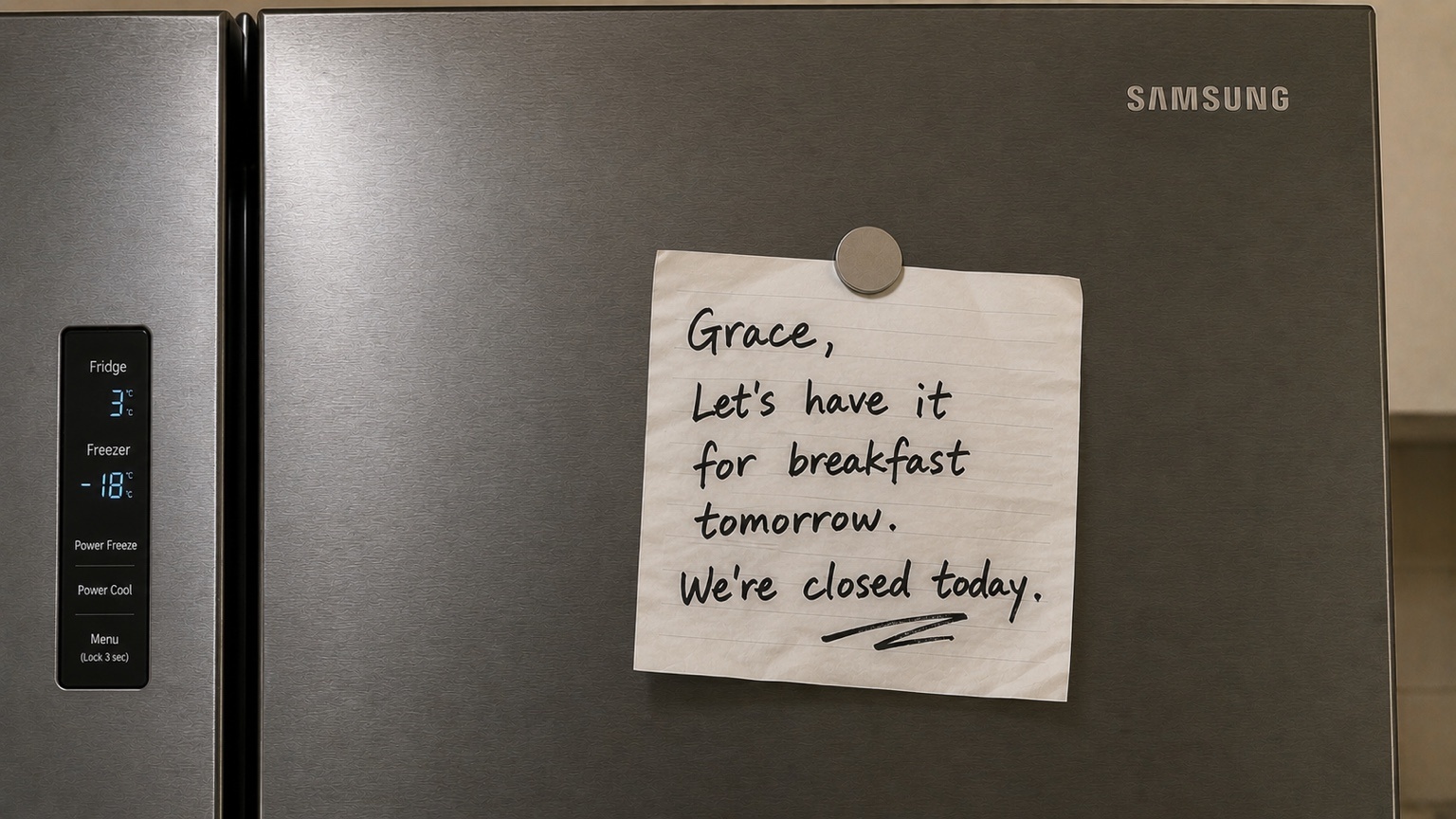
About six months into tracking my daily routine, I taped a note to the refrigerator door. It said: “Let’s have it for breakfast tomorrow. We’re closed today.”
The rule held for eight days. Day nine arrived with a stressful end, and by 10pm I was standing at the kitchen counter with a bowl of frozen blueberries thawing in a small cup of plain yogurt, eating slowly, not saying much to myself.
The guilt came. What stayed longer was the confusion. I hadn’t been especially hungry. That’s the part I didn’t understand at the time: I wasn’t hungry — I was inside a cortisol spike from the day’s stress, and my body was asking for fast fuel. That night wasn’t a willpower failure. It was a cortisol response I hadn’t learned to recognize yet.
Everything that happens in the evening either protects or disrupts the growth hormone window that follows. Growth hormone is the primary overnight fat-mobilization signal. It peaks during the first hours of deep sleep, somewhere around 10pm to 2am. Late eating, unresolved stress, and screen exposure all suppress this window in ways that show up in body composition over months.
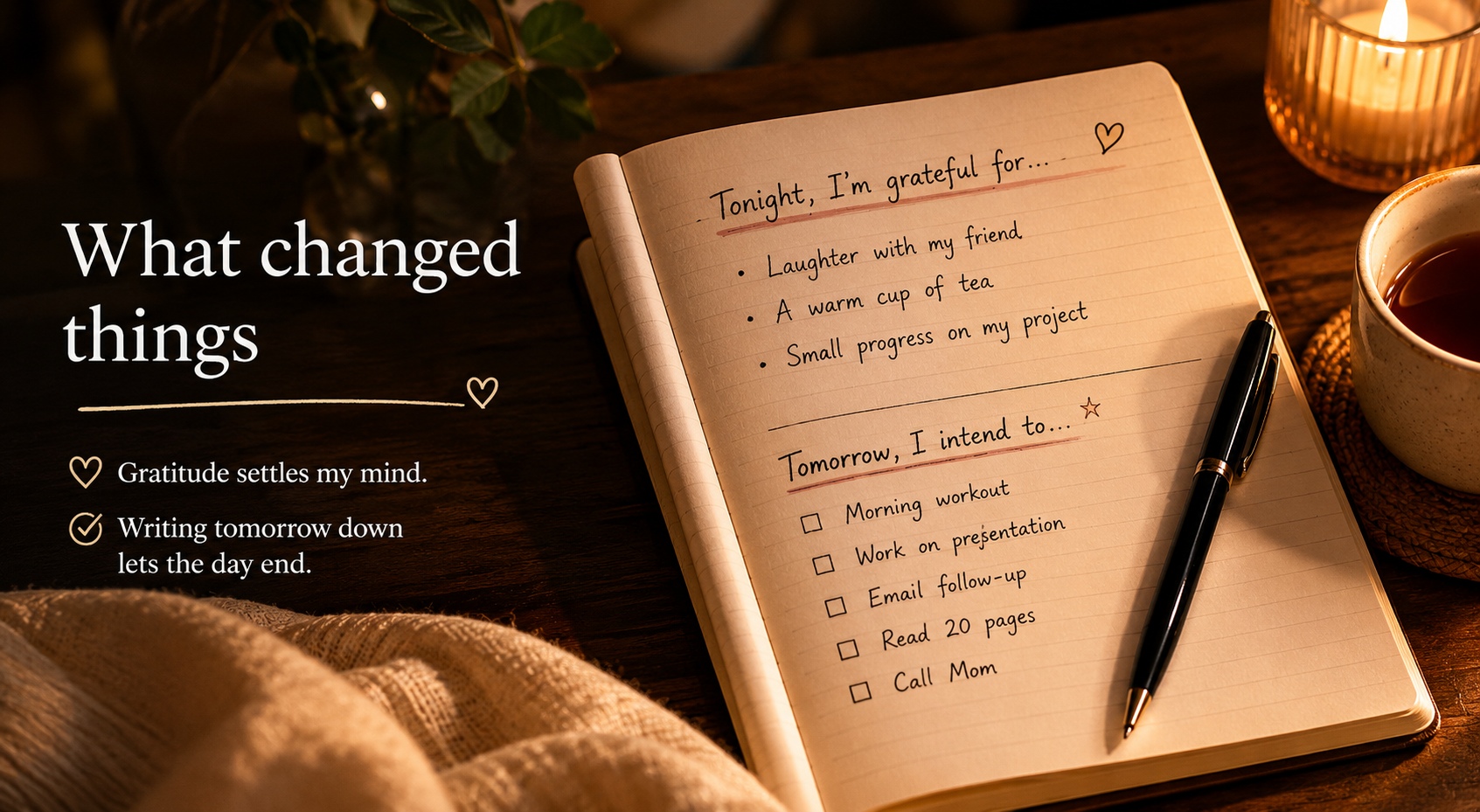
The practice that changed my evenings most was a short journal at the end of the day. Three specific things I was grateful for from that day, followed by a brief list of what I intended to do tomorrow. Ten minutes total. The gratitude engages the parasympathetic nervous system in a way that stress-looping doesn’t. The task list for tomorrow gives the day a clear ending. Whatever I needed to hold for the next day is written down. There’s nothing left to carry into sleep.
The National Heart, Lung, and Blood Institute documents how sleep quality, not just duration, governs the hormonal repair that happens overnight. The evening protocol isn’t about relaxation as a concept. It’s about giving the body the conditions it needs to do its actual work.
Evening Protocol: 7pm Through Sleep
- Dinner by 7–7:30pm: The 2–3 hour gap before sleep allows insulin to settle before the growth hormone window opens. Late meals directly suppress overnight fat mobilization.
- Gratitude journal and tomorrow’s task list: Three specific things you’re grateful for. A few lines for tomorrow. The nervous system needs a clear signal that today is finished.
- Herbal tea after 8pm: Something warm that isn’t a screen. Chamomile, passionflower, lemon balm. The ritual matters alongside the chemistry.
- Blue light reduction after 8pm: Screens suppress melatonin production. Warm-screen settings or blue light glasses from 8pm onward.
- Bedroom at 65–68°F: Supports deeper sleep architecture and activates brown adipose tissue overnight. Lower thermostat, heavier blanket.
The Weekly Framework That Keeps It All Together
Daily habits work inside a weekly structure. Without it, hard weeks pull everything apart. These are the anchors I return to regardless of how disrupted everything else has been.
Weekly Non-Negotiables
A few years ago I stopped measuring progress by weight alone. The scale is the last variable to change — often by several weeks. Waiting for it while ignoring everything else is a reliable way to lose motivation before the real changes arrive.
If you want to understand what to track instead of the scale, I’ve written about non-scale progress signals in detail in the post linked below. Shifting to these markers is what makes a daily routine to lose belly fat after 40 feel rewarding long before the scale catches up. They tend to move first, and they’re far more informative than a number that fluctuates with hydration and hormonal cycles.
Sunday evening protein prep is what makes the whole week’s daily habits practical. Thirty minutes: hard-boiled eggs, cooked legumes, portioned tofu. The protein breakfast happens on Tuesday morning even when Tuesday morning is rushed. Without that prep, the morning gets chaotic, protein gets skipped, and the blood sugar pattern I’ve worked to stabilize starts fraying before 10am. The prep isn’t interesting. It’s what makes everything else work when the week gets hard.
Frequently Asked Questions
How long before this routine produces visible results?
The routine gives you feedback signals within 72 hours — not results, but signs that the system is actually responding. Start there, because those early signals are what tell you whether what you’re doing is calibrated correctly before you wait weeks for something visible.
Protein at breakfast is the easiest one to feel quickly. If the afternoon hunger has a different quality within three days — not gone, but quieter, less urgent, more predictable — the protein amount is working. If nothing has shifted, the amount probably needs adjusting up.
The coffee delay and morning light work on a slightly longer timeline. The cortisol curve starts recalibrating within a week, and the signal tends to be a steadier mid-morning stretch where the usual slump either softens or shifts later in the day.
The visible body changes come after all of this has been running correctly for weeks. They’re the output of the system, not something you can track separately or hurry. The most useful thing to watch for in the meantime is whether those early calibration signals are holding — because if they are, everything downstream is moving in the right direction even when you can’t see it yet.
I cannot realistically delay my morning coffee. What should I do?
Start at thirty minutes instead of ninety. Any reduction in the cortisol-caffeine overlap in the early morning is better than none. Drink water first, get your light exposure, then coffee at thirty minutes. The uncomfortable adjustment period lasts about two weeks, and during that time you’ll start to notice the difference, which makes extending the delay easier because you have your own evidence that it matters.
What if I can only implement two or three changes? Which matter most?
Ranked by direct impact on belly fat: the protein breakfast, finishing dinner 2–3 hours before sleep, and a consistent wake time. Those three address insulin, growth hormone, and the cortisol curve. These are the most direct hormonal levers for visceral fat after 40. The post-meal walk would be my fourth addition because it costs almost nothing in time relative to its effect on afternoon blood sugar and insulin sensitivity.
I’m postmenopausal. Does this routine still apply?
Especially postmenopausal. The four mechanisms this routine addresses (insulin resistance, cortisol reactivity, sleep disruption, and muscle loss) all become more significant after full menopause, not less. The estrogen that previously moderated visceral fat accumulation is no longer present. Habits that support insulin sensitivity and sleep quality matter more now than they did before. Research on post-meal walking and protein timing shows particularly strong effects in postmenopausal women specifically.
The afternoon teas: are they actually supported by research?
Honestly, not in any rigorous clinical sense. Roasted brown rice tea has some evidence for mild blood sugar stabilization; dried onion skin contains quercetin, which has anti-inflammatory properties. But a significant part of the effect is probably the ritual itself. Making something intentional in the afternoon replaces the craving behavior with a different sensory experience. Try it for a week. Your own data is more reliable than anything I can tell you from my experience.
Which change would be hardest for you to start — the coffee delay, the evening journal, or the lunch shift? Drop it in the comments. The honest answers tell me more than the aspirational ones.
Medical Disclaimer: This post is for informational purposes only and does not constitute medical advice. Consult your healthcare provider before making changes to your diet, exercise, or supplement routine, particularly if you have existing health conditions or are taking medication.

Grace Young is the founder of LoseFatAfter40Now.com. After years of following routines that made complete sense on paper and produced very little in practice, she shifted toward understanding the hormonal mechanisms behind what actually changes in the body after 40. Her writing draws on that research and her own experience navigating those changes. Read Grace’s full story →