10 Best Home Workouts for Women Over 40
Six weeks of what I believed were the best home workouts for women over 40. Twenty-two sessions in my workout journal.
I’d been consistent in a way I hadn’t managed in years, tracking every session in the small spiral notebook I keep on my nightstand: date, workout type, how I felt. From the outside, it looked like someone who had finally figured out how to be disciplined about exercise.
One morning I pulled on the exercise leggings I’d been rotating through those weeks and noticed the waistband felt tighter than when I’d started. Not dramatically. Just enough. I stood there a moment and reached for explanations: they must have shrunk. Different pair. Whatever logic a person reaches for when the clear answer is uncomfortable.
My husband had mentioned a few days earlier, almost in passing, that I seemed more worn out coming home from workouts than I used to. I got defensive immediately. “I’d look worse if I stopped,” I told him. I heard myself say it and recognized what it actually was: not a health argument, a fear statement. I wasn’t exercising to feel better. I was exercising because I was afraid of what would happen if I didn’t.
That evening I sat with the journal open. Twenty-two sessions. A waistband that had tightened. A husband who’d noticed something I was working to ignore. None of that fit the story I’d been telling myself, and I stopped trying to make it fit.
What I eventually found is that workout type matters far more than workout quantity when choosing the best home workouts for women over 40. For biological reasons that have nothing to do with motivation. This post ranks ten workout formats by four criteria that actually determine results in the hormonal environment of perimenopause and postmenopause. Some of what rises to the top will feel familiar. What ends up near the bottom might be exactly what you’ve been working hardest at.
When More Training Produced Fewer Results
During those six weeks, I was doing what made intuitive sense: cardio on energetic mornings, stair sessions when the weather cooperated, fasted morning walks as a baseline. I added effort wherever the schedule allowed and assumed, the way most people do, that more work meant better outcomes.
What I wasn’t accounting for was the relationship between estrogen and cortisol. Estrogen, as it declines after 40, had previously been buffering my cortisol response to exercise. With less of it available, prolonged cardio sessions and high-volume training days were producing cortisol spikes I hadn’t experienced the same way at 35. Elevated cortisol directly promotes abdominal fat storage. I had been raising cortisol repeatedly, in a hormonal environment that no longer cushioned the response, and calling it discipline.
This is not a willpower problem. It is a biology problem, and it has a specific solution: choosing workout types that work with the hormonal environment after 40 rather than against it.
Why Workout Type Matters More After 40
| Rank | Workout | Primary Benefit After 40 | Cortisol Impact | Key Note |
|---|---|---|---|---|
| 1 | Resistance Training | Muscle, metabolism, insulin sensitivity | Low (controlled) | 48h EPOC; builds bone density |
| 2 | Daily Walking | Cortisol reduction, blood sugar control | Lowers it | Post-meal timing most effective |
| 3 | HIIT | Visceral fat, EPOC | High — 2x/week ceiling is essential | 20 sec on / 40 sec rest format |
| 4 | Yoga | Cortisol management, sleep quality | Lowers it | Room temp only; hot yoga reverses benefit |
| 5 | Pilates | Core, pelvic floor, spinal stability | Neutral | Foundation for all other movement |
| 6 | Swimming | Full-body resistance, joint-safe | Low | Best when joint issues limit land exercise |
| 7 | Cycling | Cardiovascular health | Moderate (session-length dependent) | Keep to 20–30 min for cortisol control |
| 8 | Barre | Posterior chain, range of motion | Low | Complement to resistance; not standalone |
| 9 | Long Steady-State Cardio | Cardiovascular, mood | High (sustained sessions) | Add resistance training alongside |
| 10 | Hot Yoga | Flexibility, some strength | High (heat cancels cortisol benefit) | Switch to room-temp yoga instead |
Four Questions That Rewrote My Workout Rankings
Most fitness rankings use calorie burn or intensity as the primary metric. Deciding on the best home workouts for women over 40 requires different filters. When I looked specifically at evidence from perimenopausal and postmenopausal women, not younger populations or men, four questions turned out to matter most. One of them doesn’t appear on most fitness charts at all.
Does it reduce visceral fat? Not general weight loss, but specifically the deep abdominal fat that increases as estrogen declines. Some workout formats reduce it meaningfully. Others don’t move it at all.
Does it preserve or build muscle? Muscle drives resting metabolic rate, the calories burned at rest every hour of every day. After 40, women lose muscle at an accelerating rate without deliberate resistance training. Workouts that protect muscle are protecting metabolism simultaneously.
What does it do to cortisol? This is the criterion that rearranges everything. Several popular workout formats produce significant cortisol spikes with every session. Younger women with adequate estrogen can buffer that response. After 40, with estrogen declining, the cortisol cost of high-volume cardio becomes a real factor in belly fat accumulation in a way it wasn’t before.
Does it improve insulin sensitivity? Estrogen decline accelerates insulin resistance, which makes midlife weight gain self-reinforcing. Workouts that improve insulin sensitivity interrupt that cycle directly. Not all exercise formats do this equally.
The Top Three Home Workouts for Women Over 40
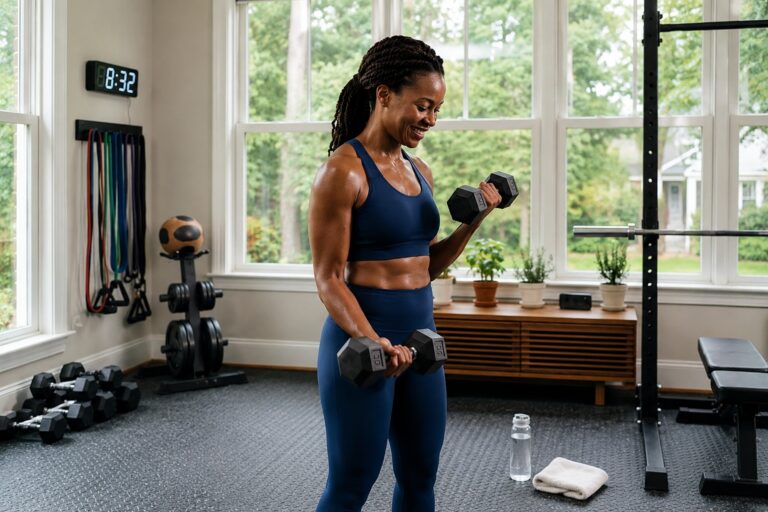
Resistance Training
My first pair of dumbbells weighed three pounds each. I remember picking them up and thinking: what is this actually going to accomplish? I had spent my adult life associating exercise with visible exertion and sweat. Three-pound weights felt less like a workout and more like a concession to something I wasn’t ready to name.
What I hadn’t registered was how much shoulder strength I had quietly lost. The first time I tried a simple lateral raise, arms out to the sides, my left shoulder sent a sharp signal and my neck stiffened immediately on the same side. Three pounds was producing discomfort I hadn’t anticipated. That alone told me something was worth paying attention to.
For the first few weeks I kept everything slow: shoulder raises, reverse flies, chest openers, fifteen to twenty minutes, three or four times a week. The day after each session was often harder than the session itself. Small muscles along the backs of my shoulders made themselves known in a way they never had before, as if they were waking up after years of being switched off.
About four weeks in, something shifted that I hadn’t expected. I walked up a flight of stairs and my posture felt noticeably different, lighter, more open. My shoulders weren’t curling forward the way they usually did. My upper back had space in it. I hadn’t lost any weight. But the structure of how I was carrying myself had changed, and I noticed it without looking for it.
That was the first time exercise felt like restoration rather than punishment.
Resistance training builds and preserves muscle — the primary driver of resting metabolic rate, and the full mechanism behind that, including EPOC, is covered in detail in How to Speed Up Your Metabolism After 40 →. It also produces meaningful improvements in insulin sensitivity for up to 72 hours after each session, something no cardio format comes close to matching. A 2022 review in the journal Menopause found that in postmenopausal women, resistance training outperforms cardio for visceral fat reduction, bone density, and resting metabolic rate. The National Institute on Aging documents this connection between muscle preservation and long-term metabolic health in detail.
Home setup: Dumbbells, resistance bands, or bodyweight. Three sessions per week, 35 to 45 minutes each. Add resistance gradually every two to three weeks. That progressive load is what produces sustained results rather than a plateau.
Daily Walking (7,000–10,000 Steps)
Walking may be the one physical activity I’ve never had to talk myself into. My husband can’t keep up with me on foot. My sons can’t either. On a long trip once, I walked for six hours with almost no breaks and felt completely fine when I got back, while everyone else needed to sit down immediately.
So I’ve tested walking for fat loss in nearly every configuration: fasted morning walks, varied pace, different distance targets. What I found was that timing made a larger difference than I expected. Early morning walks on an empty stomach left me depleted before the day had properly started. My energy would drop off, and I’d spend the rest of the morning trying to recover from the walk itself rather than using that energy for anything else.
Post-meal walking was where I found the approach that actually worked. Even ten minutes after eating, just movement, and the heavy, distended feeling that often follows a meal would ease noticeably. I felt less bloated. More settled. That was worth something on its own, before I’d even looked at the research behind it.
Post-meal walking reduces post-meal blood glucose spikes by 20 to 30 percent, according to a 2022 analysis in Sports Medicine. Lower post-meal glucose means less insulin released, less fat-storage signaling, and more stable energy through the afternoon. I felt the difference before I understood why it was happening, which is usually how the most useful health habits arrive.
Walking’s specific advantage for women over 40 is what it does not do to cortisol. Running raises it. Cycling raises it. Brisk walking is the one steady-state cardio format that consistently lowers cortisol rather than adding to it. For women already managing elevated cortisol that’s driving belly fat storage, that distinction is real and worth protecting.
HIIT (Twice a Week, Maximum)
I should tell you what happened when I did HIIT without understanding the ceiling on frequency.
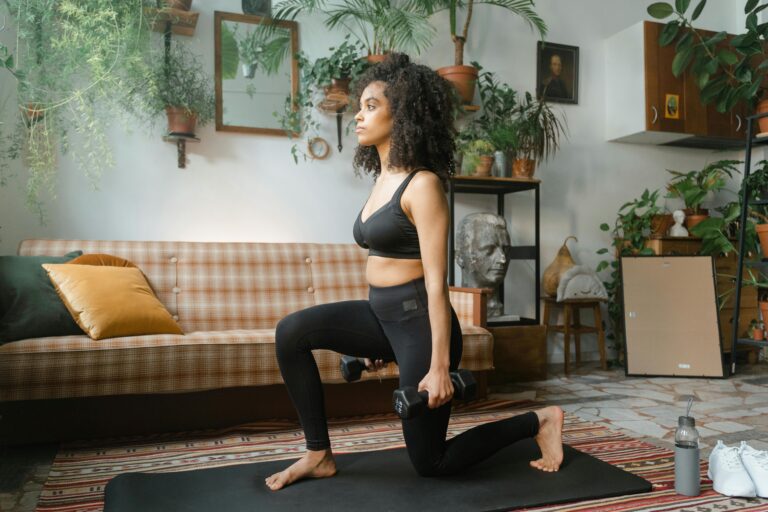
I’d been reading the research, and the case for HIIT was convincing: short intervals, visceral fat reduction, significant metabolic response. I went to the neighborhood park and started on the stairs: up fast, brief recovery, up again, then squats, lunges, jumping jacks, back to the stairs. I wasn’t following a set program. I was following the feeling of working hard, which felt like the right direction.
I aimed for five sessions that first week. Then four the next. Somewhere in the third week, my joints began communicating in a language that was hard to misread. Everything ached, not the productive soreness of muscles being challenged, but a deeper grinding quality that means something is being pushed past what it can sustain. Knees. Hips. Things that needed far more recovery time between sessions than I had given them. I had to pull back sharply, and the actual recovery took several weeks longer than the damage had taken to accumulate. My joints had been patient. They had a limit.
HIIT works for visceral fat because it creates a controlled hormonal stress response. Done twice per week, that stress produces beneficial metabolic changes. Done five times per week, you’re adding to a cortisol load that’s already elevated in a low-estrogen environment, and the result tends toward more fat storage, not less, alongside the joint wear.
The format that works for women over 40: 20-second efforts at near-maximum intensity, 40-second rest, 8 to 10 rounds. The longer rest interval allows real recovery between efforts. Without it, you’re doing sustained moderate cardio with extra joint impact and none of the distinct metabolic benefit that makes HIIT worth doing in the first place.
The Middle Tier That Earns Its Place
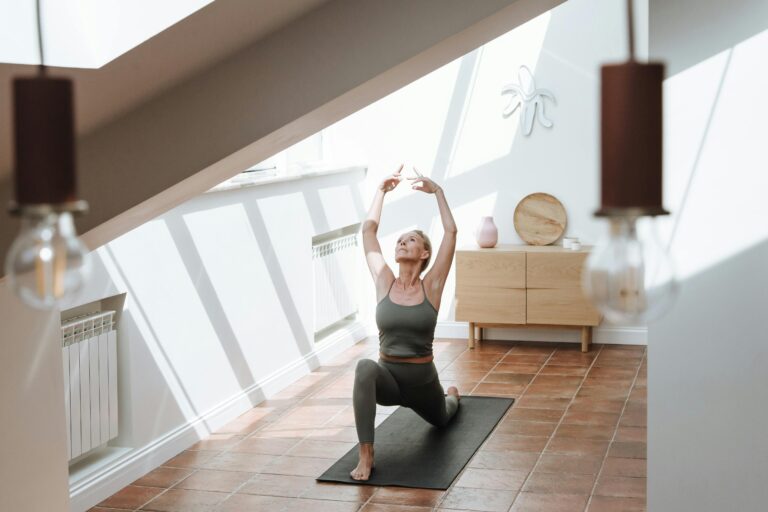
Yoga (2–3 Times Per Week)
My older sister is two years ahead of me and has maintained a physique that people consistently underestimate by about two decades. When she recommended yoga, I didn’t need much convincing. Whatever she was doing, I wanted to understand it.
My lower back had other ideas. The first session ended with me attempting positions my body had never built the foundation for, and the aftermath lasted longer than I anticipated. I had assumed yoga would be gentle by nature. What I discovered is that it asks the body for things that require preparation, and mine hadn’t done any. I ended up with a back that needed days to settle, and yoga stayed at a distance for years after that.
During the pandemic, I found a YouTube channel that changed that relationship: SeniorShape Fitness, taught by Lauren, who holds an ACE (American Council on Exercise) certification. Her movements are smooth, deliberate, and respectful of joints. I started following her yoga classes two to three times a week and, for the first time, understood what yoga was actually accomplishing.
It wasn’t primarily about flexibility. It was about how my nervous system felt in the hours afterward: quieter, less braced. The tension that normally held in my upper back and neck was simply less. Sleep on yoga nights was consistently different. In the first few weeks of adding resistance training alongside yoga, I noticed the scale nudged slightly upward before it eventually shifted down — that’s muscles storing more glycogen and water as they adapt, which can make exercise look like it’s working against you when the opposite is true. The more honest signals were cortisol ones: how settled my sleep was, how my upper back felt in the mornings.
Yoga ranks here specifically because of its effect on cortisol. Hatha and restorative yoga directly activate the parasympathetic nervous system, producing measurable cortisol reduction. For women whose belly fat is significantly cortisol-driven, which for many of us in perimenopause it is, yoga addresses a mechanism that no other workout on this list targets as directly.
Pilates (Twice Per Week)
Pilates is not primarily a fat-loss tool, and framing it that way would mislead you. What it does for women over 40 is more foundational: pelvic floor support, deep core engagement, spinal stability, and the structural integrity that allows everything else on this list to keep working safely over time. As estrogen-related connective tissue changes occur through perimenopause, the relationship between core stability and lower back health, hip function, and posture becomes increasingly concrete. Think of Pilates as maintenance for the structure that all other movement runs on. Less glamorous than a ranking might suggest, and more important than most people realize until they’ve been doing it consistently for six months.
Swimming and Aqua Exercise (Once or Twice Per Week)
Water provides roughly twelve times the resistance of air, which makes swimming full-body resistance work rather than simply cardiovascular training, with zero joint impact. For women managing knee pain, hip limitations, or lower back issues that restrict land-based exercise, swimming is uniquely accessible in a way other resistance formats aren’t. It ranks here rather than higher primarily because consistent pool access isn’t universal and because progressive loading is harder to achieve than with dumbbells or bands. Where access exists, it’s effective and worth including in the rotation.
The Bottom Four: Real Benefits and Real Caveats
These four workouts are not poor choices. I want to be clear about that before explaining where they land, because I know how it reads to see something you’ve been putting effort into ranked near the bottom. Each one has genuine benefits. They sit lower here because they are less efficient specifically for visceral fat reduction in the low-estrogen, higher-cortisol hormonal environment of perimenopause and menopause.
Cycling (Stationary or Outdoor)
Good cardiovascular work, lower joint impact than running, and practical at home with a stationary bike. The limitation: extended sessions of 45 minutes or more at moderate effort produce meaningful cortisol elevation without the muscle-building return that makes resistance training’s cortisol cost worthwhile. If cycling is already part of your routine, keep it, but keep sessions to 20 to 30 minutes and pair it with resistance training rather than treating it as a primary fat-loss strategy.
Barre
Barre provides genuine muscle engagement in the posterior chain, glutes, and deep core, and the emphasis on range of motion and hip mobility becomes increasingly valuable as joint flexibility decreases with age. It ranks lower than compound resistance training because total muscle mass engaged per session is smaller, which limits both metabolic afterburn and insulin sensitivity improvements. As a complement to resistance training it’s excellent. As a standalone strategy for visceral fat, it falls short of what the data supports.
Long Steady-State Cardio (Running, Elliptical 45–60+ Minutes)
Running carries real benefits: cardiovascular health, mood, longevity, bone density from impact loading. The evidence on visceral fat specifically in women over 40 is harder to set aside: long, frequent steady-state sessions consistently elevate cortisol, produce minimal metabolic afterburn, and result in less visceral fat reduction than equivalent time spent in resistance training. That doesn’t mean stop running. If running gives you something emotionally or mentally that nothing else does, keep it. Add resistance training alongside it, and don’t rely on running alone as your belly fat strategy.
If running supports your mental health or gives you something that nothing else replaces, keep going. The psychological value of exercise you actually enjoy is real and not trivial. Add strength work alongside rather than replacing what’s working for you emotionally.
Hot Yoga and High-Intensity Yoga Formats
Standard yoga earns a top-four spot on this list because of its cortisol-lowering effect. Hot yoga largely cancels that property. The heat and elevated intensity shift these practices from parasympathetic activation toward physiological stress, raising cortisol rather than reducing it. For women over 40 managing cortisol as a belly fat mechanism, this is precisely the property that drops heated yoga to the bottom of the ranking. Room-temperature yoga practice produces meaningfully better hormonal outcomes for this population. The same movements, different temperature, very different results.
Building a Week Around This
You don’t need all ten. The best home workouts for women over 40 are about the right combination, not maximum volume. The temptation after reading a ranked list is to fit everything in, which becomes unsustainable quickly and, through elevated cortisol, actively counterproductive. The structure that makes metabolic sense for women over 40 anchors around the top three and builds out from there based on what your actual life allows.
A Weekly Structure That Works
- Monday: Resistance training, 40 min
- Tuesday: 7,000–10,000 steps through the day + yoga 30 min if available
- Wednesday: Resistance training, 40 min
- Thursday: HIIT, 20–25 min + post-meal walking after any meal
- Friday: Resistance training, 40 min
- Saturday: Pilates, yoga, or a longer walk, 40–45 min
- Sunday: Rest. Not guilty rest, but necessary rest.
The three resistance sessions are the non-negotiable center. If Thursday’s HIIT doesn’t happen, a longer walk is a reasonable substitute. If Saturday’s yoga gets skipped because life intervenes, that’s fine. The strength sessions are what make everything else work, and they’re worth protecting first when the week gets complicated.
One thing that doesn’t fit neatly into any weekly schedule but matters anyway: daily step count. On a day when nothing structured happens, 8,000 steps is still meaningful. The combination I feel most clearly the following morning isn’t missing one planned workout. It’s missing a workout and barely moving all day. Those two together have a visible effect on how the next day feels, and tracking that has been among the most useful things I’ve done for understanding my own body.
Frequently Asked Questions
Why does running rank so low? I thought cardio was the main way to burn fat.
Running has real cardiovascular and mood benefits, and I want to be clear about that before explaining the ranking. It sits near the bottom specifically for visceral fat reduction in women over 40. Running sits near the bottom because of a specific hormonal mechanism — covered in full in Cortisol and Belly Fat After 40 → — where long sessions in a low-estrogen body produce a cortisol response that directly drives abdominal fat storage. Research consistently shows resistance training produces greater visceral fat reduction than equivalent time in cardio for this population. That doesn’t make running harmful. It makes it inefficient as a primary belly fat strategy for women over 40 specifically.
I only have 20 minutes most days. Which workout should I choose?
Resistance training, every time. Among all the best home workouts for women over 40, twenty minutes of strength work produces a 48-hour metabolic elevation that a short cardio session or walk simply doesn’t generate. If resistance training isn’t possible for some reason on a given day, post-meal walking is the next best option — not for calorie burn, but for the blood sugar and cortisol effects that accumulate meaningfully over weeks. The 20 minutes after lunch or dinner is more valuable than 20 fasted minutes first thing in the morning for most women over 40.
How do I know if I’m overdoing it?
The signals are specific: persistent fatigue that a rest day doesn’t fix, sleep that worsens despite regular exercise, belly measurements that don’t change despite consistent effort, and getting sick more often than usual. These are signs of chronically elevated cortisol, where exercise is adding to the problem rather than addressing it. If any of those feel familiar, the answer is almost always less exercise of better quality rather than more. My own experience with five HIIT sessions per week taught me this through joint pain that took weeks longer to recover from than the original damage had taken to accumulate.
I’ve been doing yoga regularly but not seeing changes in my waist. What’s missing?
Yoga by itself doesn’t address muscle preservation, which is the critical driver of resting metabolic rate after 40. It manages cortisol and supports sleep quality, both real and valuable, but it doesn’t build or maintain the muscle mass that keeps metabolism intact as estrogen declines. Women who do only yoga often maintain good flexibility and cortisol levels while still losing muscle and experiencing metabolic slowdown. Adding two resistance training sessions per week alongside yoga tends to produce the combination of results that neither alone provides. They’re solving different parts of the same problem, and they work well together.
Does the time of day matter for these workouts?
There’s research supporting morning exercise as better aligned with the natural cortisol curve: you work out when cortisol is already naturally elevated, then let it decline through the rest of the day rather than spiking it again in the evening. Evening intense exercise can also delay sleep onset, which interferes with the overnight hormonal processes where fat metabolism and muscle repair happen. That said, the best time to exercise is the time you’ll actually do it consistently. A consistent 6pm habit you maintain beats a 6am habit you skip three times a week. If intense exercise right before bed disrupts your sleep, adjust the timing. Otherwise, choose what you’ll actually sustain.
Which of these workouts is already part of your routine — and which ranking surprised you most? I’d like to know in the comments.
Medical Disclaimer: This post is for informational purposes only and does not constitute medical advice. Please consult your physician before beginning a new exercise program, particularly if you have existing joint conditions, cardiovascular concerns, or osteoporosis.

Grace Young is the founder of LoseFatAfter40Now.com, a resource for women navigating weight, hormones, and metabolism after 40. She holds an M.Ed. and doctoral-level coursework in Education, and approaches every topic with a research-first mindset grounded in real personal experience. Read Grace’s full story →