Beginner’s Guide to Strength Training for Women Over 40
I was 45 when the calcific tendinitis in my right shoulder stopped me. For nearly four months, the pain woke me at night — a grinding ache across the top of my shoulder that made sleeping on my right side impossible. Reaching for anything on a high shelf meant bracing for what came after. Lifting my arm past shoulder height was simply out. I stopped training, which I’d been doing consistently for about two years by that point.
What that break showed me, more clearly than any article had, is that strength training for women over 40 isn’t optional. It’s the maintenance that holds everything together. When the capacity you’ve built gets taken away, even temporarily, the gap becomes visible fast. I’d had shoulder stiffness for years before I started training. I just hadn’t noticed how much the training had been compensating for it.
Coming back was slow and genuinely humbling. But the return clarified something I’d only half-understood before: resistance training at this age isn’t an aesthetic project or a form of punishment you apply until you’ve reached a goal. It’s upkeep. The biological equivalent of maintaining infrastructure so that when something disrupts you, there’s more to return to.
This guide covers what I wish I’d had from the start: the biology behind why this matters after 40, the five movement patterns that do most of the work, a four-week plan you can begin this week, and an honest account of what the early weeks actually feel like.
Quick Navigation
Why Strength Training Hits Differently After 40
I didn’t immediately connect my shoulder discomfort to muscle loss. After I returned to teaching, I started noticing that lifting my arm to write on the board was uncomfortable: a tight, grinding feeling across the top of my shoulder. By late afternoon, my neck felt like it was being slowly compressed from both sides. I’d chalk it all up to stress, or sitting too long, or just being 44.
It took several months before I made the connection: I had almost no upper back strength. Not because of injury. Simply because I’d never trained it. I’d spent years walking for exercise (good, consistent walking) but walking doesn’t load the posterior chain, doesn’t challenge the shoulders, doesn’t slow the muscle loss that begins quietly and gradually around your mid-thirties.
That muscle loss is called sarcopenia. Without deliberate resistance training, women lose between 3 and 5 percent of muscle per decade after 40. That number sounds abstract until you feel it in small, concrete ways: a shoulder that protests when you reach overhead, a tiredness at the end of the day that wasn’t there at 35, a waistband that tightens even when nothing about your eating has changed.
Muscle does more than move your body. It’s your metabolic engine. Less muscle means fewer calories burned at rest — which is why the caloric approach to weight loss that worked in your 30s often stops working after 40 without any apparent explanation. It means bones that receive less mechanical stress and gradually lose density. It means insulin sensitivity that declines, which directly affects where your body stores fat.
(Journal of Strength and Conditioning Research, 2022; International Osteoporosis Foundation, 2022)
A 2022 review in the Journal of Strength and Conditioning Research confirmed that resistance training is the single most effective exercise intervention for preserving lean mass, improving insulin sensitivity, and slowing bone density loss in women over 40. Cardio plays a role. But it can’t do this particular job.
The 5 Movement Patterns at the Core of Strength Training for Women Over 40
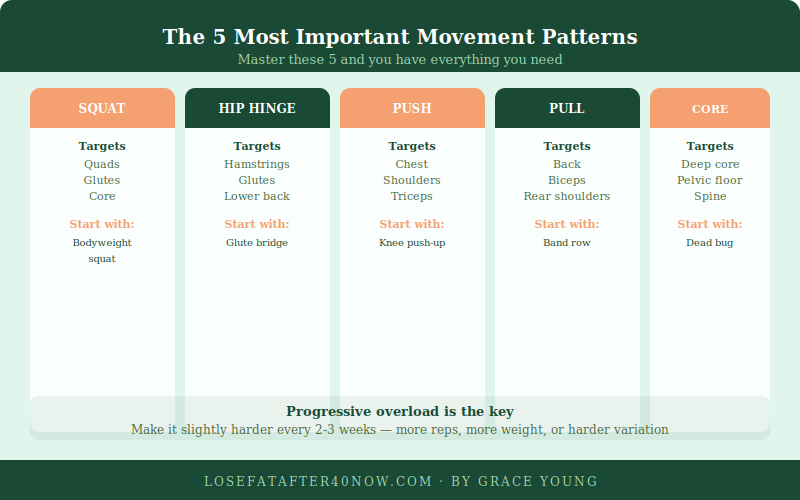
You don’t need dozens of exercises. You need five movement patterns, done consistently with gradual progression, and they cover the vast majority of what strength training can do for your body.
The Squat (Lower Body Push)
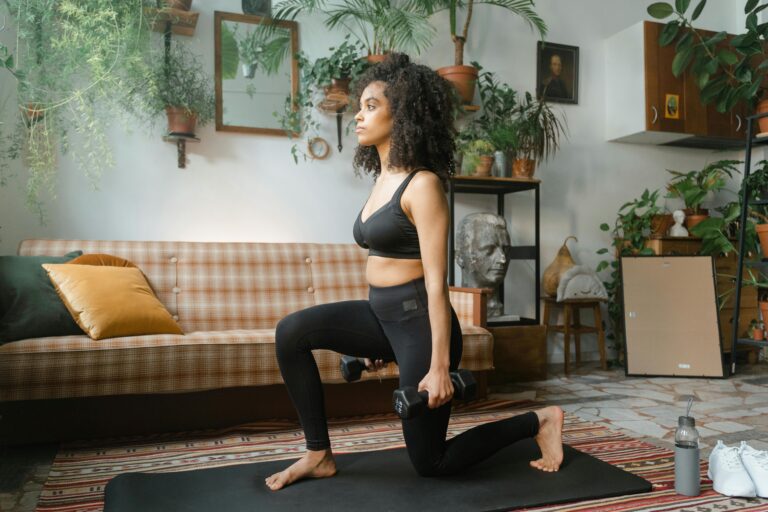
Trains quadriceps, glutes, and core simultaneously. Directly mirrors the mechanics of sitting down and standing up, which means it translates immediately to real-life function. Beginner: bodyweight squat or squat to a chair. Intermediate: goblet squat holding a dumbbell at chest. Form priority: weight in heels, chest tall, knees tracking over toes.
The Hip Hinge (Posterior Chain)
Trains glutes, hamstrings, and lower back: the muscles most undertrained in women who do mostly cardio. A strong posterior chain means better posture, less back pain, and more metabolic impact per session. Beginner: glute bridge lying on back. Intermediate: Romanian deadlift with light dumbbells. The key is hinging at the hips, not bending at the waist.
The Push (Upper Body)
Chest, shoulders, triceps. The push-up, done with proper form, is one of the most effective upper body exercises available at any level. Beginner: push-up from knees or hands against a wall. Intermediate: full push-up from toes. Form: body in a straight line, elbows at 45 degrees, lower chest toward floor with control.
The Pull (Upper Back and Posture)
This one addressed my shoulder discomfort more directly than anything else. Pulling movements, rows and band pulls, train the upper back, rear shoulders, and the muscles that hold your posture upright. They counter the forward rounding that comes from years of desk work and phone use. Beginner: resistance band row anchored at waist height. Intermediate: dumbbell bent-over row. Squeeze your shoulder blades at the top; don’t let the shoulders shrug toward your ears.
The Core (Stability, Not Crunches)
After 40, core training should focus on stability and resistance to movement, not sit-ups, which compress the lumbar spine. The goal is strengthening the deep muscles that hold your spine and pelvis in place under load. Beginner: dead bug (lying on back, extending opposite arm and leg while keeping lower back pressed to floor). Intermediate: forearm plank held 20 to 40 seconds. These movements feel deceptively simple and produce results.
How I Found My Way In
The most honest thing I can tell you about my first weeks is that I was completely lost. I’d open YouTube and immediately feel overwhelmed: squats, lunges, deadlifts, planks, someone saying start with compound movements, someone else saying start with activation work, a third person explaining progressive overload in a way that assumed I already understood it.
My biggest stumbling block wasn’t the exercises themselves. It was the uncertainty of not knowing whether I was doing them right. Every session I’d think: Is the burning in my knee normal? Am I supposed to feel this in my lower back? Is this soreness okay or is this damage?
So I made myself start small enough that getting it wrong had low stakes. Squats: five at a time. Planks: 15 seconds. A band row: 10 repetitions, rest, then 10 more. I felt almost embarrassed by how little it was. But those small sessions let me focus entirely on how my body felt moving through each position, which turned out to be exactly right.
Squats and lunges were the ones I nearly quit over. My knees hurt, my outer thighs ached, my IT band pulled with every rep. I stopped for a few days, then started again lighter and slower. Then stopped again. It took several restarts before the movements stopped hurting. I understand now that the soreness was my connective tissue catching up with what my muscles were being asked to do. Tendons and ligaments adapt more slowly. Patience was the skill I didn’t know I needed.
The first real sign that it was working came about six weeks in. I’d been doing band rows and overhead reaches every session, specifically because of the shoulder discomfort I’d had for months. One afternoon I rotated my shoulder in a big arc and noticed the grinding, tight feeling wasn’t there. My range of motion had quietly changed. It was a small thing. But it was the first time my body told me: this is doing something.
After that came the functional changes. Lifting a heavy bag without bracing. Getting through a long teaching day without that accumulated, bone-deep exhaustion in my upper back. What I hadn’t understood before was that tendons and joint tissue recover more slowly than muscle — the point when pain subsides and the point when actual functional capacity returns aren’t the same thing. The shoulder stopped hurting before it was truly stable again. That gap was humbling, but knowing it existed made me more patient about the timeline.
- Squats: 5 bodyweight reps, paused at the bottom to feel the form
- Plank: 15 seconds, then rest, then 15 more
- Band row: 10 slow reps, focusing on squeezing shoulder blades
- Glute bridge: 12 reps, holding 2 seconds at the top
- Total time per session: 15 to 20 minutes
Finding your way in can happen more than once. About two years after I started, the calcific tendinitis flare I described above pulled me out of training entirely. When I came back, roughly ten weeks after the acute pain resolved, I wasn’t starting from zero but I wasn’t starting from where I’d left off either. That middle space is harder than true beginner status in some ways.
The shoulder movements I’d done without thinking felt unstable. My rotator cuff had clearly lost strength during the months off. Squats and lunges brought back knee discomfort I hadn’t felt in years, a reminder that when muscles weaken from disuse, the joints they’re supposed to support take more of the load. I went lighter than felt necessary. I finished sessions feeling underchallenged but sore anyway.
What changed things was shifting emphasis toward pull movements over the first two weeks back: band rows and face pulls specifically. My shoulder didn’t hurt during those movements, and within about a week I could feel the rear deltoid and upper back engaging more properly. The grinding quality of the shoulder discomfort started to ease. By four or five weeks in, the hesitation I’d had about overhead movements was almost gone. Six weeks after that first session back, I could press overhead without bracing for pain.
That experience taught me something I’d learned the slow way the first time: pull movements are the foundation, not the afterthought. Get the pulling work right first, and most other things fall into alignment behind it.
Your 4-Week Beginner Plan
Three sessions per week, with at least one rest day between. Each session runs 30 to 40 minutes including warm-up. The warm-up matters more than most beginners expect: five minutes of leg swings, arm circles, hip rotations, and slow bodyweight squats prepares connective tissue and joints in ways that meaningfully reduce injury risk.
| Session | Focus | Exercises | Sets × Reps |
|---|---|---|---|
| A | Lower Body | Bodyweight squat, Glute bridge, Reverse lunge, Dead bug, Clamshell | 3×10–12 / 3×12 / 3×10 each / 3×8 each / 2×15 each |
| B | Upper Body | Push-up (any variation), Band or dumbbell row, Overhead press, Bicep curl, Plank hold | 3×10 / 3×12 / 3×12 / 2×12 / 3×20–30 sec |
| C | Full Body | Goblet squat, Romanian deadlift, Push-up, Band row, Dead bug | 3×10 / 3×10 / 3×10 / 3×12 / 3×8 each |
Weeks 1 and 2: Use bodyweight or very light resistance. Move slowly and deliberately. The goal is learning the feel of each pattern, not yet challenging your muscles.
Weeks 3 and 4: Add light resistance where movements feel easy. Increase reps by one or two per set when you finish a set feeling like you could have done several more. That’s your signal to add a small challenge.
The right weight for any exercise is one where the last two or three reps feel like real effort, not impossible, but not comfortable either. If you finish a set feeling like you could have done it twice over, the weight is too light to produce change.
The Only Equipment You Actually Need
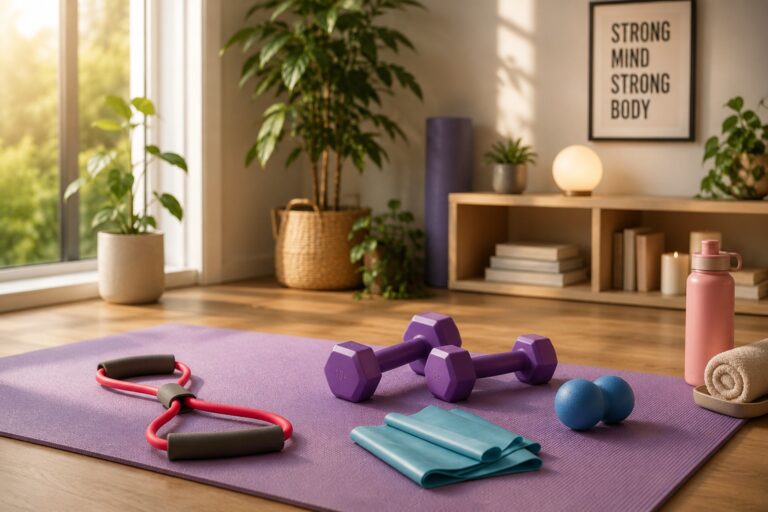
The entire plan above can be done with three things.
Resistance bands: A set of fabric loop bands covers lower body work, glute activation, rows, and shoulder exercises. They’re gentle on joints, highly versatile, and cost $15 to $25 for a quality set. These are the most useful piece of equipment I own.
One pair of light dumbbells (5 to 15 lbs): For rows, presses, Romanian deadlifts, and goblet squats. Start lighter than you think you need to. The purpose in the first month is teaching your nervous system movement patterns. The loading comes later.
A non-slip mat: For floor work: glute bridges, dead bugs, planks. Any mat at least 6mm thick that won’t slide. Under $30.
Total: under $80. A gym is optional. The floor of your living room is enough to begin strength training for women over 40.
Mistakes I Made So You Don’t Have To
Skipping the warm-up. I treated it as optional in the beginning and paid for it with unnecessary soreness and a minor knee issue in week three. After 40, joints and connective tissue need preparation. Five minutes changes everything.
Assuming soreness meant something was wrong. Muscle soreness 24 to 48 hours after training (DOMS) is normal and expected, especially early on. Sharp pain during a movement, or soreness that lingers beyond 72 hours, is a signal to rest. The difference matters.
Neglecting pulling movements. My instinct was toward the exercises I could see visible results in: squats, push-ups, ab work. The muscles I couldn’t easily see, upper back, rear shoulders, rear glutes, were the ones causing my posture problems and shoulder pain. Equal pulling and pushing changed how I felt within weeks.
Stopping when the discomfort was actually productive. The last two or three reps of a set, the ones that require real effort, are where most of the adaptation happens. Going through the motions without reaching that threshold meant sessions that felt fine but produced little change.
I’d also add: don’t expect the first few sessions to feel good. Movement patterns that are new feel awkward before they feel natural. The goal in weeks one and two is exposure, not performance.
When Will You Actually Feel Different?
The honest answer is: later than you hope, and sooner than you think. The first changes are almost always functional, things you notice in how your body moves and recovers, before they become visible.
| Timeframe | What to Realistically Expect |
|---|---|
| Weeks 1–2 | Soreness and learning curve. Movements feel unfamiliar. |
| Weeks 3–4 | Noticeably stronger. Movements begin to feel natural. |
| Month 2 | Functional changes: better range of motion, less fatigue, improved posture. Tendons and ligaments adapting — joint discomfort begins to ease, though full functional capacity takes longer than the pain relief does. |
| Month 3–4 | Visible changes begin. Measurable strength gains. Energy across the day improves. |
| Month 6+ | Real body recomposition: leaner, stronger, metabolically more efficient. |
My own first meaningful change, the shoulder mobility improvement, came around six weeks. Body composition changes took longer, closer to three months. The improvements that arrived first were the ones that kept me going: the functional shifts, the reduced pain, the energy difference at the end of a full teaching day.
Start with 10 to 15 reps per set at a weight that challenges you by the last two or three reps. This range builds muscle effectively without excessive joint stress, the right balance for women beginning strength training after 40. As you progress, varying between 8 to 12 reps (heavier) and 12 to 20 reps (lighter) continues to drive adaptation.
Rest 60 to 90 seconds between sets. Longer rest periods than you might expect allow recovery quality that protects against excessive cortisol elevation and reduces injury risk compared to circuit-style short rest. (Sports Medicine, 2022)
What I Do Now, and Why I Keep Doing It
Three to four sessions a week now, using dumbbells, resistance bands, bodyweight movements, and a balance board I added after coming back from the tendinitis. No fixed program. The routine shifts based on what I’ve been neglecting and what my shoulder is tolerating that week.
What I’ve learned is that consistency doesn’t mean identical. Some weeks I train four times. Other weeks life cuts it to two and I maintain. The goal isn’t to maximize every session — it’s to keep showing up often enough that the baseline doesn’t erode.
Strength training for women over 40 is more maintenance practice than transformation project. What you’re doing is keeping pace with a biological process that won’t pause. The gap between “I can do this” and “I can no longer do this” is smaller than it looks from the healthy side. I’ve stood on the other side of that gap. The view is not better.
Squats and lunges, the movements I nearly quit over in the beginning, feel natural now. Not effortless. Natural. I still have days where I drop the weight or cut a session short. Consistency means coming back, not executing perfectly.
Frequently Asked Questions
Will strength training make me bulky?
No, and this is worth being direct about. Women don’t produce enough testosterone to build large muscle mass through typical training. What strength training produces in women is a leaner, more defined appearance: reduced fat relative to muscle, better posture, and a more metabolically efficient body. The “toned” look most women want comes specifically from building muscle. Avoiding weights actively works against it.
How much soreness is normal when starting out?
Some muscle soreness 24 to 48 hours after a session (called delayed-onset muscle soreness, or DOMS) is completely normal, especially in the first several weeks. It means your muscles were challenged beyond what they’re used to. That’s the stimulus for adaptation. Soreness that significantly limits your range of motion, lasts more than 72 hours, or involves sharp joint pain during movement is a signal to rest longer and reduce intensity before continuing.
Can I do strength training if I have bad knees?
In many cases, yes, and done correctly, it can actually reduce knee pain over time by strengthening the muscles that support the joint. The key is starting with movements that don’t aggravate your specific issue and building gradually. Glute bridges, band clamshells, and seated leg extensions are typically well-tolerated. If you have a diagnosed condition, check with your doctor or physical therapist before starting. Don’t assume bad knees mean no strength training at all.
How long before I see results?
Muscles respond to training faster than the connective tissue around them — tendons, ligaments, cartilage all adapt on a slower schedule. The 4 to 8 week window for functional changes (reduced joint discomfort, better range of motion, stronger posture) is largely that connective tissue catching up, which is also why the programming here is deliberately conservative in early weeks: the muscle work is paced to what the joints can actually absorb. Visible body composition changes tend to follow at 10 to 16 weeks. The longer timeline compared to diet-only approaches reflects the fact that what’s changing is deeper than weight — it’s how the body handles energy at rest, which takes longer to shift but also holds longer once it does.
Do I need a gym?
Not at all. The plan in this guide requires only resistance bands, one pair of light dumbbells, and a mat: under $80 total. A gym is an option, not a requirement. Most of the strength gains available to beginners and intermediate trainees can be achieved entirely at home with minimal equipment.