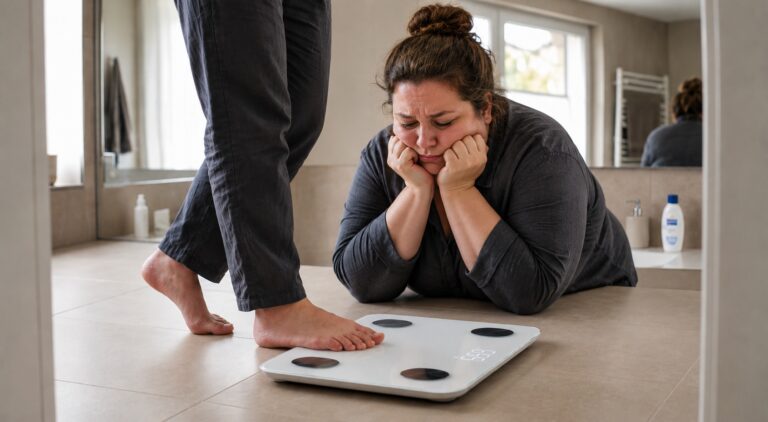
Estrogen and Weight Gain After 40: What You Need to Know
“Have you talked to anyone about your estrogen levels?”
My doctor’s question took me by surprise. I’d asked something I thought was simple: why my clothes were fitting differently around the middle when nothing else had changed. Same eating patterns. Same schedule. A full year had passed, and nothing I tried touched the softness that had settled across my waist.
I was 44. The answer I expected involved metabolism, or maybe a sluggish thyroid. Estrogen hadn’t crossed my mind.
I’d always thought of estrogen as primarily reproductive: periods, fertility, the transition toward menopause. The idea that estrogen and weight gain after 40 might be directly connected, that this hormone might be behind what I was noticing around my waist, was entirely new to me. I drove home that afternoon and started pulling research I should have read years earlier.
What I found didn’t just explain the waistband. It explained the afternoon energy slumps, the muscle that felt harder to keep, the way certain meals seemed to register differently than they had at 37. This post covers what estrogen actually does beyond its reproductive role, how its decline changes where fat goes and how fast metabolism slows, and what the research supports doing about it.

The Weight That Moved Without Warning
The thing that made it undeniable was a ring.
I’d worn the same ring on my right hand for years — a simple one, always the same fit. One evening I noticed it had become loose enough to slide off without any effort, where it had always needed a little coaxing. I stepped on the scale out of habit. Within a pound of where it had been six months earlier. Same weight. But something about the distribution had quietly rearranged itself without asking permission.
I’d been watching the wrong number entirely. The scale hadn’t moved, but fat was relocating, away from the periphery and toward the center, and I was only catching it by accident. Not how much I was carrying, but where my body had decided to put it.
This is central adiposity: a change in where fat is stored, not necessarily an increase in total fat. The abdomen fills while the number on the scale stays relatively stable. It’s one of the most disorienting aspects of perimenopause because none of the usual markers, weight, clothing size, calorie intake, fully capture it.
Estrogen is the central piece of that story. Once you understand the mechanism, the experience stops feeling like a mystery and starts feeling like a predictable consequence of a hormonal transition. A frustrating one, but a comprehensible one.
What the Research Shows About Estrogen and Body Composition
What Estrogen Was Quietly Managing All Along
Estrogen’s reproductive role is the one most people know: it governs the menstrual cycle, supports pregnancy, and eventually withdraws during menopause. But the hormone was running a much larger operation in the background, one that only becomes fully visible when it starts to pull back.
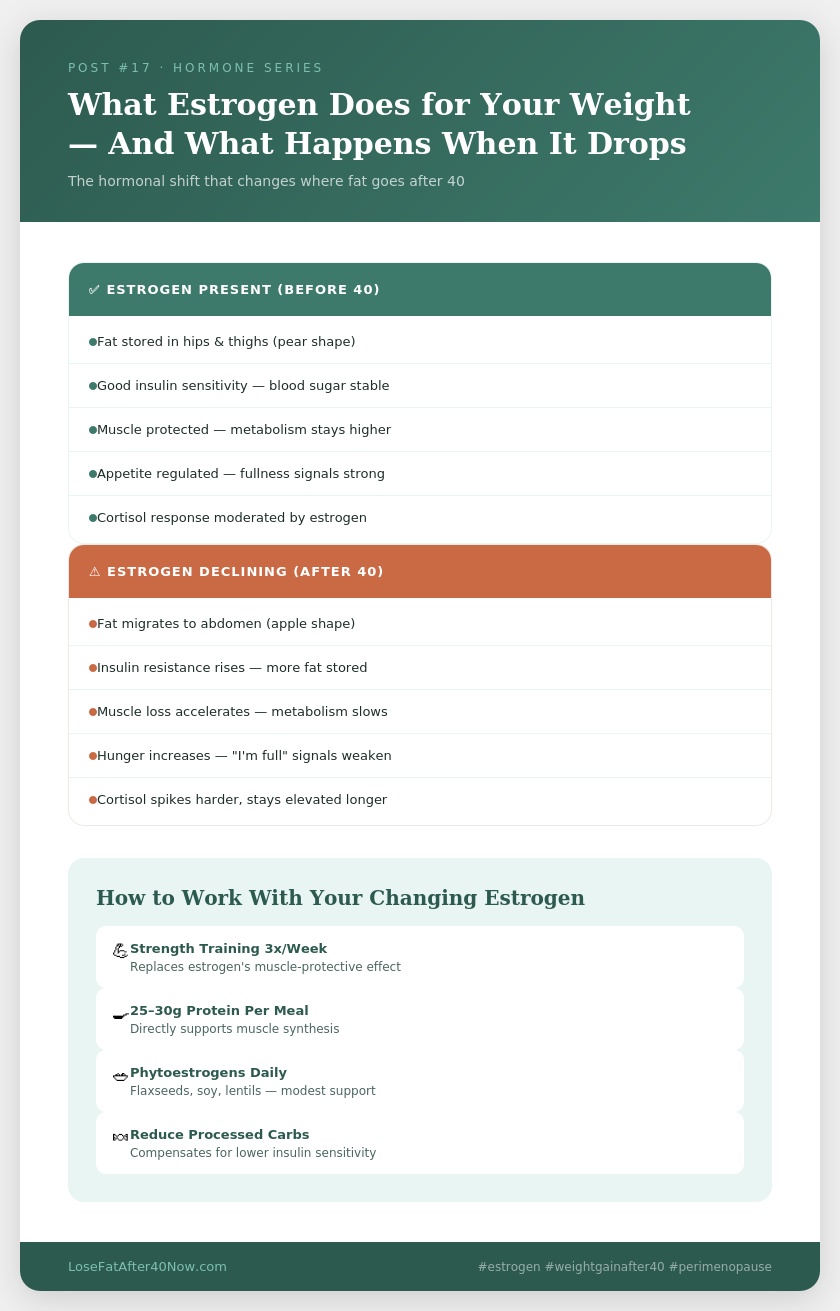
Before perimenopause, estrogen helped direct where your body stored fat. Adequate estrogen levels favored storage in the hips, thighs, and buttocks, a pattern that’s metabolically relatively quiet. Estrogen also supported insulin sensitivity, which kept blood sugar stable after meals. It had a protective effect on muscle tissue, slowing the natural rate of age-related muscle breakdown. And it influenced leptin, the fullness hormone, helping to keep appetite calibrated.
There was an indirect effect on mood and appetite through serotonin as well. Estrogen supported both serotonin production and sensitivity, which is part of why the perimenopausal years can bring carbohydrate cravings and mood shifts alongside the physical changes.
What Estrogen Was Managing Before It Started to Decline
- Fat storage location: Directed toward hips and thighs, away from the abdomen
- Insulin response: Supported efficient blood sugar clearance after meals
- Muscle preservation: Slowed the natural rate of age-related muscle breakdown
- Appetite signaling: Supported leptin, the hormone that tells you when you’re full
- Mood-appetite link: Enabled serotonin, which modulates carbohydrate cravings
When estrogen begins declining during perimenopause, all of these functions are affected simultaneously. That’s why the changes can feel so wide-ranging.
How Estrogen Drives Weight Gain After 40
This is where estrogen and weight gain after 40 become most concrete, and most confusing, because the problem often isn’t about added weight at all. It’s about relocation.
As estrogen declines, the signal that steered fat toward the hips and thighs weakens. Fat that would previously have been stored peripherally begins accumulating in the abdomen instead. This shift happens even when total body weight stays roughly stable. A woman can lose two pounds and gain an inch of waist measurement in the same month. Not because she’s doing anything wrong, but because the hormonal architecture governing fat distribution has changed.
There are two categories of belly fat involved. Subcutaneous fat, the layer you can pinch just under the skin, is relatively less metabolically active. Visceral fat, the deep fat surrounding the organs, carries different implications: more closely associated with insulin resistance, chronic low-grade inflammation, and cardiovascular risk. The estrogen-related shift specifically favors visceral accumulation, the kind with the most metabolic consequence.
This is why the waistband changes while the scale doesn’t move much. The question after 40 isn’t always “how do I lose weight?” It becomes: “how do I change where my body is storing what it already has?”
Estrogen, Insulin, and Why Carbs Hit Harder After 40
One of the most direct downstream effects of estrogen decline is on how the body processes blood sugar.
When estrogen was adequate, cells responded efficiently to insulin: blood sugar rose after a meal and came back down in a reasonable window. As estrogen declines, cells become progressively less responsive. Blood sugar spikes higher after eating, takes longer to clear, and more of that excess glucose gets converted to fat, preferentially in the abdominal region.
This is why many women in their 40s notice that foods they ate without consequence at 35 now seem to land differently. The food is the same. The hormonal machinery processing it isn’t.
What Insulin Resistance Looks Like Day-to-Day After 40
- Carbohydrates, especially refined ones, seem to store faster than they used to
- Energy crashes roughly 1 to 2 hours after carbohydrate-heavy meals
- Cravings that feel different from ordinary hunger: urgent and specific
- The same meal producing more abdominal fat storage than it did five years earlier
The Muscle Loss That Slows Your Metabolism After 40
There’s a third mechanism that receives less attention than fat redistribution but may matter just as much for long-term body composition: estrogen’s role in preserving muscle.
Muscle is the primary driver of resting metabolic rate, the calories your body burns just keeping itself running. Before perimenopause, estrogen helped regulate the balance between muscle breakdown and repair. It’s one reason women in their 30s tend to hold muscle relatively well even without deliberate training.
As estrogen declines, this protection weakens. The gradual muscle loss that begins in your 30s accelerates through perimenopause and beyond. Your body burns fewer calories at rest, which means the same eating patterns that held your weight steady at 35 may produce gradual increases at 45, without any change in behavior. This isn’t a willpower story. It’s a physiology story.
| Body Function | With Adequate Estrogen | With Declining Estrogen |
|---|---|---|
| Fat storage location | Hips, thighs, buttocks | Abdomen (preferentially visceral) |
| Insulin sensitivity | Cells respond efficiently | Insulin resistance increases |
| Muscle retention | Muscle breakdown moderated | Muscle loss accelerates |
| Resting metabolism | Supported by higher muscle mass | Slows as muscle declines |
| Appetite signaling | Fullness signals are stronger | Hunger increases; satiety weakens |
| Blood sugar after meals | Returns to baseline efficiently | Stays elevated longer |
The Loop That Keeps Going
One of the more frustrating aspects of this process is that it tends to become self-reinforcing.
As estrogen from the ovaries declines, belly fat begins to accumulate. Here’s the part that surprised me: belly fat itself produces a form of estrogen called estrone — through a process called peripheral aromatization. Estrone is biochemically weaker than estradiol, the form your ovaries produced, and it’s associated with increased inflammation rather than the metabolic protections estradiol provided.
So declining estrogen leads to more visceral fat, and more visceral fat produces an estrogen variant that drives further inflammation and additional fat storage. The initial decline set the cycle in motion; the body then keeps turning it without any further hormonal change required.
Understanding this matters practically. Reducing visceral fat through strength training and blood sugar management disrupts the cycle at its source. You’re not just responding to symptoms; you’re interrupting the mechanism that’s sustaining them.
Working With Your Estrogen Shift
You can’t stop estrogen from declining. That’s not a failure — it’s a biological transition that runs on its own schedule. But the downstream effects are meaningfully modifiable, and the research on specific strategies is solid enough to act on.
Strength training, three times a week. Muscle is what estrogen used to protect. Without that protection, you have to build and maintain it deliberately. Progressive resistance work three times a week (bands, dumbbells, or bodyweight) replaces the metabolic floor that estrogen used to hold up. No other single intervention comes close in terms of impact on body composition after 40.
Protein at every meal. Aim for 25 to 30 grams at breakfast, lunch, and dinner. The muscle-building process becomes less efficient after 40; researchers call this anabolic resistance. Giving your body the raw materials it needs becomes more important, not less, precisely because the system is working harder for the same result.
Phytoestrogens, added regularly. Phytoestrogens are plant compounds that bind weakly to estrogen receptors. They don’t raise blood estrogen levels, but research suggests they may partially compensate for estrogen’s decline in specific tissues. Reliable sources: edamame, tempeh, tofu, flaxseeds, and lentils.
Blood sugar management, actively. Protein and vegetables before carbohydrates at meals. A short walk after eating. Reducing ultra-processed carbohydrates that spike insulin most sharply. These are insulin sensitivity strategies, targeting the specific function that estrogen decline damaged.
Sleep, protected as a priority. Poor sleep amplifies every effect of declining estrogen on weight and metabolism. Cortisol rises when sleep is inadequate, directly undermining whatever effort you’re putting into the strategies above.
What Makes the Estrogen Shift Harder
- Chronic under-eating: raises cortisol, accelerates muscle loss, worsens insulin resistance (Obesity Reviews, 2020)
- Excessive high-intensity cardio without recovery: elevates cortisol, antagonizes estrogen’s remaining protective effects
- Chronic poor sleep: independently increases abdominal fat and compounds insulin resistance
- High refined carbohydrate intake: magnifies the insulin resistance that estrogen decline has already created
On HRT: What the Research Actually Says
Many women ask about hormone replacement therapy when they start understanding what estrogen decline is doing metabolically, and it’s a question worth taking seriously rather than brushing aside.
Low-dose estrogen therapy has been shown in research to attenuate several of the effects described in this post: reduced visceral fat accumulation, improved insulin sensitivity, and some protection of lean mass. A 2022 review published in Climacteric found that initiating HRT during the perimenopause window, rather than years after menopause, carries the most favorable metabolic benefit-to-risk profile for most women.
HRT isn’t appropriate for everyone. The decision involves personal and family health history, the specific type and formulation of hormones, individual cardiovascular and breast cancer risk factors, and where you are in the menopausal transition. These variables matter, and the calculation is highly individual.
What I’d encourage: have a direct, informed conversation with a gynecologist or endocrinologist who specializes in women’s hormonal health, and go in already understanding what estrogen does metabolically, because that shapes what questions to ask. The lifestyle strategies in this post work with or without HRT.
Frequently Asked Questions
The Bottom Line
Estrogen decline is at the center of much of what feels confusing about weight changes in your 40s. The waistband that shifts without weight gain. The metabolism that slows despite no obvious behavioral change. The muscle that requires more deliberate effort to maintain. Estrogen runs through all of it.
When you know what you’re actually responding to, redistributed fat, reduced insulin sensitivity, accelerated muscle loss, you can target those specific problems rather than working harder at the same things that stopped working.
The strategies that address estrogen and weight gain after 40 most directly are specific and evidence-backed: strength training to replace what estrogen used to protect, adequate protein to support the muscle-building process, phytoestrogens as a modest daily complement, and active blood sugar management to compensate for reduced insulin sensitivity. None of them require perfection. They require consistency over 8 to 12 weeks.
What changes have you noticed most since your 40s began, and what has or hasn’t helped? Leave a comment below.
This post is for informational purposes only and does not constitute medical advice. Always consult with a qualified healthcare provider before making changes to your diet, exercise routine, or considering hormone therapy.

Grace Young is the founder of LoseFatAfter40Now.com, a health and wellness blog for women navigating weight, hormones, and body composition in their 40s and beyond. She holds an M.Ed. and has completed doctoral coursework in health education. Read Grace’s full story →