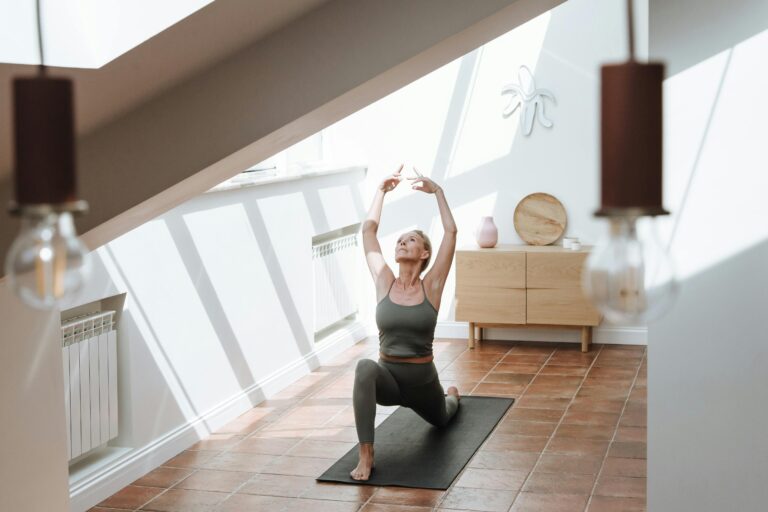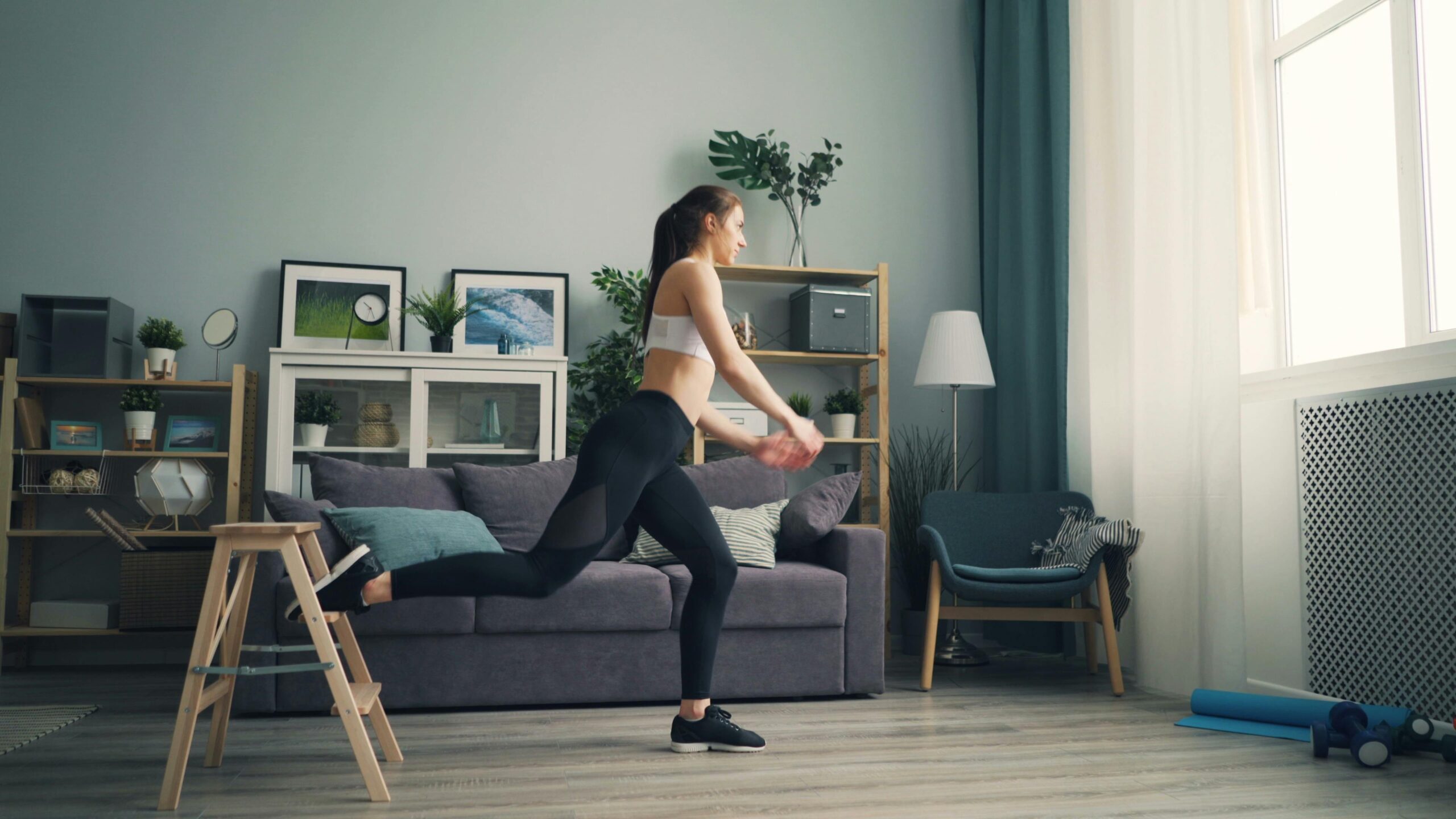
Simple Home Workout for Women Over 40 (No Gym Needed)
I used to send my friends videos of myself stretching. Legs flat against the wall, back on the floor, twenty minutes before sleep, look how flexible I am. After years of assuming I had the right home workout for women over 40 figured out (flexibility sessions, long rides, stretching before sleep) I was proud of what my body could do. I’d practiced those holds since my thirties without a second thought. Something about it felt deeply satisfying: the quiet, the full-body release, the way it settled everything down before bed.
Then one morning in my mid-forties, I couldn’t get out of bed.
The pain arrived the moment I shifted my weight to sit up. I lay there going through the previous day in my mind, had I lifted something heavy? Slept at a strange angle? Nothing came to me. It took two more days before the connection clicked: the stretching session. The legs-against-the-wall hold I’d done a hundred times before. My body had processed it completely differently this time. And after that, similar movements (anything that had once felt like easy flexibility) started coming with a price. Recovery was longer. Sometimes the soreness stretched through an entire week of daily life.
That was my first real lesson about exercising in your 40s. Not the lesson about which exercises to do, the more foundational one. The body that worked a certain way in your late thirties does not respond to the same inputs in your mid-forties. The rules change. And the women who figure this out stop fighting their bodies and start working with them instead.
This post covers what I eventually figured out, through a year of cycling that didn’t move the scale, through squats I couldn’t manage five of, and through a British medical journal study that answered a question I’d been asking for two years. I’ll share the complete routine I built and why it works in a way most fitness content never explains.
The Question That Matters More Than “Home vs. Gym”
My husband has had a gym membership for most of our adult life. Every year, without much deliberation, he renews it. He goes consistently, he enjoys it, and it works for him. For fifteen years I had one too, added at his suggestion more than from my own conviction. I went. Sometimes frequently, sometimes with months in between. But I never made it mine. The membership was there; the routine never took root.
When I stopped arguing with myself about gym memberships and started thinking clearly about what was actually happening, the insight was uncomfortable: the gym was never the problem. The routine (or the absence of one) was the problem. A year-round membership that produces twelve irregular visits is worse for your body than a twenty-dollar resistance band used four times a week in your living room.
The debate everyone enters when they decide to get serious about fitness (home workout versus gym) is usually the wrong starting question. And it applies just as much to building an effective home workout for women over 40 as it does for anyone at any age. The right question is: what environment will make you actually show up? Not occasionally, not when you’re motivated. Consistently. The way you eat without deciding whether you feel like it. The way you breathe.
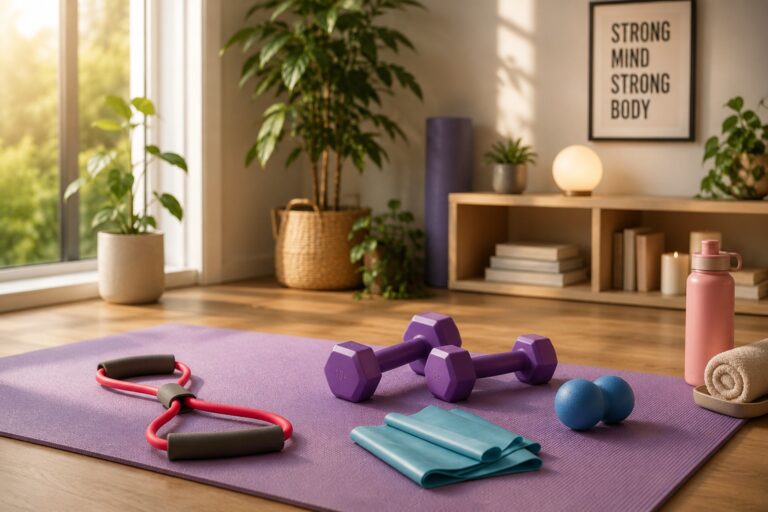
I came to believe that exercise should have that quality, built into the day rather than bolted on. For me, home was the environment that made this possible. No commute, no decision overhead, no performance anxiety. The mat, the bands, and the clear wall are there when I wake up, and the barrier to starting is nearly zero.
This doesn’t mean home is the right answer for everyone. If a gym makes you actually go, if the environment, equipment, or community is what keeps you consistent, then the gym is the right answer for you. The location is personal. The consistency is the goal.
A Year of Cycling and Nothing to Show For It
My father taught me to ride a bicycle in sixth grade. I still remember the exact moment I realized he’d let go of the seat and I was moving on my own. I’ve loved cycling ever since, not as obligation, not out of duty. It’s one of the few physical activities that still feels like something you do for pleasure, not for punishment.
So when I decided to get serious about the weight that had been accumulating through my forties, cycling felt like the obvious answer. I started going out several times a week. My husband joined me on many of those rides, and because I was keeping up with his pace, I was working harder than I would have alone. We went to the lake nearby, which is beautiful, wind in the face, good light, the kind of scenery that makes an hour disappear.
I kept this up for over a year.
My weight did not move.
What confused me as much as the scale was how I felt after those rides. My husband came home refreshed, energized, cleared. I came home exhausted, not the pleasant tiredness of satisfying work, but the drained feeling of a hard day at the office. He was doing the same ride. Why was his recovery so different from mine?
The answer is rooted in a hormonal mechanism that gets almost no attention in mainstream fitness content. After estrogen declines during perimenopause, cortisol (the primary stress hormone) behaves differently in women’s bodies. Long moderate-to-high intensity cardio tends to raise cortisol significantly. In women with lower estrogen levels, research suggests that elevation may linger longer and clear more slowly. Estrogen had been moderating my cortisol response for years, and I hadn’t known it. My husband’s hormonal environment processed the same ride differently because his hormonal environment is fundamentally different.
Why Long Cardio Stalls Fat Loss After 40
The long cycling sessions I believed were working against the fat were, through the cortisol mechanism, likely helping hold it in place. Neither of us was doing anything wrong. Our bodies were operating under different biological rules, a distinction that almost no fitness content addresses directly.
When the Body Changes Its Rules
The stretching injury from the opening turned out to be the first sign of a larger pattern, one that kept resurfacing in different forms over the months that followed. Similar holds and flexibility poses that I’d done proudly for years, stretches I’d filmed and sent to friends because I was pleased with what my body could do, started coming back at me. Recovery after them wasn’t the refreshing reset I expected. It was days of managing the fallout.
The biological explanation is connected to the same hormonal shift. Estrogen supports collagen production, which contributes to the resilience and elasticity of connective tissue, tendons, ligaments, and the deep stabilizing muscles around joints. When estrogen declines, this changes. Not catastrophically, but measurably. Movements that the body previously absorbed without much consequence can become sources of strain that persist far longer than they should.
Understanding the mechanism took the sting out of it. My body hadn’t broken down; it had simply started running on a different set of rules, and it needed different inputs than it used to.
The same logic applied to squats. Every fitness source I encountered told me to squat. Magazines, books, YouTube channels, everything, squats were everywhere, presented as the essential lower body exercise. And I could barely do five. The range of motion, the knee load, the compound demand on a body that had spent years at a desk. It felt like an impossible wall. I assumed I was just not fit enough yet, that I needed to push through to get to the point where squats became accessible.
What I eventually understood was that the body struggling with squats was not a body that needed to be bullied into squats. It was a body signaling its actual starting point. The question wasn’t how to force the exercise I’d been told to do. It was what exercises could produce the same outcomes without the same cost.
The Recovery Gap Nobody Prepares You For
Recovery time after exercise increases meaningfully after 40, particularly as estrogen declines. A workout that required 24 hours of recovery at 35 may require 48 to 72 hours at 45. This reflects a genuine physiological shift, one that calls for adjusting training frequency and intensity rather than pushing harder to override it. Pushing through extended recovery time may raise cortisol further, compounding the problem.
What the Research Actually Found
I started looking for exercise that wouldn’t hurt me. That sounds like a low bar, but given the specifics, a back that seized after gentle stretching, knees that objected to squats, and a cortisol response that made long cardio counterproductive. It was a genuine constraint I had to work within.
Planks and wall sits I could do. A few seconds each, but I could do them. I had always thought of them as core exercises, or filler between the real work. What I didn’t know was that there was a substantial body of research on these specific holds (isometric exercises) and their measurable effect on cardiovascular health.
The study that changed how I trained was a 2023 network meta-analysis published in the British Journal of Sports Medicine. It is the largest analysis of its kind: 270 randomized controlled trials, nearly 16,000 participants, comparing five categories of exercise, aerobic training, dynamic resistance training, combined training, HIIT, and isometric training, specifically for their effect on resting blood pressure.
The result surprised the research community. Isometric exercise (static holds, no movement) reduced systolic blood pressure by an average of 8.24 mmHg. Aerobic exercise, long considered the gold standard for cardiovascular management, reduced it by 4.49 mmHg. The researchers noted that the blood pressure reductions from isometric training were comparable in magnitude to first-line antihypertensive medications.
I applied the protocol exactly as described.
The Evidence-Based Isometric Protocol (British Journal of Sports Medicine, 2023)
- Hold duration: 2 minutes, sustain the position, maintain the contraction
- Rest between rounds: 2 minutes, fully release, let the muscles recover before the next round
- Sets per session: 4 complete rounds (hold + rest)
- Frequency: 3 sessions per week on non-consecutive days
- Primary exercises: wall sit and plank, most studied, greatest measured effect on blood pressure
- Build time: start at 30 seconds and add 10 seconds per week until reaching 2 minutes
- Timeline for results: measurable blood pressure reduction typically appears within 4 to 8 weeks of consistent practice
My systolic blood pressure, which I had been tracking at home, dropped 5 to 8 points over the following weeks, a meaningful change, not statistical noise. The mechanism is now well understood: during an isometric hold, sustained muscle contraction temporarily restricts blood flow within the working muscle. When the hold ends and you release, blood surges back through the vessels. Over time, this repeated contraction-and-release cycle stimulates the endothelial cells lining blood vessel walls to produce nitric oxide, a signaling molecule that promotes vasodilation and reduces arterial stiffness. The effect accumulates with each session.
For women over 40, isometric exercise may also carry a cortisol advantage. Unlike long-duration cardio, isometric holds appear to produce their cardiovascular benefit without the same prolonged cortisol elevation. The stimulus is intense; the hormonal cost appears considerably lower.
Starting at One Minute
The routine I built didn’t begin as a routine. It began with a decision to stop arguing with my body. Staying sedentary because exercise felt inaccessible or repeatedly painful. I knew exactly where that path ended. The direction was clear. So I identified what I could actually do, and I started there.
Resistance bands. Wall push-ups. Step exercises. These were the starting points I chose, not because they were impressive, but because they were available, joint-friendly, and I could do them for one minute without anything hurting.
One minute was the beginning.
I developed a habit of talking myself through it in a particular way. Not motivational speeches. Just honest, quiet self-acknowledgment: Grace, this isn’t hard at all, is it? So let’s do it again tomorrow. Just a little more. Good. It sounds almost absurdly simple. But there is something important in it, meeting your body where it actually is rather than where you think it should be, and treating small, completable progress as real progress. I had been trying to start at the level I wanted to be at. The breakthrough was starting at the level I could actually sustain.
One minute became two. Two became five. Five became ten, then fifteen, then twenty. Each increment felt natural rather than forced, because each previous level had been fully consolidated before I moved on.
The first visible change came at my sides. The fat along my obliques (the area I’d found most stubborn, most discouraging) started to reduce. Visibly, in how my clothes fit through the midsection. That moment had the particular quality of getting an A in a subject you’d given up on. Something shifted: if this approach was producing results here, I wanted to understand the full picture. I started studying the mechanics and the research behind what I was doing, proper form, programming principles, what the evidence actually said about each exercise.
A Realistic Timeline: What Typically Happens and When
Based on both research and personal experience, here is what most women beginning home resistance and isometric training after 40 can expect:
- Weeks 1–2: The body adapts neurologically before any visible changes. Energy levels often begin stabilizing. Sleep quality can improve even in the first two weeks.
- Weeks 3–4: Muscle activation improves, exercises that felt shaky start feeling controlled. Some women notice the oblique and waistline area changing first, before the scale moves.
- Weeks 5–8: Measurable blood pressure reductions for those following the isometric protocol. Clothing fits differently through the midsection even when the scale hasn’t shifted significantly.
- Weeks 8–12: Strength gains become consistent. The routine begins to feel like a baseline rather than a deliberate effort. The habit is in place.
The Complete Home Workout for Women Over 40: Workouts A and B
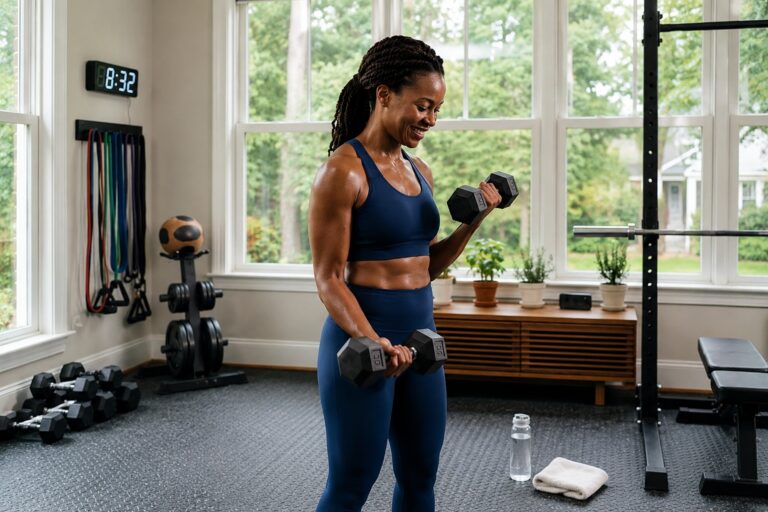
This is the routine I built and refined over several years. It integrates isometric holds into a full resistance training structure, uses bands and light dumbbells (optional), and takes 35 to 45 minutes per session. The isometric exercises aren’t treated as add-ons, they’re embedded throughout because the combination of dynamic resistance training and isometric holds produces better outcomes for both muscle and blood pressure than either approach alone.
Workout A. Lower Body + Core + Isometric Holds
- Wall Sit: 4 × 45–120 seconds. The primary isometric protocol. Back flat against wall, thighs parallel to floor (or as close as possible). Start at 30–45 seconds and add 10 seconds each week. Rest 2 full minutes between rounds. This single exercise, done three times per week consistently, produces the blood pressure results described in the research.
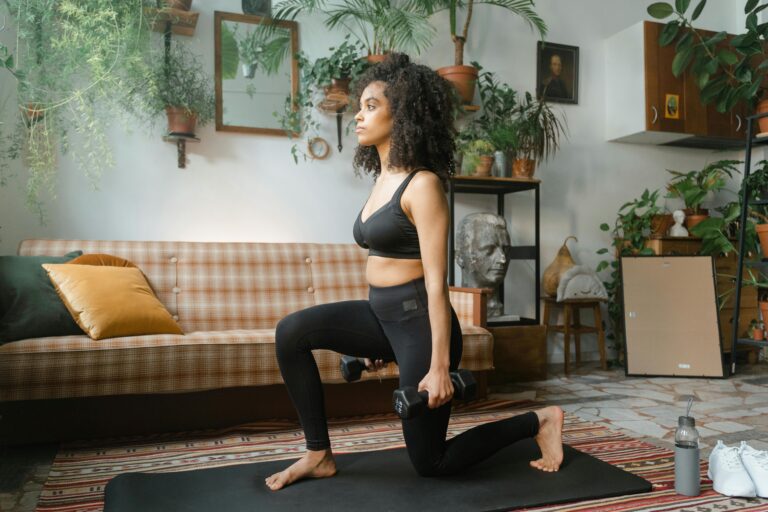
- Resistance Band Squats: 3 × 12–15 reps. Band positioned above knees. If standard squats cause knee discomfort, begin with sit-to-stand from a chair, the movement pattern is identical. The band increases glute activation and stabilizes the knee alignment throughout the movement.
- Glute Bridge Hold: 3 × 45 seconds. Back flat on the floor, feet planted, hips raised to bridge position. Hold at the top. Develops the glutes, hamstrings, and deep lower back stabilizers, the muscle groups most critical for pelvic stability in women over 40.
- Lateral Band Walks: 3 × 12 steps each direction. Band above knees, slight squat position throughout. Hip abductors, underworked in most women, critical for knee health and preventing the hip drop pattern that contributes to lower back pain.
- Plank: 3 × 30–60 seconds. Forearms on the floor, body in a straight line from head to heels, core braced. Build toward the 2-minute research protocol by adding 10 seconds weekly.
- Side Plank: 3 × 20–45 seconds each side. Lateral core stability and hip abductor activation. Addresses the stabilizing muscles that standard planks don’t fully target.
Workout B. Upper Body + HIIT Finisher
- Wall Push-Ups: 3 × 12–15 reps. Palms flat on wall at chest height, body held in a plank position throughout the movement. Progress to incline push-ups (hands on a table or step) and eventually floor push-ups as upper body strength builds. Chest, shoulders, triceps, and core simultaneously.
- Resistance Band Rows: 3 × 12 reps. Anchor the band to a door handle at waist height, step back to create tension, pull the elbow straight back to the hip. The most important posture exercise in this routine, develops mid-back and rear deltoids that counteract the forward rounding from years of desk posture.
- Band Overhead Press: 3 × 10–12 reps. Stand on the band, press handles directly overhead. Shoulder strength and rotator cuff stability, often underdeveloped in women who have primarily done cardio training.
- Isometric Wall Push: 5 × 10-second holds. Palms flat against the wall at chest height, push hard against the wall without the body moving. Upper body isometric stimulus with no equipment required. More effective than it appears for chest and shoulder endurance.
- Band Pull-Aparts: 3 × 15 reps. Hold band at chest width with straight arms, pull apart to a T position at shoulder height. Rear deltoids and upper back, directly addresses the forward posture that develops after years of sitting.
- HIIT Finisher, 10 minutes: 20 seconds of movement (step-ups, marching in place, standing bicycle crunches, or low-impact jacks) followed by 40 seconds of rest, repeated 8 rounds. Short enough to avoid the prolonged cortisol elevation that research links to reduced results from longer HIIT after 40; effective enough to add meaningful cardiovascular and metabolic demand.
Weekly Schedule and How to Progress
| Day | Activity | Duration | Primary Goal |
|---|---|---|---|
| Monday | Workout A. Lower Body + Isometric | 40–45 min | Muscle + blood pressure |
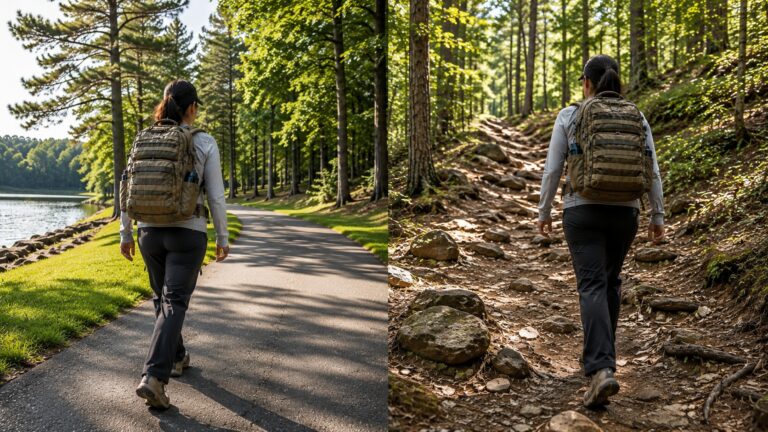
| Tuesday | 30-min walk + mobility | 30–45 min | Active recovery + insulin sensitivity |
| Wednesday | Workout B. Upper Body + HIIT | 40–45 min | Muscle + cardiovascular |
| Thursday | Workout A. Lower Body + Isometric | 40–45 min | Muscle + blood pressure |
| Friday | Rest or gentle mobility only | 20 min | Recovery |
| Saturday | Workout B. Upper Body + HIIT | 40–45 min | Muscle + cardiovascular |
| Sunday | Walk or full rest | 30–60 min | Active recovery |
Total structured workout time: approximately 2.5 to 3 hours per week. This is the evidence-supported volume for metabolic benefit with adequate recovery for women over 40. More sessions without sufficient recovery tends to worsen results, particularly in a lower-estrogen hormonal environment where cortisol clears more slowly and muscle repair takes longer.
Without a full weight rack, progression at home follows different logic. But the fundamental principle behind any effective training routine for women over 40, progressive overload, consistently giving muscles slightly more than they’ve adapted to, applies just as fully.
How to Keep Progressing Without a Weight Room
- Extend hold times before adding resistance: Adding 10 seconds to your wall sit or plank each week is meaningful progressive overload. It costs nothing and produces genuine vascular and muscular adaptation.
- Slow down the lowering phase: A 3-second descent on squats, push-ups, or band rows dramatically increases time-under-tension without adding any resistance. The muscle can’t distinguish between load and duration of tension.
- Advance band resistance: Light → medium → heavy. A complete set of resistance bands covers a significant range of progressive resistance for under $30.
- Add single-leg or single-arm variations: Single-leg glute bridges and single-arm band rows are considerably harder than their bilateral versions and introduce balance demands that compound the training stimulus.
- Reduce rest time deliberately: Cutting rest periods from 90 to 60 seconds between sets raises metabolic demand with no equipment change at all.
The Plateau That’s Usually Not a Plateau
The most common stall in home training isn’t insufficient exercise stimulus, it’s inadequate protein intake undermining the muscle response that the training is producing. Most women who believe they’ve plateaued are consistently eating 50–70g of protein daily when 90–120g is what muscle preservation and growth requires after 40. Before modifying the workout, track protein intake for one week. The answer is usually there.
Frequently Asked Questions
I can only hold a wall sit for 20 seconds. Is that actually doing anything?
Twenty seconds is a starting point, not a failure. The research protocol used 2-minute holds, but those participants built toward that over time. Starting at 20 seconds and adding 10 seconds each week is exactly the right approach. Within 6 to 8 weeks, most people can reach 60 to 90 seconds; within 10 to 12 weeks, 2 minutes becomes achievable for most people without significant knee conditions. The vascular adaptation that produces blood pressure reduction begins immediately at whatever hold time you’re currently doing. Every session counts. The body does not need you at the end goal immediately. It needs you showing up consistently at wherever you actually are right now.
Why did long cardio work in my 30s but not now?
The difference is largely hormonal. Estrogen used to moderate how your body handled the cortisol spike that comes with long, sustained cardio, and that buffer thins out after 40. The full mechanism is covered in Cortisol and Belly Fat After 40: What’s the Connection? →. In practice, that’s why shorter sessions, resistance training, isometric holds, a few real minutes of HIIT, tend to do more for you now than an hour on the bike ever did. Your body just isn’t absorbing that kind of stress the way it used to.
How long before this routine stops feeling like something I have to force?
From research and personal experience, somewhere between 6 and 10 weeks of consistent practice, something shifts. The friction of starting decreases. It stops feeling like a decision and begins feeling like something you simply do, the way you eat breakfast or make coffee in the morning. What accelerates that transition is starting small enough that you consistently succeed. Consistency at a manageable level builds the neural and behavioral pathways; attempting an impressive program you can only sustain for three weeks builds nothing durable. One minute was my starting point. Whatever yours is, start there, not where you think you should be.
Can home resistance training really preserve muscle the same way gym training does?
For the muscle preservation and progressive building that women over 40 most need, yes. Home training with resistance bands and bodyweight progressions produces equivalent results to gym-based training for the moderate load ranges most relevant here. The equipment that’s exclusively gym-appropriate (heavy barbells, complex cable systems) becomes relevant for advanced athletic performance. What your body most needs after 40: challenging major muscle groups progressively, maintaining the muscle mass that drives resting metabolic rate, all of this translates completely to a home environment. Research on resistance band training shows comparable strength and muscle gains to free weights at equivalent intensities.
I have had lower back pain for years. Can I still build a home workout for women over 40 around these exercises?
The isometric exercises here (planks, side planks, glute bridge holds) are among the most consistently recommended exercises for chronic lower back pain, not contraindicated by it. They develop the deep core, glutes, and hip stabilizers that most lower back pain reflects the weakening of. The key modification: if your lower back or knees are currently symptomatic, begin wall sits at a higher position (less knee bend, back higher on the wall) and build depth gradually. For any exercise that produces pain during the movement itself (not general muscle soreness) stop and consult a physical therapist before continuing. Pain during movement is signal, not something to train through.
What actually makes you show up consistently, home, gym, or somewhere else entirely? I’d like to know. Leave a comment below and tell me what your environment looks like.
Medical Disclaimer: This post is for informational purposes only and does not constitute medical advice. If you have hypertension, cardiovascular conditions, joint issues, or other health concerns, please consult your healthcare provider before beginning or modifying an exercise program.

Grace Young is the founder of this blog. After years of trying approaches that had worked in her thirties and wondering why they’d stopped, she went deep into the research on hormones, exercise physiology, and what the body actually needs after 40, and found answers that most fitness content never discusses. She writes about what she discovered, and what finally worked. Read Grace’s full story →