Cortisol and Belly Fat After 40: What’s the Connection?
Quiet weeks, I slept through. Seven hours, sometimes close to eight. I’d wake with something that felt like actual readiness — not dragged out of sleep but arriving at it, like the morning had waited for me. Pressure weeks were the same hours in bed but a different experience entirely. I’d surface at six feeling like I’d spent the night slightly braced. The edginess that came with those weeks wasn’t ordinary tiredness. It sat behind my eyes and in my jaw and stayed well into the afternoon, and no amount of coffee helped because coffee was part of the problem.
I tracked this contrast for close to three months before I connected it to anything biological. Same meals both kinds of weeks. Same movement. What changed was the quality of how I recovered, and when recovery was poor, everything downstream was worse: the concentration, the mood, the particular irritability that showed up around dinnertime when I hadn’t done anything to earn it.
That pattern, between how I slept and how I felt for days afterward, was where the connection between cortisol and belly fat after 40 started to become real for me rather than theoretical. The weeks where I hadn’t properly rested, the weeks where demands had stacked without clearing, were the weeks my body wasn’t recovering. And a body that isn’t recovering is a body that’s still in alert mode. Still producing cortisol. Still directing things toward storage rather than toward repair.
If you’ve been consistent with food and movement and your belly is still resisting — or if you’ve noticed that hard weeks and calm weeks produce different bodies even when you’ve done nothing differently — cortisol may be the variable that makes everything finally make sense. This post covers the mechanism, the specific reasons it intensifies after 40, the hidden triggers most women miss, and what actually works to shift it.

What Cortisol Is Actually Doing Inside Your Body
Cortisol is produced by the adrenal glands in response to perceived stress, whether that’s a difficult conversation, a hard deadline, or three consecutive nights of poor sleep. In short bursts, it serves a real purpose. It sharpens focus, mobilizes energy, and helps you respond quickly to an immediate demand. The fight-or-flight response evolved to handle genuine emergencies.
The problem is what happens when those short bursts never fully stop. Modern life has converted what should be a brief emergency response into a continuous low-grade hum. The body was designed for acute, intense, and then resolved stress events. It was not designed for chronic, unremitting low-level activation.
The Normal Cortisol Rhythm: What Disrupts It
Cortisol naturally peaks around 8 a.m., which is part of what helps wake you up. It then drops steadily throughout the day, reaching its lowest point near midnight. Chronic stress flattens this rhythm, keeping cortisol elevated in the evening when it should be dropping. That evening elevation is one of the most significant contributors to poor sleep and abdominal fat accumulation in women over 40. When your cortisol is still high at 9 or 10 p.m., your body is not in recovery mode. It’s still in alert mode, still directing resources away from repair and toward readiness.
Cortisol is not the enemy. Chronically elevated cortisol is. The goal isn’t to eliminate a stress response. The goal is to help your body return to baseline quickly after a stressor instead of staying activated for hours, days, or weeks. That distinction matters enormously for how you approach the problem.
The Direct Line from Cortisol to Belly Fat After 40
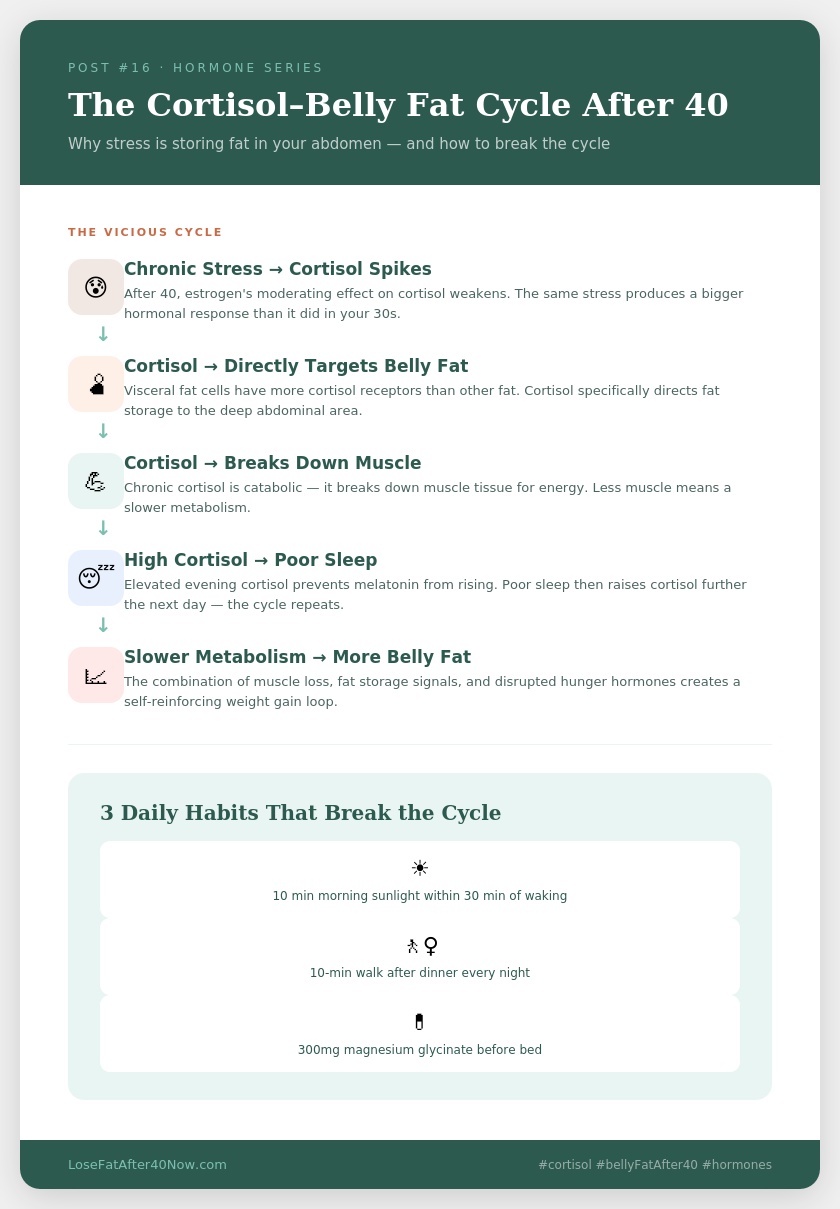
Here is the specific mechanism that took me a long time to fully absorb: cortisol does not cause general fat gain. It causes abdominal fat gain, specifically.
Visceral adipose tissue, the deep belly fat that surrounds your organs, is densely loaded with cortisol receptors. It is biologically primed to respond to cortisol signals. When cortisol rises, visceral fat cells absorb and store circulating fat more efficiently than fat tissue located elsewhere in the body. The more chronically elevated your cortisol, the more aggressively your body directs fat toward the midsection.
What the Research Confirms
A study published in Psychosomatic Medicine (2000) found that women with higher cortisol reactivity had significantly more abdominal fat than women with lower reactivity, even after controlling for overall body weight. The location of fat, not just total fat, tracked directly with cortisol sensitivity. A subsequent meta-analysis in Obesity Reviews (2022) confirmed that chronically elevated cortisol was independently associated with visceral fat accumulation in midlife women, separate from dietary intake.
Beyond directing fat toward the abdomen, cortisol creates a cascade of metabolic effects that compound over time.
Cortisol drives appetite for calorie-dense, high-sugar, and high-fat foods. This isn’t a willpower failure. It’s a hormonal instruction telling your brain to seek fast energy in response to a perceived threat. Stress eating has a genuine biological logic that has nothing to do with discipline.
Cortisol also increases the activity of lipoprotein lipase in abdominal fat cells, making those cells better at extracting and storing fat from the bloodstream. The belly literally becomes more efficient at fat storage when cortisol is chronically elevated.
It breaks down muscle tissue to use as fuel during periods of sustained stress. Less muscle means a slower resting metabolism. This is one reason why chronic dieting combined with chronic stress can produce such a frustrating outcome: losing muscle while maintaining or gaining fat, all while trying hard.
Cortisol also disrupts sleep, which raises cortisol further the next day. Poor sleep increases ghrelin (the hunger hormone) and reduces leptin (the satiety signal). You eat more, feel full for less time, and burn fewer calories. The cycle reinforces itself.
Why Midlife Changes How Cortisol Behaves
Younger women deal with cortisol too. There are specific reasons, though, why midlife intensifies this particular problem.
Estrogen plays a moderating role on the HPA axis, the hypothalamic-pituitary-adrenal system that regulates cortisol production and clearance. In your 30s, estrogen was quietly buffering your cortisol response, helping it rise when needed and return to baseline more readily. As estrogen declines during perimenopause, this buffer weakens. The same stressor that felt manageable at 35 can now produce a stronger cortisol response at 45. Not because you’ve become more fragile, but because the physiological damper has loosened.
Life in your 40s also tends to bring a particular convergence. Career responsibilities that feel higher-stakes, teenagers or young adults at home, aging parents who need more attention, financial pressures that have grown more complex over time. The body does not distinguish between professional and personal stress. All of it generates cortisol.
Sleep disruption, common in perimenopause because of hot flashes, irregular cycles, and the general restlessness that accompanies hormonal fluctuation, is itself a powerful cortisol trigger. One poor night raises cortisol the next day. Elevated cortisol makes the following night harder. Women dealing with perimenopausal sleep changes can get caught in a loop that feels impossible to break without understanding the underlying mechanism.
Chronic dieting history also matters here. Severe calorie restriction is a physiological stressor. The body interprets restricted food intake as a potential famine and responds with cortisol, which promotes fat storage as a protective mechanism. Women who arrive at their 40s with years of on-and-off restrictive dieting behind them often have an entrenched cortisol pattern that resists correction until the dieting approach itself changes.
The Triggers You Probably Don’t Recognize as Stress
Cortisol responds to far more than the obvious pressure points. Several everyday behaviors raise it in ways that don’t register as “stress” in any psychological sense, which is why they go unaddressed for years.
Eating too little. Consuming under roughly 1,200 calories per day signals to the body that food is scarce. Cortisol rises to mobilize stored energy and preserve survival functions. A restriction approach designed to lose fat can produce a hormonal environment that actively holds onto it instead.
High-intensity cardio sessions done too often. Long, intense cardio workouts, particularly on an empty stomach, trigger a cortisol spike. For women over 40, adding this on top of an already elevated cortisol baseline can undercut the metabolic benefits of the workout entirely. The evidence consistently points to moderate intensity as the cortisol-friendly approach for this life stage.
Caffeine timing. One or two morning cups of coffee fall within what most bodies handle well. Multiple sources of caffeine throughout the day, or any caffeine consumed after early afternoon, can keep cortisol elevated into evening. If sleep is a problem, caffeine timing is one of the first variables worth addressing.
Phone and screen use before sleep. The emotional stimulation of social media feeds, news alerts, or reactive content activates cortisol at exactly the window when the body most needs it to decline. Evening cortisol elevation from screen exposure is an underappreciated driver of the sleep disruption cycle.
Skipping breakfast. Cortisol peaks naturally in the morning. Without a food signal, that morning peak can stay elevated longer rather than beginning its natural decline. Breakfast within two hours of waking is one of the simplest available tools for normalizing cortisol rhythm across the day.
Cortisol Triggers That Don’t Feel Like Stress
Eating under 1,200 calories/day · Frequent long high-intensity cardio sessions · Multiple caffeine sources past early afternoon · Evening screen exposure with reactive content · Skipping breakfast · Chronically over-scheduled days with no recovery buffer
(Journal of Clinical Endocrinology and Metabolism, 2021)
What I Tried First — and Why One Hour Was All I Got
Before I understood any of this, I had my own approach to managing stress. Every few weeks I’d book a massage. When the shoulder tension became noticeable, I’d add a sauna session afterward. This felt responsible. Deliberate self-care. I was actively doing something about it.
And it worked. For about an hour.
I’d walk out feeling loosened and softened, the kind of full-body quiet that made everything seem manageable. By the following morning, my shoulders had reassembled their usual tension. By mid-week, the belly tightness was back. I kept thinking I needed more appointments, or more frequent ones. Maybe a longer session. Maybe a different therapist.
A massage therapist I’d seen for about eight months said something that stayed with me. She mentioned that my shoulders held tension in an unusual way, that the pattern she saw wasn’t typical for someone who wasn’t dealing with chronic physiological activation. She wasn’t diagnosing anything. But the word “chronic” landed differently than the rest of the sentence.
I had been treating symptoms. The shoulder tightness, the fatigue, the belly puffiness that reliably returned after every appointment. The source, the cortisol pattern generating those symptoms, I was never reaching. No amount of massage was going to interrupt the hormonal signaling that kept recreating the same physical output.
That was the shift. Not from “I should take better care of myself” to “I should try harder.” From “I’ve been managing the output” to “I need to address the mechanism.” Those are two entirely different problems, and they require two entirely different solutions.
What Actually Lowers Cortisol — and What Raises It in Disguise
Once I was working with the mechanism rather than around it, things changed. Several approaches made a real difference. A few that I’d assumed were helpful turned out to make the underlying pattern worse.
Morning sunlight within 30 minutes of waking. Light exposure early in the day anchors the cortisol peak to the morning, allowing it to drop naturally rather than extending into afternoon and evening. Five to ten minutes outside is enough, even on overcast days. Within about three weeks of doing this consistently, my late-afternoon energy crashes became less sharp.
Breakfast with protein, within two hours of waking. A protein-centered breakfast, roughly 25 to 30 grams, signals food availability and helps cortisol begin its decline from the morning peak. I had been delaying breakfast as part of an intermittent fasting approach. Shifting to an earlier first meal immediately changed my mid-morning focus and hunger pattern.
A 10-minute walk after meals. Post-meal walking lowers blood sugar and reduces cortisol directly. No equipment, no cost, compounds quietly across weeks and months. The daily routine post covers this habit in more detail.
Replacing some high-intensity cardio with strength training. Moderate resistance training helps regulate cortisol over time. Chronic high-intensity cardio, especially multiple long sessions per week, can worsen it. I replaced one weekly cardio session with 25 minutes of strength work. The difference in recovery and evening energy was noticeable within 10 days.
Protecting sleep as the highest-leverage single intervention. Every other cortisol management strategy works better with adequate sleep as the foundation. Even modest improvements in sleep duration and quality produce measurable cortisol reductions within days.
Eating enough food. This was the hardest mental shift. Chronic calorie restriction keeps cortisol elevated. Adequate protein and overall calorie intake signal to the body that resources are available. For women who’ve been in a diet mindset for years, eating more, not less, can be the change that lets cortisol come down and fat loss actually resume.
Slow breathing for five minutes. A physiological sigh, one full inhale followed by a second shorter inhale to fully inflate the lungs, then a long slow exhale, activates the parasympathetic nervous system and lowers acute cortisol faster than other known breathing techniques. Stanford research published in Cell Reports Medicine (2023) confirmed this approach produced the strongest physiological effect among several breathing methods tested. Five minutes in the evening is enough to shift the evening cortisol curve.
A Daily Cortisol Framework That Works With Your Biology
Morning: 5–10 min sunlight before phone, protein breakfast within 2 hours of waking
Midday: 10-min walk after lunch, no caffeine after 1–2 p.m.
Afternoon: Strength training preferred over long cardio sessions
Evening: Dinner before 7 p.m. when possible, screens off 30 min before bed
Before sleep: 5-min slow breathing (physiological sigh method)
Overall: Eat adequate protein and calories. Don’t under-eat while over-exercising.
Most women notice sleep and energy changes within 2–4 weeks. Belly fat changes typically become visible around 6–8 weeks.
My Daily Cortisol Routine
I didn’t implement all of this at once. Trying to overhaul everything simultaneously would have been its own cortisol trigger.
I started with three things. Morning sunlight before I checked my phone, 10 minutes outside with my coffee, letting the day start quietly rather than reactively. A 10-minute walk after dinner, around the block, consistent regardless of weather. No phone for 30 minutes before sleep.
That was the first month. Within two weeks, sleep improved noticeably. The mid-afternoon heaviness, the kind that used to make me feel like a different person than I was at 9 a.m., became less predictable, then less frequent. By the end of the month, the belly observations I’d been tracking for three months started showing a pattern in the other direction.
Over the following two months I added a protein-centered breakfast and replaced one weekly cardio session with resistance work. About six to eight weeks after that, I had the most consistent results I’d seen in years. Not from eating less or exercising more. From working with the hormonal environment rather than trying to override it.
The timeline is realistic: sleep and energy changes are usually the first signals, typically within 2 to 4 weeks. Visible belly fat changes follow around 6 to 8 weeks of consistency, with more significant results emerging between 3 and 4 months.
Cortisol and Belly Fat After 40: How the Mechanism Works
| Cortisol Effect | What Happens in the Body | Result for Belly Fat |
|---|---|---|
| Directs fat to visceral receptors | Abdominal fat cells absorb circulating fat more efficiently | Belly fat accumulates specifically, not generally |
| Drives appetite for calorie-dense food | Brain seeks fast-energy foods in response to perceived threat | Overeating of high-sugar, high-fat foods |
| Breaks down muscle tissue | Uses protein as fuel during sustained stress | Slower resting metabolism, easier fat gain |
| Disrupts sleep | Raises ghrelin, lowers leptin | More hunger, less satiety, more fat storage |
| Elevates blood glucose | Triggers insulin release to manage circulating sugar | Additional fat storage signaling |
| Flattens cortisol rhythm | Keeps cortisol high in evenings instead of dropping | Poor recovery, persistent belly puffiness |
Frequently Asked Questions
Can you test cortisol levels at home?
Saliva cortisol kits are available online and through some functional medicine providers. They measure cortisol at four points across the day, giving a picture of your daily rhythm rather than a single snapshot. They’re not a substitute for clinical assessment, but they can be a useful starting point if you suspect your rhythm is significantly disrupted.
How long before cortisol changes affect belly fat?
The first sign that things are shifting isn’t something you’ll see — it’s something you’ll notice in the rhythm of your day. Cortisol follows a natural curve: high in the morning, declining steadily through the afternoon, lowest around midnight. When that curve has been flattened by chronic stress, the evening never quite comes down, and mornings start with a kind of residual alertness that isn’t rest. When the curve starts normalizing, mornings feel different before anything else does. Less urgency on waking. Less late-evening restlessness. The transition into sleep becomes quieter. Those are the real early markers that the chronic elevation is coming down. Most women notice this shift within two to four weeks of consistent application. The visible belly fat changes follow the rhythm — typically beginning around six to eight weeks, once the body has stopped receiving the sustained fat-storage signal that elevated cortisol generates. The fat didn’t accumulate overnight. It won’t leave that way either.
Does meditation actually lower cortisol?
Yes, consistently. Even brief daily practices, 5 to 10 minutes, have been shown in multiple studies to reduce cortisol over time. The physiological sigh breathing technique mentioned above has the fastest-known acute effect. You don’t need a structured meditation program. Focused breathing with a long exhale for five minutes produces measurable parasympathetic activation.
Is cortisol always the explanation for belly fat after 40?
Not always. Cortisol is one significant factor among several, alongside estrogen decline, insulin resistance, sleep quality, and muscle loss. But for women who are handling nutrition and movement reasonably well and still seeing stubborn belly fat that doesn’t respond, cortisol is often the overlooked variable. It’s worth addressing before concluding that nothing will work.
If I manage cortisol, do I still need to watch what I eat?
Yes. Cortisol management is a third pillar alongside nutrition and movement, not a replacement for either. What changes when cortisol comes down is that your nutrition and exercise efforts become more effective. The body stops actively undermining fat loss through fat-storage signaling. The same habits that felt like they weren’t working can produce completely different results in a lower-cortisol hormonal environment.
The Bottom Line
Belly fat after 40 is not simply a calorie problem. For many women, cortisol is the invisible mechanism driving fat toward the abdomen regardless of how carefully they eat or how consistently they move.
Addressing cortisol doesn’t mean abandoning diet and exercise. It means adding a third dimension to your approach: regulating the hormonal environment so that everything else you’re doing can finally produce the results it should.
You’re not lazy. You’re not broken. You may simply be dealing with a chronically elevated stress hormone in a body that has lost the hormonal buffer that used to soften its effects. That’s a biology problem. It has biology solutions.
Start with morning sunlight and an after-dinner walk this week. Two habits. Give it four weeks. See what changes.
Has stress been a hidden factor in your weight loss picture? Share your experience in the comments. I read every one.
Medical Disclaimer: This post is for informational purposes only and does not constitute medical advice. If you suspect cortisol dysregulation or adrenal-related issues, please consult a qualified healthcare provider before making changes to your health routine.