Why Women Over 40 Lose Muscle Faster (And How to Stop It)
Twelve three-ring binders. Fifteen years of old teaching materials I hadn’t opened since I left the classroom, sealed inside a cardboard box that weighed about 30 pounds (13.6 kg). That box is what finally showed me something about muscle loss in women over 40 that I’d been missing completely.
I was moving it up to the storage closet above our stairwell, the same 12 steps I’d carried heavier boxes up for years without a second thought. This time I made it to step six and had to sit down. Not out of breath. My arms were simply done.
I’d always assumed muscle loss was something that happened to women who stopped moving. I hadn’t stopped moving. If anything, I was more active than I’d been in years, walking most mornings, staying generally on my feet. What I didn’t understand yet was that the kind of moving I was doing wasn’t the kind that protects muscle at all, and that gap between “active” and “strong” is exactly where muscle loss after 40 quietly does its damage.
That afternoon sent me into the research, and what I found reframed almost everything I thought I knew about staying strong after 40.
What Actually Causes Muscle Loss in Women Over 40
The medical term is sarcopenia: the gradual, age-related decline in muscle mass and strength. According to Mayo Clinic, this process typically begins in the 30s and speeds up meaningfully after 40, particularly in women moving through perimenopause and menopause.
Estimates vary, but women lose somewhere in the range of 3-8% of muscle mass per decade starting in their 30s, with the rate of loss increasing after menopause (Journal of Cachexia, Sarcopenia and Muscle, 2022). Left unaddressed, that adds up to a meaningful percentage of peak muscle mass gone by age 70.
Muscle loss in women over 40 isn’t just about strength or appearance. Muscle is metabolically active tissue, burning roughly 6 calories per pound daily at rest. Lose 10 pounds of muscle and resting metabolism drops by about 60 calories a day, which compounds to tens of thousands of calories over a year. Muscle mass is also directly tied to insulin sensitivity, fall risk, bone density, and functional independence later in life. This is a health issue, not a cosmetic one.
Muscle Loss After 40: The Numbers
Why Estrogen Decline Accelerates Muscle Loss
Estrogen has direct, muscle-protective properties. It supports muscle protein synthesis, helps the satellite cells that repair tissue after exercise, and dampens some of the inflammatory signals that break muscle down. When estrogen drops through perimenopause and menopause, those processes all become less efficient at once.
This is why a workout routine that maintained your muscle at 35 may no longer maintain it at 45. It isn’t that you’re suddenly doing it wrong. The hormonal environment your muscles are operating in has changed, so the stimulus needs to change with it.
The Cortisol Connection to Muscle Loss
Cortisol is catabolic, meaning it breaks tissue down, including muscle, to mobilize quick energy. In short bursts this is normal and useful. The problem is chronically elevated cortisol, which becomes more common after 40 as estrogen’s moderating effect on the stress response weakens, sleep quality often declines, and midlife stress accumulates.
Mechanistically, cortisol activates pathways that flag muscle protein for breakdown. With adequate protein and enough anabolic signaling, the body rebuilds what cortisol takes apart. When the balance tips toward high cortisol and lower anabolic hormones, exactly what tends to happen after 40, the net effect is muscle loss even in women who feel like they’re doing everything right.
Three Things That Make Muscle Loss Worse
1. Cardio Without Any Resistance Work
Walking, cycling, and other steady cardio burn calories without giving muscle the mechanical loading signal it needs to be maintained. Cardio still has real benefits, but on its own it does very little to slow muscle loss in women over 40.
2. Not Enough Protein
Most women over 40 eat noticeably less protein than their bodies actually need for muscle maintenance, often closer to guidelines built for much younger adults. Research points to roughly 1.2-1.6g per kg of body weight daily as a more accurate target (Nutrients, 2020).
3. Chronic Sleep Deficit
Most muscle repair happens during deep sleep, when growth hormone is released. Consistently sleeping under 7 hours suppresses growth hormone, raises cortisol, and reduces muscle protein synthesis, compounding the muscle loss that declining estrogen has already set in motion.
The Truth: What Actually Reverses Muscle Loss
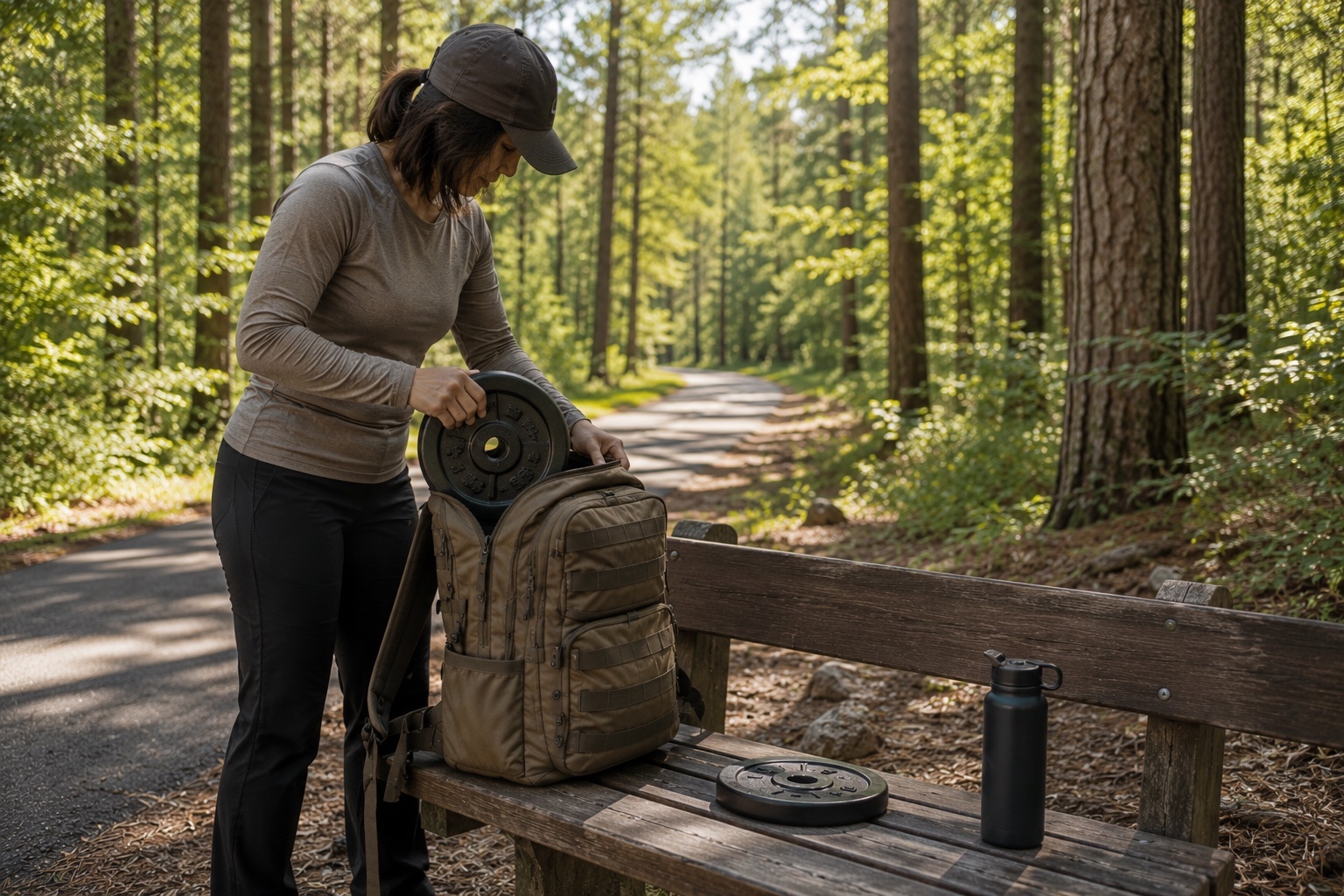
A few days after the stairwell, I loaded an old backpack with about 15 lbs (6.8 kg) and took it on my usual route: paved greenway, then the uneven trail down to the lake. I didn’t even make it to the dirt path along Pine Tree Greenway before my shoulders were burning and my calves were pulling. I turned back at thirty minutes, well short of my normal loop.
I’d been walking almost every day for years. It had never once felt like that. That was the moment it actually sank in: I was active, but I wasn’t giving my muscles any reason to adapt. Walking alone wasn’t the wrong thing to do, it just wasn’t doing the specific job I needed it to do.
The mechanism is called mechanotransduction: the mechanical stress of carrying load activates signaling pathways, including mTOR, that stimulate muscle protein synthesis directly, even when estrogen is low. It’s the same principle behind resistance training, and it’s why simply walking further or faster doesn’t produce the same effect that walking under load does.
Over the following weeks I built the same loop back up: thirty minutes, then forty-five, then a full hour, and eventually the entire route, paved greenway to the lake trail to the dirt path along Pine Tree Greenway and back, about an hour and a half, with the pack up to 20 lbs (9 kg). My calves got visibly harder. The shoulder ache I’d expected to get worse actually disappeared entirely once my upper back and shoulders adapted to carrying weight properly.
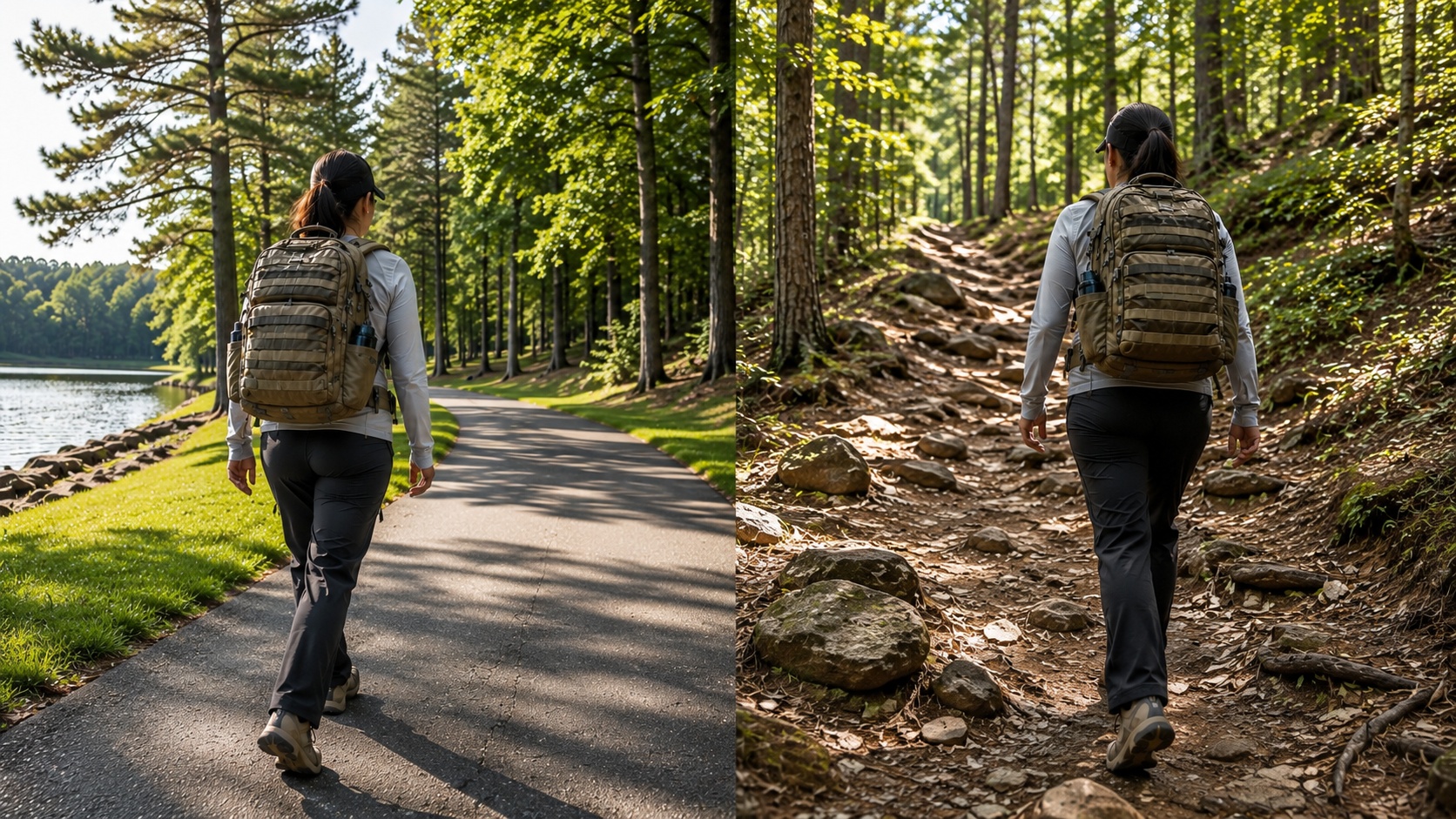
What Loaded Walking (Rucking) Does That Regular Walking Doesn’t
- A mechanical loading signal gets added to an activity you may already be doing daily
- Shoulders, upper back, and core all have to work to stabilize the load, not just the legs
- Progressive overload happens automatically, just by increasing pack weight over time
- The cardiovascular benefit of walking stays intact, with a genuine muscle-building stimulus added on top (Journal of Strength and Conditioning Research, 2023)
| Cardio-Only Walking | Walking With Added Load |
|---|---|
| Burns calories, supports heart health | Does both of that, plus provides a mechanical stimulus for muscle |
| No progressive overload built in | Progressive overload just by adding weight to the pack |
| Minimal upper body or core demand | Shoulders, upper back, and core work to stabilize the load |
| Muscle loss continues in the background | Directly counteracts the mechanism driving muscle loss |
Structured resistance training with weights produces this same effect and is still the most researched intervention for reversing sarcopenia in women over 40, including postmenopausal women. Loaded walking is simply a lower-barrier entry point if a gym or a home weight set isn’t where you want to start.
Protein: The Practical Lever
Resistance stimulus, whether from weights or a loaded pack, tells the body to build muscle. Protein supplies the material to actually do it. Without enough protein, that signal has nothing to build with.
Part of the reason protein needs go up after 40 is anabolic resistance: the muscle-building response to a given amount of protein weakens with age. A younger woman might need 20g to maximally trigger muscle protein synthesis; a woman over 40 may need 30-40g to get the same response.
- Daily total: roughly 90-120g (1.2-1.6g per kg of body weight)
- Per meal: 30-40g to reliably cross the threshold for muscle protein synthesis
- Timing: protein at every meal, with breakfast as the highest-priority window
Other Factors That Support Muscle Preservation
Sleep. Aim for 7-9 hours. Deep sleep is when growth hormone peaks and repair actually happens.
Creatine monohydrate. Among the most researched supplements for muscle preservation. In postmenopausal women specifically, 3-5g daily alongside resistance training produces better outcomes than training alone (Menopause, 2023).
Managing cortisol. Sleep, time outdoors, and simply not overtraining all help protect the muscle that loaded movement and resistance work are building.
Vitamin D. Muscle tissue has vitamin D receptors, and low levels are linked to reduced muscle function and higher fall risk. Testing and correcting a deficiency is a low-cost, high-impact step.
Signs You Might Be Losing Muscle
- Everyday tasks that used to feel easy now take real effort: carrying boxes, opening jars, climbing stairs
- Weight is stable but your body feels softer, less firm, even without any change on the scale
- A workout that used to feel manageable now feels noticeably harder
- Recovery after activity takes longer than it used to
A DEXA scan is the most objective way to check, giving precise muscle mass, fat mass, and bone density numbers as a baseline you can track over time.
Frequently Asked Questions
Can women over 40 actually build new muscle, or only slow the loss?
Both. Research consistently shows women over 40, including postmenopausal women in their 60s and 70s, can build real new muscle with consistent resistance stimulus and adequate protein. The rate is slower than at 25, but it’s real, and the idea that muscle building stops after 40 isn’t supported by the evidence.
How long before I notice a difference?
Strength gains often start within 2-4 weeks, driven early on by your nervous system getting better at recruiting muscle rather than new muscle tissue itself. Visible changes typically show up around 8-12 weeks of consistency.
Do I need a gym, or does rucking actually count as strength training?
You don’t need a gym. A loaded backpack on a walk you’re already taking is a legitimate way to introduce a muscle-building stimulus, and it pairs well with a couple of sessions of resistance bands or dumbbells at home each week.
Is it too late to start at 50 or 60?
No. Multiple studies show meaningful muscle gains in women well into their 60s and 70s who start resistance or loaded training later in life. Where you’re starting from sets your baseline, not your ceiling.
How heavy should my pack be if I want to try rucking?
Most women do well starting around 10-15 lbs (4.5-6.8 kg) and increasing gradually over several weeks, the same way you’d add weight to any strength exercise. There’s no need to rush the load.
The Bottom Line
I’d spent years assuming that being generally active meant my muscles were fine. The box on the stairs said otherwise, and the walk with a loaded pack a few days later confirmed it. Muscle loss in women over 40 isn’t really about being inactive. It’s about whether the activity you’re doing gives your muscles a reason to adapt.
Declining estrogen, rising cortisol, low protein, and movement without load are the specific conditions that let muscle loss run quietly in the background. Loaded walking, resistance training, and enough protein are the specific levers that push back against it. None of it requires a gym membership or hours a day.
I carry that same binder box up all 12 steps now, without stopping.
Have you noticed changes in strength or muscle that surprised you after 40? Tell me about it in the comments. I read every one.
Disclaimer: This post is for informational purposes only and does not constitute medical advice. Please consult a healthcare provider before beginning a new exercise program, especially if you have existing health conditions.