What to Eat Before and After a Workout at 40 (Fuel Your Body Right)
Quick Navigation
- What Changed When I Stopped Training on Empty
- Why Your Body Uses Workout Nutrition Differently After 40
- What to Eat Before Your Workout at 40
- After Your Workout: When Muscle Repair Actually Happens
- A Full Day in Practice
- Hydration After 40
- Supplements With Legitimate Evidence
- Frequently Asked Questions
Have you ever gone through a phase where you trained consistently, stayed disciplined, and still felt like something was working against you instead of with you?
That was me, and for a long time, I gave almost no thought to workout nutrition after 40. I was focused on showing up, staying consistent, getting the movement in. What to eat before and after a workout felt like a separate concern to figure out at meals, not something that could actually change the results I was seeing.
And then there was the fasted cardio logic I’d absorbed from enough fitness articles and offhand conversations that I’d stopped questioning it. Train on an empty stomach, the thinking went. No fuel in the system forces the body straight to stored fat. I heard it enough times that I went out every morning before eating anything, convinced I was making the disciplined, smart choice.
What I actually remember from those sessions is not fat burning. It’s the speed at which my energy disappeared.
Halfway through even a moderate jog, something would give out. My legs slowed before I wanted them to. I couldn’t finish half of what I’d planned. Not from lack of motivation, but because my body had simply run out of something. I felt lightheaded on some days. On others, my legs simply stopped cooperating the way they should have. By the time I got home, I wasn’t sitting down calmly to a meal. I was grabbing at whatever was closest. Sweets, specifically, sounded almost impossible to ignore.
At the time, I still believed the workouts were effective. Looking back now, I think my body was simply stressed and reacting to that stress in entirely predictable ways. The sessions I thought were disciplined were quietly making recovery harder and the rest of my day harder to manage.

What Changed When I Stopped Training on Empty
The reason I changed wasn’t a research discovery. It was simpler. I just wanted enough energy to actually finish my jog without feeling miserable halfway through.
So before exercising, I started eating something small. A banana. Sometimes a handful of almonds. Other days a fruit and vegetable smoothie or a bowl of warm soup. Nothing heavy, just enough so that my body didn’t feel completely empty going into the session.
The difference surprised me almost immediately.
I could jog all the way home without my body shutting down midway. I actually completed my planned route. For the first time in a long while, I came back through the door feeling steady instead of drained. I remember standing in the kitchen, satisfied that I had finished what I set out to do. That sounds like a small thing, but after months of cutting sessions short, it wasn’t small at all. I could jog continuously for 30 to 40 minutes without stopping, and that felt like something.
What surprised me more was what came afterward. Because I wasn’t starving when I got home, I didn’t attack food. I sat down. I chewed slowly. I actually tasted what I was eating. The desperate, almost panicked relationship with food that had followed those fasted workouts simply wasn’t there.
Something shifted mentally, too. Finishing the workout, actually finishing it instead of abandoning it halfway, broke the cycle of feeling like I’d failed. I wasn’t eating afterward to reward myself for surviving a hard session. I was eating because it was time to eat. That calm feeling alone changed how my days looked more than I expected.
Workout Nutrition After 40: Why Your Body Responds Differently
What I experienced with fasted training had a clear biological explanation, and understanding it is what makes getting workout nutrition after 40 right so much more important than it was at 30.
When you exercise on an empty stomach, cortisol — your body’s primary stress hormone — rises sharply. Cortisol’s job, in part, is to mobilize energy when none is available, so it breaks down muscle tissue to convert protein into glucose. In your 20s and early 30s, this process is relatively contained. Muscle recovers quickly. The system rebounds.
After 40, it doesn’t rebound the same way. Estrogen, which helped buffer cortisol’s muscle-breakdown effects for decades, is declining. Muscle protein synthesis (the process through which your body repairs and builds muscle fiber) becomes less efficient with age. Researchers call this anabolic resistance: older muscle tissue requires more nutritional stimulus to trigger the same rebuilding response that younger tissue achieves more readily.
This means that training fasted after 40 carries a higher cost than it did before. The cortisol spike is harder to recover from. The muscle breakdown during the session is more significant. And the body needs more protein support, both before and after training, to offset what’s lost and rebuild what was damaged.
The same logic applies to the post-workout side of workout nutrition after 40. A 2019 review in Nutrients found that older adults required approximately 40 grams of protein per meal, versus 20 to 25 grams for younger adults, to maximally stimulate muscle protein synthesis. Timing matters more, too. The post-exercise window during which muscle tissue is most receptive to protein narrows with age, which is why getting protein in within two hours of training matters more at 45 than it did at 30.
Research Snapshot: Workout Nutrition After 40
What to Eat Before Your Workout at 40: Timing and Choices
The goal before training is simple: give your body enough fuel to perform well without causing digestive discomfort or a blood sugar crash during the session. What that looks like depends entirely on how much time you have before you start moving.
2 to 3 Hours Before Training: A Full Balanced Meal
With two to three hours before training, your body has time to digest a complete meal without carrying any of it into the session uncomfortably. This meal should include moderate protein (25 to 30 grams), moderate carbohydrates, and relatively low fat.
Protein before training reduces muscle protein breakdown during the session, a particular concern after 40, when that breakdown happens more readily. Eggs, chicken, fish, Greek yogurt, or a protein shake all work well here.
Carbohydrates are the preferred fuel source for strength and resistance training. Whole-food options like oats, sweet potato, rice, or fruit provide steady energy rather than the spike-and-crash that processed carbs produce. Fat slows digestion considerably, so keep pre-workout meals lower in fat.
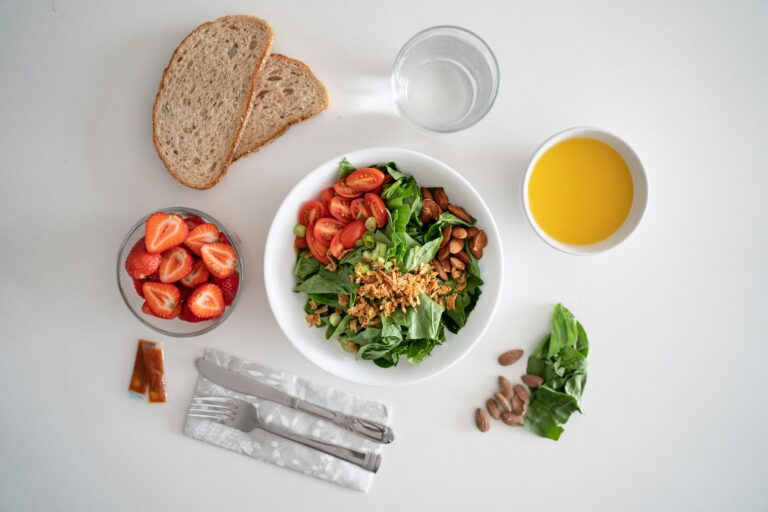
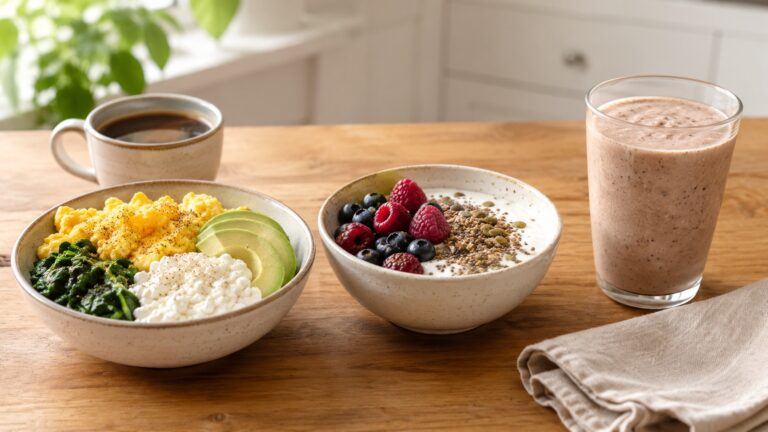
Some meals that work well at this timing: oatmeal with protein powder stirred in plus a banana; grilled chicken with sweet potato and steamed greens; Greek yogurt with berries and a small handful of granola; eggs on whole grain toast with a piece of fruit.
30 to 60 Minutes Before: A Small, Easily Digestible Snack
If a full meal isn’t practical, a small snack 30 to 60 minutes before training works well. Keep it higher in easily digestible carbohydrates and moderate in protein, low in fat and fiber, which both slow digestion and can cause discomfort during exercise. A banana with a small amount of protein powder; plain low-fat Greek yogurt with a few berries; a rice cake with almond butter; a hard-boiled egg with a small apple. These are all practical and easy to prepare quickly.
Morning Training: Do You Need to Eat First?
My own experience answered this question before I understood the research behind it. Most women over 40 train better, and recover better, with at least a small amount of protein before morning workouts.
Training completely fasted raises cortisol significantly. After 40, when cortisol is already more prone to elevation and its muscle-breakdown effects are less buffered by estrogen, that is a real physiological cost. A small protein-forward snack before morning training, even just a few bites of Greek yogurt or a half-scoop of protein in water, preserves more muscle and often improves performance without causing digestive problems.
If you train fasted and feel strong doing it, that’s a valid choice. But make post-workout nutrition your immediate priority afterward, and get it in as quickly as possible.
Pre-Workout Checklist: What Works After 40
- 2–3 hours before: balanced meal with 25–30g protein, moderate carbs, low fat
- 30–60 minutes before: small snack with digestible carbs and moderate protein, low in fat and fiber
- Morning training: even a small protein snack (half-scoop protein in water, or a few bites of Greek yogurt) meaningfully reduces cortisol-driven muscle breakdown
- Whole-food carbs (oats, sweet potato, fruit) for steady energy; avoid processed carbs pre-workout
- Skip high-fat meals close to training; they delay digestion and dull energy during the session
After Your Workout: When Muscle Repair Actually Happens
Post-workout nutrition was the piece I understood last, and the part that changed my recovery most noticeably once I got it right.
For a long time, I exercised and then delayed eating real protein for hours. I’d have random snacks first. By the time I tried to eat something protein-focused, it had often been two or even three hours since training ended, and eating enough protein at that point already felt heavy and difficult. I could feel the difference in my body: a lingering soreness that carried over into the next morning, a general fatigue that didn’t fully lift between sessions. My joints, not just my muscles, seemed to stay sore longer. The recovery felt slow in a way that made me wonder whether I was doing more harm than good.
What shifted my thinking was understanding what’s actually happening in muscle tissue during recovery. During exercise, you create microscopic damage to muscle fibers. That damage is the signal, the stimulus the body needs to rebuild those fibers stronger. But rebuilding requires raw materials. Protein, specifically. Without adequate protein available in the post-workout period, the repair process is incomplete. Your body has the signal but not the supply.
Now I aim to eat protein within an hour of finishing a session. My everyday choices rotate between things I can prepare quickly: edamame, tofu, broccoli with fish, and cod are regular options. I’m not measuring precisely or following a complicated protocol, just making sure the materials are actually there when my body needs them most.
What surprised me was that the benefit wasn’t confined to muscle soreness. My body started feeling like it was actually recovering between sessions rather than simply grinding through them. That shift, from exercise feeling depleting to exercise feeling manageable, happened more quickly than I expected once the post-workout nutrition was consistently in place.
The Post-Workout Protein Window: What the Research Shows
Aim for 25–40g of protein within 1–2 hours after training. The anabolic window is wider than older sports nutrition advice suggested, but for women over 40, anabolic resistance means the window is more critical than it was at earlier ages. Getting protein in within this period produces measurably better muscle repair outcomes than waiting several hours (Nutrients, 2019).
Leucine-rich sources trigger muscle protein synthesis most powerfully: whey protein isolate, eggs, Greek yogurt, and white fish are the most effective. Plant-based options (edamame, tofu, tempeh) work well when combined; the key is reaching sufficient total protein in the meal, not the format it arrives in.
If appetite is suppressed after harder sessions (common and normal), a liquid option such as a protein shake or Greek yogurt thinned with a little milk is easier to consume than a full meal and still delivers what muscles need.
Best Post-Workout Protein Sources
- Whey protein isolate: The fastest-absorbing option, with the highest leucine content of any protein source. Practical for quick consumption within the first hour post-workout, especially when appetite is low.
- Eggs: Complete protein with high bioavailability. Two to three eggs alongside vegetables makes a solid post-workout meal when you have a few minutes to prepare it.
- Greek yogurt: High protein, good leucine content, and easy to eat quickly. Plain full-fat with berries works well as a post-workout snack when a full meal isn’t immediate.
- Cod or other white fish: Lean, high-protein, and easy on digestion after exercise. Pairs well with a carbohydrate source as part of a full post-workout meal.
- Edamame or firm tofu: For plant-based options, both provide more protein per serving than most plant foods and work well when combined with other protein sources.
Carbohydrates After Training
Carbohydrates after training replenish muscle glycogen (the stored fuel your muscles burn during exercise) and stimulate an insulin response that helps drive amino acids into muscle cells more effectively. For moderate-intensity strength training done three times per week, full glycogen replenishment isn’t critical at every single session. But including moderate carbohydrates with your post-workout protein, such as fruit, rice, sweet potato, or oats, supports recovery, reduces cortisol more quickly after exercise, and helps energy and mood in the hours that follow. Keep portions moderate; the goal is recovery support, not a large calorie load.
A Full Day in Practice
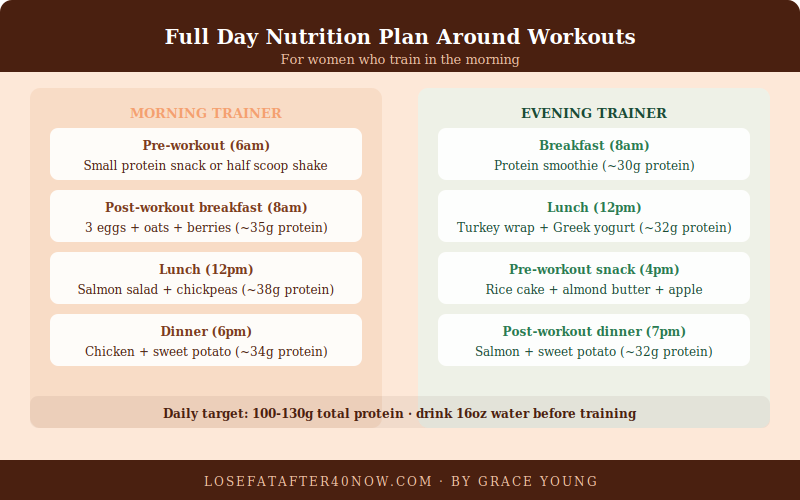
The principles above look different depending on when you train. Here are three practical schedules that translate the timing guidelines into real days:
Morning Trainer (6–7 a.m. workout)
| Timing | What to Eat | Approx. Protein |
|---|---|---|
| Before training (6 a.m.) | Small protein snack: ½ cup Greek yogurt or ½ scoop protein in water | ~12–15g |
| Post-workout breakfast (8 a.m.) | 3 eggs + oats + berries | ~32g |
| Lunch (12 p.m.) | Salmon or cod + chickpeas or edamame + salad | ~38g |
| Dinner (6 p.m.) | Chicken or tofu + vegetables + sweet potato | ~30g |
Midday Trainer (12–1 p.m. workout)
| Timing | What to Eat | Approx. Protein |
|---|---|---|
| Breakfast (8 a.m.) | Eggs + Greek yogurt | ~30g |
| Pre-workout snack (11 a.m.) | Banana + hard-boiled egg | ~8g |
| Post-workout meal (1:30 p.m.) | Chicken or fish + rice + vegetables | ~35g |
| Dinner (6:30 p.m.) | Tofu stir-fry or fish + roasted vegetables + quinoa | ~30g |
Evening Trainer (5–6 p.m. workout)
| Timing | What to Eat | Approx. Protein |
|---|---|---|
| Breakfast (8 a.m.) | Protein smoothie (plant protein + fruit + greens) | ~28g |
| Lunch (12 p.m.) | Lentil soup or tuna salad + Greek yogurt | ~32g |
| Pre-workout snack (4 p.m.) | Rice cake + almond butter + small apple | ~5g |
| Post-workout dinner (7 p.m.) | Salmon or cod + sweet potato + broccoli | ~32g |
Hydration After 40: Don’t Underestimate This
Dehydration of even 2 percent of body weight measurably reduces strength, endurance, and mental focus during exercise. After 40, this matters more than it used to because thirst sensation becomes a less reliable signal; you can be meaningfully dehydrated before you feel it.
Before training: Drink 16oz (500ml) in the hour before your workout, spread through the hour rather than all at once immediately before you start.
During training: Sip 4–8oz every 15–20 minutes during moderate-intensity sessions. For workouts under 45 minutes, consistent hydration leading up to the session matters more than drinking during it.
After training: Rehydrate with 16–24oz in the hour following exercise. Adding a pinch of sea salt and a squeeze of lemon to your post-workout water replaces electrolytes lost through sweat, relevant if you train hard, sweat heavily, or are in a warm environment.
After 40: Thirst Is No Longer a Reliable Hydration Signal
Thirst sensation declines with age, meaning women over 40 are more likely to reach a state of mild dehydration before they notice it (Physiology & Behavior, 2013). Even at the 1–2% level, mild dehydration reduces exercise performance, increases perceived effort, and slows post-workout recovery (Sports Medicine, 2015).
A practical daily habit: 16oz of water upon waking before coffee, another 16oz in the hour before training. Use urine color as your hydration gauge throughout the day: pale yellow is the target. Dark yellow by late afternoon means you’re behind.
Supplements With Legitimate Evidence for Women Over 40
Whole food nutrition comes first. No supplement compensates for poor eating patterns. But a few have meaningful research behind them specifically for workout nutrition after 40, particularly where performance and recovery are concerned:
Creatine monohydrate is one of the most thoroughly researched supplements available. For women over 40, it supports strength development, muscle preservation, and there is growing evidence for cognitive benefits as well. The standard protocol is 3–5 grams daily, any time of day, with food. No loading phase is required or helpful.
Protein powder: whey isolate offers the fastest post-workout absorption and the highest leucine content. Plant-based blends combining pea and rice protein work well for those who prefer non-dairy options. Aim for a product that provides at least 25 grams of protein per serving, with minimal added sugar.
Magnesium glycinate supports muscle function, sleep quality, and nervous system recovery after exercise. 300–400mg taken in the evening — not immediately around training, since the relaxation effect is better suited to sleep preparation.
Omega-3 (EPA + DHA) reduces exercise-induced inflammation and has been shown to support muscle protein synthesis in older adults. 1–2 grams of combined EPA + DHA daily with food. If you eat fatty fish regularly (salmon, mackerel, sardines), a supplement may not be necessary, though for those who don’t, it fills a real gap.
Frequently Asked Questions
Do I need to eat immediately after a workout?
Within two hours is the practical target, not necessarily within the first 10 minutes. The post-workout window during which muscle tissue is most receptive to protein is wider than older sports nutrition advice suggested. Eating a high-protein meal within one to two hours of finishing your session covers the window effectively for most women over 40. If it has been several hours since your last meal when you train, closer to 30–60 minutes post-workout is better.
What if I’m not hungry after training?
Appetite suppression after harder sessions is common and completely normal. The hormonal response to intense exercise temporarily reduces hunger signals. A liquid option works just as well as solid food: a protein shake, Greek yogurt thinned with a little milk, or a smoothie with protein powder. The goal is getting the protein in, not the format it arrives in.
Is fasted cardio worth doing for fat loss after 40?
Fasted training does increase fat oxidation during the session itself; that part is accurate. But it also raises cortisol significantly and accelerates muscle breakdown, both of which are more costly after 40 than in earlier decades. The overall body composition difference between fasted and fed training in the research is small. For most women over 40, the muscle-preserving benefit of even a modest pre-workout snack outweighs the marginal fat-oxidation advantage of training completely fasted.
Does what I eat around workouts matter if my overall diet is good?
Overall diet quality is the foundation. No workout nutrition strategy compensates for poor eating across the rest of the day. That said, for women who are already eating well and training consistently, optimizing what they eat before and after workouts at 40 does produce measurable improvements in recovery speed, muscle preservation, and energy between sessions. The older you are, the more the details compound in both directions.
How much total protein do I need per day if I’m training?
Current research suggests 1.6–2.0 grams of protein per kilogram of body weight per day for women over 40 who are strength training, higher than standard dietary recommendations, which were not designed with active, aging muscle tissue in mind. Spreading that total across three to four meals produces better muscle protein synthesis outcomes than concentrating it in one or two large servings.
The Bottom Line
You don’t need a complicated nutrition system to support your workouts well after 40. The core principles are actually quite clear.
Give your body some fuel before training, enough to complete the session without running on empty, without the cortisol spike that fasted training triggers, and without the post-workout hunger spiral that undermines the rest of your day. Prioritize protein after training, within two hours, in a meaningful dose. Stay consistently hydrated, not just in the hour around your session. And if you’re adding one supplement, creatine has the strongest evidence base for women over 40 by a significant margin.
What I learned from months of getting this wrong is that the workout itself is only part of what determines the results you actually see. Getting workout nutrition after 40 right, what you eat around training and when, shapes how hard you can push, how well you recover, and how much of each session translates into real, lasting change.
You’re putting in the work. The nutrition should be working with you, not against you.
What’s been your experience with eating around your workouts? Have you noticed a difference in your energy or recovery depending on the timing? Share what’s been working, or what you’re still trying to figure out, in the comments below.

About Grace Young
Grace Young is the founder of LoseFatAfter40Now.com. In her mid-40s, she began researching the hormonal and metabolic shifts that make weight management feel so different after 40, and built this blog around what she learned, tested, and experienced firsthand. Read Grace’s full story →