
Sleep and Weight Loss After 40: Why 7 Hours Is Non-Negotiable
Two nights of short sleep raises your hunger hormone by 24 percent.
Not a month of poor sleep. Not a year of accumulated debt. Two nights.
That number sits at the center of everything I now understand about sleep and weight loss after 40. I read it after close to a decade of broken, fragmented, never-quite-enough sleep — and the first thing I thought was: that explains everything. The weight that kept creeping up despite careful eating. The hunger showing up before breakfast was even finished. The years of doing what I thought I was supposed to do and watching none of it work.
My sleep had been broken for structural reasons. Two kids with a five-year age gap meant nearly a decade with at least one child who wasn’t sleeping through the night. I’d wake around 2 a.m., get back to sleep eventually, start the day four or five hours in. I didn’t think of it as sleep deprivation. It was just that season of life.
By the time that disruption eased, the patterns had calcified into habit. The 2 a.m. waking stayed. The coffee count climbed. And I kept attributing the weight gain and the constant hunger to everything except what was actually driving them.
This post explains exactly what happens to your body when sleep falls short after 40, why I spent years not connecting those two things, and what actually helped when I finally started taking sleep as seriously as I took food.

The Years Nothing Worked, and Why I Didn’t See It
The five-year gap between my two kids meant something I didn’t fully appreciate at the time: close to a decade with at least one child who wasn’t reliably sleeping through the night. For several of those years, uninterrupted sleep was rare. I’d wake around 2 a.m., sometimes for a reason, sometimes not, and get back to sleep for maybe four or five hours before the day started over again.
I didn’t think of it as sleep deprivation. Broken sleep was just what that period of life was. You push through. You have a second coffee. You keep going.
But my body was keeping a different count. The first thing I noticed wasn’t weight gain. It was that I stopped bouncing back. A bad night used to mean one tired day, followed by recovery. Starting around that period, I stopped recovering. Every morning began from a deficit. My face was always slightly puffy. Clothes fit differently around my midsection, even when my eating hadn’t changed much.
I told myself it was age. I was approaching 40, and this was probably just what that looked like. Maybe I wasn’t moving enough. Maybe my metabolism had finally caught up with me. I cycled through explanations the way you do when you can’t identify the real cause, never once considering that my body had been running in a low-grade stress state for years, and that sleep was the missing piece entirely.
What Sleep Deprivation Actually Does to Your Metabolism
Once I understood the mechanism, the weight gain from those years made complete sense. The link between sleep and weight loss after 40 runs deeper than most people realize. Sleep isn’t rest in the passive sense. It’s one of the most hormonally active periods of the day. When it gets cut short or fragmented consistently, the hormonal consequences are specific, measurable, and directly tied to fat storage and hunger.
(Spiegel et al., Annals of Internal Medicine, 2004)
(Spiegel et al., Annals of Internal Medicine, 2004)
(Spiegel et al., Journal of Applied Physiology, 2005)
(Patel et al., American Journal of Epidemiology, 2006)
Ghrelin Rises, Leptin Falls
Ghrelin is the hormone that signals hunger. It tells your brain you need to eat. After even one night of poor sleep, ghrelin rises measurably. After several consecutive nights, it stays elevated. Hunger feels persistent and urgent regardless of what or how much you’ve already eaten.
Leptin does the opposite job: it’s the signal that tells your brain you’ve had enough. Sleep deprivation suppresses leptin. The “I’m satisfied” message weakens. You can finish a full meal and still feel like something is missing. This isn’t a discipline problem. The hormonal signals are simply off, and effort alone is not a reliable counter to hormonal drive.
Cortisol Stops Following Its Normal Curve
Under normal circumstances, cortisol peaks in the morning to get you moving and drops steadily through the day, reaching its lowest point at night to allow recovery and sleep. Sleep deprivation disrupts this rhythm. Cortisol stays elevated in the evening when it should be falling.
For women over 40, whose cortisol regulation is already shifting as estrogen and progesterone decline, this disruption compounds quickly. Chronically elevated cortisol signals the body to store fat in the visceral area (the belly specifically), and simultaneously breaks down muscle tissue for energy. Both outcomes work directly against fat loss.
Insulin Sensitivity Drops
Research from the University of Chicago found that just four nights of sleeping 4.5 hours reduced insulin sensitivity by 30 percent in otherwise healthy adults. For women over 40 already facing declining insulin sensitivity from hormonal changes, adding sleep deprivation on top creates a compounding problem: blood sugar spikes higher after meals, more glucose gets converted to fat, and the cycle of cravings and energy crashes that derails eating habits becomes harder and harder to break.
The Pattern I Finally Started Noticing
Knowing the research is useful. What made it real for me was watching my own appetite on days after sleeping differently.
After my youngest started sleeping more reliably, I began to notice something I hadn’t been able to see when every night was broken: the days after a five-hour night looked completely different from the days after seven hours of solid sleep. The difference was too consistent to be coincidence.
| After About 5 Hours of Sleep | After About 7 Hours of Sleep |
|---|---|
| Intense craving for coconut dark chocolate by mid-morning, before breakfast was even finished | Cravings manageable; I could walk past the pantry without thinking about it |
| Hungry again within two hours of lunch: peanut butter, something sweet, anything with a strong taste | Felt satisfied after meals; snacks were a choice, not a compulsion |
| Needed two or three coffees to stay functional after noon | One coffee in the morning was enough; no afternoon crash |
| By 1 p.m., couldn’t concentrate for more than ten minutes; just wanted to lie down | Steady energy through the afternoon; no wall |
| Evening felt like a finish line, and I usually ate more than I intended after crossing it | Dinner portions felt right; no urgent need to keep eating afterward |
On a five-hour night, I wasn’t choosing to eat more. The hunger was real in a way that felt different from ordinary hunger: more urgent, less connected to whether I’d recently eaten. The coconut dark chocolate I kept in the pantry for occasional treats became something I was thinking about before the morning was half over. A coffee and something sweet at 2 p.m. on a day when I’d already eaten a full lunch. That kind of hunger doesn’t come from a calorie deficit. It comes from a hormonal state.
The contrast between those days and the seven-hour days was clear enough that eventually I couldn’t explain it away. My discipline hadn’t changed between those two types of days. The hormonal environment had, and my appetite followed it completely.
Later I understood why. Sleep deprivation raises ghrelin, suppresses leptin, keeps cortisol elevated, and reduces insulin sensitivity. I had been experiencing all of that for years and calling it a willpower problem.
Why 7 Hours Is the Actual Threshold
The 7-hour number isn’t arbitrary. It comes from a consistent body of research on the relationship between sleep duration and metabolic outcomes.
A study that followed more than 68,000 women over 16 years found that those sleeping five hours or less per night were 15 percent more likely to be obese and significantly more likely to gain 30 or more pounds over the course of the study, compared to women sleeping seven hours (Patel et al., American Journal of Epidemiology, 2006). A meta-analysis in Sleep (Cappuccio et al., 2008) confirmed that sleeping fewer than six hours is independently associated with both higher BMI and greater abdominal fat accumulation.
Below seven hours, the hormonal disruptions described above become measurable and consistent. Between seven and nine hours, most adults’ hunger hormones, cortisol patterns, and metabolic rate operate within a healthy range.
- 9+ hours consistently: May indicate an underlying issue worth discussing with a doctor
- 7-8 hours: Optimal zone for hunger hormones, insulin sensitivity, and fat-burning conditions
- 6-7 hours: Borderline. Some hormonal disruption beginning, higher cravings risk, reduced recovery
- 5-6 hours: Measurable ghrelin rise, leptin suppression, cortisol disruption
- Under 5 hours: Significant metabolic impairment across hunger, fat storage, and blood sugar regulation
For women over 40, the target is seven to eight hours, most nights. Not six hours and a coffee. Not five hours on weekdays with catch-up sleep on weekends. Research on inconsistent sleep timing shows that irregular patterns disrupt metabolic function independently of total hours logged. Consistency matters as much as quantity.
What I Changed, and What Changed Back
Recognizing the connection was one thing. Actually changing my sleep was slower, partly because the disruption had been structural, built into years of caring for young children, and by the time that external cause lifted, the poor patterns had become habit.
I started with the simplest thing: making my bedtime and wake time more consistent. Not perfect. I didn’t always manage it. But I stopped letting myself drift past midnight without a reason, and I stopped sleeping in past 7:30 on weekends to compensate. The consistency alone began to change how evenings felt. Within about two weeks, I noticed I was less wired at 10 p.m., which I hadn’t expected at all.
I moved my last coffee to before noon. That was harder than I thought it would be for about five days, and then it almost completely stopped being an issue.
I also started eating dinner earlier, before 6:30 on most evenings instead of 8 or 8:30. I hadn’t connected late eating to middle-of-the-night waking before, but once I made the change, the 2 a.m. wake-ups that had been so routine became much less frequent. That surprised me more than almost anything else I tried.

The stretching I do in bed every night: it took about two weeks to become automatic, and I notice when I skip it.
The thing that made the clearest difference was adding a short stretching routine in bed before sleep. Nothing structured or formal, just 10 minutes of slow, deliberate movement. My body eventually learned to associate it with sleep coming, and I started falling asleep faster and waking during the night less. I put my phone away at least an hour before bed, dimmed the lights in the living room after 9 p.m., and kept the bedroom cooler than I had been.
I never got to a perfect eight hours every night. But reducing the number of nights under six hours, replacing most of them with nights in the six-to-seven range, sometimes more, changed things in a way I could feel.
The first thing I noticed was the puffiness. When sleep improves and cortisol starts settling, the water stored alongside glycogen shifts — which can make the scale show an early change that partly reverses a few days later. What I was seeing in my face and midsection was that: water moving, not fat. The scale was giving me a number that looked like progress, then took some of it back, because it couldn’t separate the two. That confusion is actually what made me stop watching the scale and start watching the puffiness instead. It was a more honest signal.
The scale started moving about six weeks in, slowly but consistently. I was eating the same things I’d been eating before. The main thing that had changed was the hormonal environment those choices were happening in. The connection between sleep and weight loss after 40 had been working against me for years. Now it was finally working with me.
A Practical Sleep Plan for Sleep and Weight Loss After 40
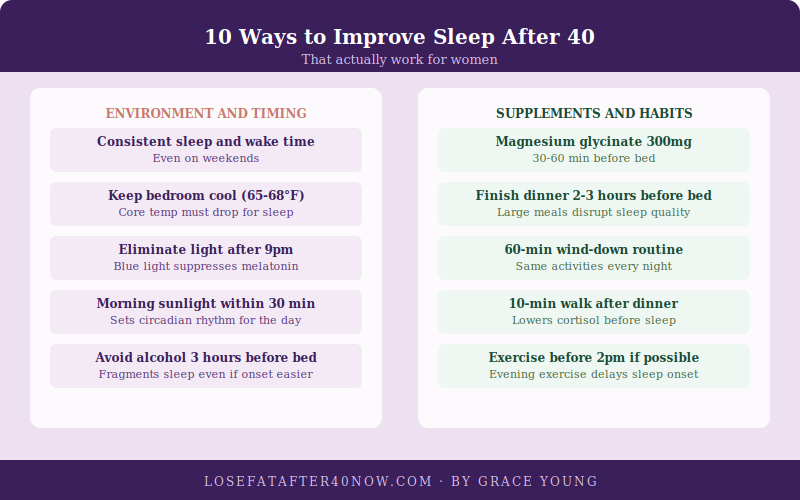
If sleep has been a weak point, the changes below are ordered by impact, starting with what tends to move the needle most.
| Change | Why It Matters After 40 | How to Start |
|---|---|---|
| Consistent sleep and wake time | Sets your circadian rhythm, which is the foundation every other sleep improvement builds on | Pick a wake time and keep it every day for two weeks, including weekends |
| Morning light within 30 minutes of waking | Anchors cortisol peak early so it can drop by evening, allowing melatonin to rise naturally | 10 minutes outdoors; even a cloudy day has enough light to work |
| Cool bedroom (65-68°F / 18-20°C) | Core body temperature must drop 1-2°F to initiate deep sleep; especially critical when hot flashes are involved | Lower the thermostat at night; switch to lighter bedding |
| No screens after 9 p.m. | Blue light suppresses melatonin, an effect that grows more significant after 40 as natural melatonin production declines | Phone on charger outside the bedroom by 9 p.m. |
| Dinner before 7 p.m. | Late large meals raise core temperature, disrupt blood sugar overnight, and are a leading cause of 2-3 a.m. waking | Move dinner 30 minutes earlier each week until it’s consistently before 7 |
| Magnesium glycinate (300mg before bed) | Supports GABA, the calming neurotransmitter that progesterone used to help regulate, and aids muscle relaxation | Take 300mg, 30-45 minutes before sleep; glycinate form specifically, not oxide |
| Bedtime stretching routine | Creates a physical transition signal; teaches your nervous system that movement means sleep is close | 10 minutes in bed; doesn’t need to be yoga, just slow and deliberate |
| Notepad for nighttime thoughts | Lower progesterone reduces GABA, making the brain more reactive to stress signals overnight; writing removes thoughts from active processing | Keep a notepad next to the bed; write down anything circling before sleep |
Weekend recovery sleep can reduce some of the acute effects of weekday sleep loss, but it does not fully restore insulin sensitivity or normalize cortisol rhythm. The irregular timing itself is its own source of metabolic disruption. Consistent timing across the whole week outperforms inconsistent sleep followed by weekend catch-up, every time.
Frequently Asked Questions
The Bottom Line
Sleep and weight loss after 40 are not two separate conversations. They’re the same conversation. The hormonal disruption from chronic short sleep (elevated cortisol, rising ghrelin, suppressed leptin, declining insulin sensitivity) creates a biological environment that makes fat loss measurably harder, regardless of how well you’re eating or how consistently you’re moving.
You can’t reliably out-diet broken sleep. The biology won’t cooperate.
Seven hours is the threshold where hormones start working with you rather than against you — not a goal to aspire to, but the floor where everything else you’re trying actually has a chance. Getting there doesn’t require perfection. It requires consistency. A consistent bedtime, a cool and dark room, an early dinner, ten minutes of stretching before sleep. These aren’t small things. They’re the conditions under which everything else you’re working toward becomes possible.
If you’ve been doing everything right and not seeing results, sleep is worth addressing first, not as one more thing to optimize later, but as the environment in which everything else either works or doesn’t.
What has been your biggest obstacle to getting enough sleep? I’d love to hear whether any of the strategies above have made a real difference. Leave a comment below.