30-Day Belly Fat Challenge for Women Over 40 (Free Printable Plan)
“How’d the 30-day challenge go?”
She asked across the lunch table, her fork halfway to her mouth. We ate together a few times a week, and I’d mentioned the challenge when I started it — a HIIT program I’d found in a fitness book, the kind that promised maximum fat loss in minimum time. Short bursts at maximum heart rate, alternating with rest. The science sounded solid. What it actually felt like was gasping through every session for a full month, wondering whether I was doing it right or simply surviving it.
“Done,” I said. “All 30 days.”
“And?”
“Lost just over two pounds by Day 30. Back to where I started in eight days.”
She set down her fork. “So you just… keep doing it?”
I had no answer.
That conversation became the starting point for this 30-day belly fat challenge for women over 40 — not another round of intensity and restriction, but four habits added one per week, designed around the hormonal shifts that make the standard approach fail.
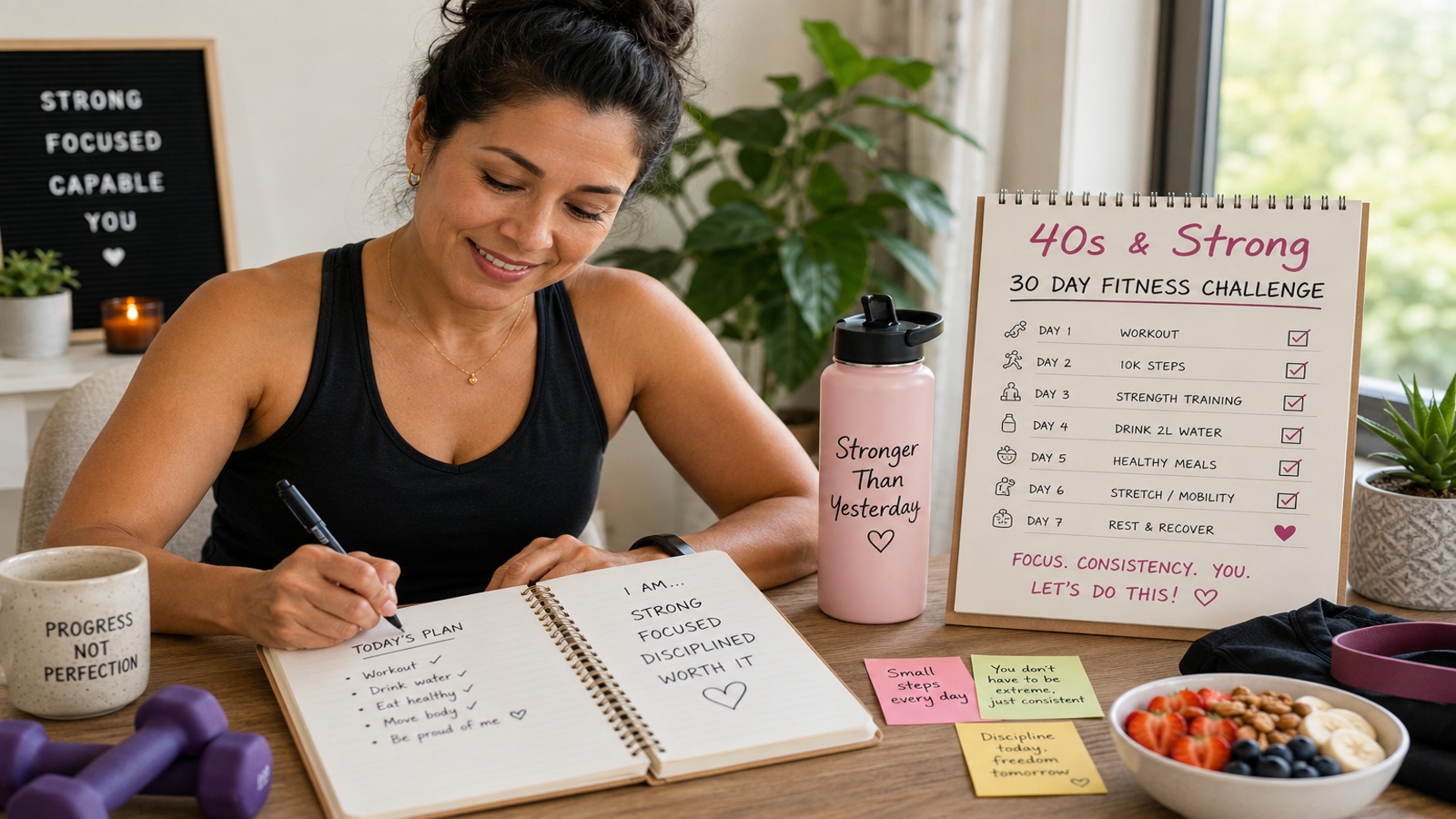
Why Every Challenge I Finished Changed Nothing
I completed that 30-day HIIT challenge. Every single session. By Day 30, the scale had moved: 2.2 pounds gone. I felt something I hadn’t felt in a while — like I’d actually done something.
Day 38, I was back to exactly where I’d started.
What stays with me isn’t the regain itself. It’s how quiet it was. No binge week. No obvious collapse. The challenge ended, and within eight days, those 2.2 pounds returned without drama, as if my body had been holding its breath for a month and finally exhaled.
That wasn’t the only time. I’d done at least three or four structured programs before that one, each with a different name, each with the same ending. Restriction plus intensity, repeated until the month ran out, followed by a return to baseline so reliable it started to feel almost mechanical.
The pattern took me a while to name. Every program I’d tried used the same two tools: eat less, work harder. For a younger body, some of that can produce lasting change. For a body in perimenopause, those two tools are often working directly against the biology they’re trying to fix.
The Hormonal Reason Most 30-Day Belly Fat Challenges Backfire After 40
High-intensity exercise is a physical stressor. Significant caloric restriction is also a physical stressor. Both raise cortisol. And elevated cortisol, in a body where estrogen is declining, has a direct route to the abdomen.
In a low-estrogen body, both exercise stress and caloric restriction produce stronger, longer-lasting cortisol responses than they did before — the full mechanism is covered in Cortisol and Belly Fat After 40 →.
What the Research Shows
This is why the challenge that produced results for a colleague in her late 30s left you more exhausted and no thinner. The mechanics inside the body are different now. Restriction and high intensity are not neutral tools — applied to a perimenopausal body, they often activate the exact hormonal response that stores belly fat after 40.
Before You Start: Why This 30-Day Belly Fat Challenge After 40 Works Differently
This 30-day belly fat challenge is built on addition, not subtraction. Each week, you add one habit. You don’t eliminate anything overnight. The four habits address the specific systems that decline with estrogen: blood sugar stability, muscle mass, sleep quality, and circadian rhythm regulation. Each one directly reduces the cortisol load on your body.
Five Things to Know Before Day 1
- 80% consistency is the target, not 100%. Missing a day doesn’t restart the challenge. The next morning, continue from where you are.
- The scale is one data point, not the whole picture. Visceral fat can reduce meaningfully before the scale reflects it. Take a waist measurement on Day 1 and track how your clothes fit.
- Eating under 1,200 calories raises cortisol. This challenge does not require restriction. It adds structure to what you’re already doing.
- The first week of any habit feels awkward. That’s not a signal to stop. It’s what new habits feel like before they become automatic. Give each one at least seven days.
- Day 30 is the beginning, not the finish line. The goal is four habits that continue beyond the challenge. The month is a container for getting started, not a timer that runs out.
Week 1 (Days 1–7): The Protein Foundation
Week 1 HabitHit 25 grams of protein at breakfast every day. Nothing else changes this week.
Breakfast protein does three things that matter directly for belly fat after 40: it stabilizes blood sugar through the morning, raises GLP-1 (the satiety hormone) for several hours, and begins preserving the muscle mass that declining estrogen would otherwise erode. Muscle loss after 40 isn’t cosmetic: it slows your resting metabolic rate, which is one of the mechanisms behind the weight that accumulates without any obvious change in eating.
By Day 4, I noticed something I hadn’t expected. For years, I’d had a habit of reaching for tortilla chips and salsa in the afternoon, not out of genuine hunger, more a kind of automatic afternoon ritual. On Day 4, I stood in the kitchen at my usual time and realized the pull wasn’t there. Not suppressed or resisted. Just absent.
The physical part was only half of it. There was something quieter alongside it, a small sense of having done something right. Not a dramatic feeling, more like the difference between a day where nothing goes wrong and a day where one thing goes specifically well. That small accumulation of confidence, repeated over a week, turned out to matter more than I’d expected.
A 2022 analysis in Nutrients found that adults over 40 who consumed 25–30g of protein at breakfast reduced total caloric intake across the rest of the day by 15–18% without any intentional restriction. The food choices changed on their own.
What 25g of protein at breakfast looks like:
- 2 eggs + half cup black beans + half cup quinoa: approx. 26g
- 3 scrambled eggs + half cup Greek yogurt: approx. 33g
- Protein smoothie (1 scoop whey + half cup cottage cheese + milk): approx. 32g
- 2 eggs + 2 slices smoked salmon + avocado: approx. 30g
Week 2 (Days 8–14): Strength Training and the Evening Walk
Week 2 HabitAdd three 30-minute strength sessions and a 10-minute walk after dinner. Keep the protein breakfast from Week 1.
For women over 40, strength training is the most valuable form of exercise. Not because it burns the most calories in the session, but because it counteracts estrogen-driven muscle loss, improves insulin sensitivity, and elevates resting metabolism for 24 to 48 hours after each session. Cardio burns calories while you’re doing it. Strength training changes how many you burn while you’re doing nothing.
Session A: Lower Body Bodyweight squat 3×12, glute bridge 3×15, reverse lunge 3×10 each side, clamshell 2×15, dead bug 3×8.
Session B: Upper Body Push-up 3×10, resistance band row 3×12, overhead press 3×12, bicep curl 2×12, plank 3×20 seconds.
Session C: Full Body Goblet squat 3×10, Romanian deadlift 3×10, push-up 3×10, band row 3×12, dead bug 3×8.
The after-dinner walk is one of the most underused habits on this list. Research in Diabetologia (2022) found that a 10-minute walk within 30 minutes of eating reduced post-meal blood glucose by approximately 22% compared to sitting. Lower post-meal glucose means less insulin released and less of that meal converted to fat storage.
If You Miss a Session
Continue from the next scheduled day. Don’t double up to compensate; that’s exactly the intensity spike that raises cortisol. Progress in this 30-day challenge is measured across the full month, not in any single week.
Week 3 (Days 15–21): Sleep and Cortisol Reset
Week 3 HabitScreens off 45 minutes before bed, every night. Keep all three habits from Weeks 1 and 2.
I had been a poor sleeper for years. Not dramatically poor: I wasn’t lying awake until 3 a.m. A full one to two hours of staring at the ceiling after lights out was simply how my nights went. I’d come to accept it as my baseline.
What changed things was a sleep book written by a physician, which explained clearly what blue light does to melatonin production in the hour before sleep. It wasn’t complicated. The screens were keeping the melatonin signal suppressed past the point when it needed to rise. I put the book down, walked to the kitchen, and plugged in my charger there instead of beside the bed.
Night one without the phone: the 40 minutes it used to take to fall asleep happened again. My mind kept reaching for something that wasn’t there. Night five, it took under 12 minutes. By Night 7, I woke up before my alarm, which had not happened in longer than I could remember. And more than that, I woke up oriented. Not groggy. Not needing 20 minutes and a full cup of coffee before I felt like a person.
The change that surprised me most was what happened when I ran. I run a few mornings a week, and mornings after poor sleep had always felt like running through something thick: low energy, no drive, a hunger that arrived before I’d covered half a mile. After a week of the screen change, I ran on an empty stomach and had energy that felt like it came from somewhere I hadn’t accessed in a long time. My body had reserves it hadn’t seemed to have before.
What Poor Sleep Does to Belly Fat
Less than 7 hours of sleep raises ghrelin (hunger hormone) and suppresses leptin (fullness signal), independently of what you eat. Deep sleep also triggers growth hormone release, which is one of the body’s main fat-mobilizing signals.
A 2019 meta-analysis in Sleep Medicine Reviews found that chronic short sleep is associated with a 41% increased risk of developing abdominal obesity, separate from dietary factors. (NHLBI: Sleep Deprivation and Deficiency)
The protocol: dim the lights after 9 p.m., move your phone out of the bedroom, take 300mg magnesium glycinate 30 minutes before bed (consult your healthcare provider before adding any supplement), and choose reading, gentle stretching, or slow breathing over news and screens.
Week 4 (Days 22–30): Morning Light and Full Integration
Week 4 HabitTen minutes of morning sunlight within 30 minutes of waking. Keep all four habits together through Day 30.
Morning light is the single strongest signal your body uses to anchor its circadian clock, the timing system that regulates cortisol, melatonin, insulin, and metabolism together. Light exposure within the first 30 minutes of waking triggers the cortisol awakening response at the right time: cortisol peaks early, as it should, and drops naturally through the day instead of staying elevated into the evening.
This does not require a dedicated outdoor walk. Step outside with your coffee. Sit by an open window with the blinds pulled back. On overcast days, five to ten minutes of outdoor light still provides substantially more photon exposure than indoor lighting.
Your full daily checklist from Day 22 onward:
- Morning sunlight within 30 minutes of waking (10 min)
- 16 oz water before coffee
- Protein breakfast (25g minimum)
- Strength training on scheduled days
- 10-minute walk after dinner
- Screens off 45 minutes before bed
- Magnesium glycinate (300mg) before bed
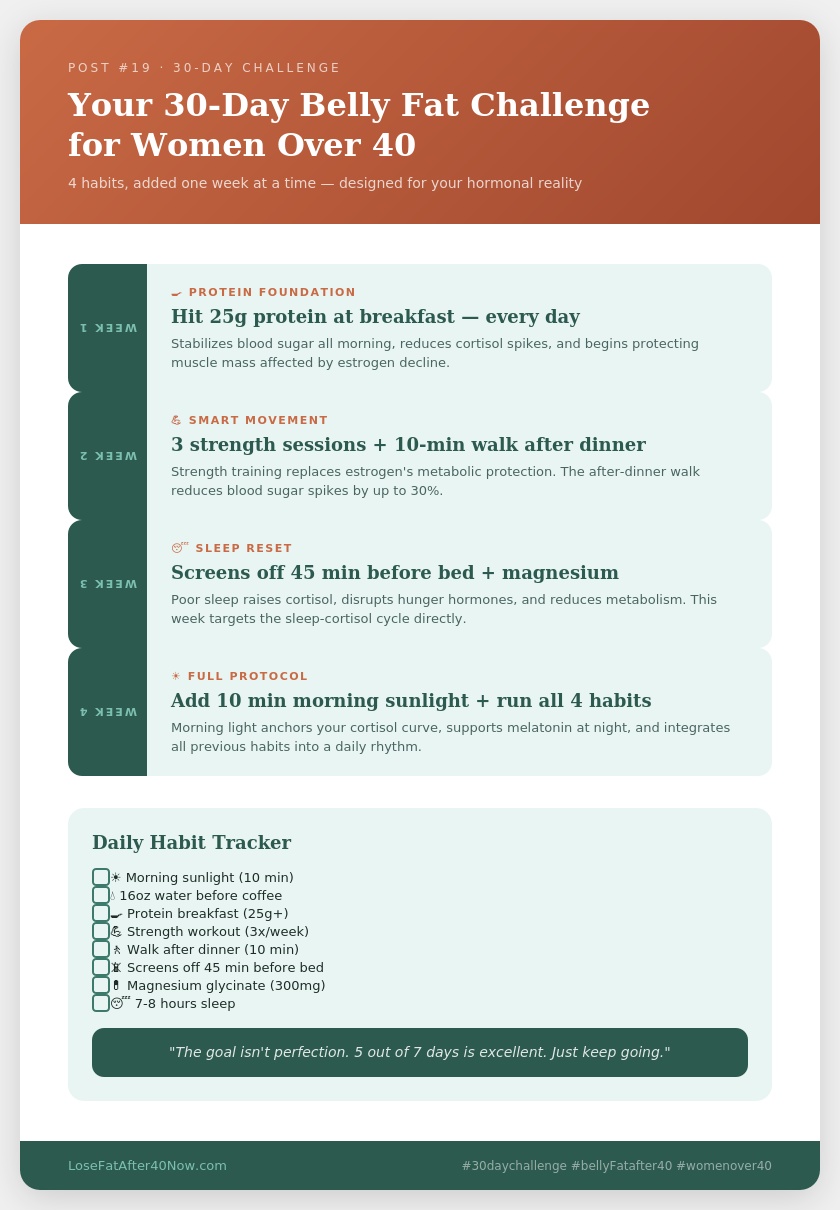
Your 30-Day Habit Tracker
Check off each habit daily. The goal in Days 1–7 is one habit done consistently. By Week 4, you’re running all seven. Aim for 5–7 per day in the final week; 3–4 in earlier weeks is solid progress.
| Week | Sunlight | Water | Protein | Workout | Eve. Walk | Screens Off | Magnesium |
|---|---|---|---|---|---|---|---|
| Days 1–7 | — | Yes | Yes | — | — | — | — |
| Days 8–14 | — | Yes | Yes | Yes | Yes | — | — |
| Days 15–21 | — | Yes | Yes | Yes | Yes | Yes | Yes |
| Days 22–30 | Yes | Yes | Yes | Yes | Yes | Yes | Yes |
A missed habit doesn’t restart the challenge. It just means that habit is available again the next day.
What to Expect Week by Week
The results of this 30-day belly fat challenge move more slowly than a restriction-based approach. They also last, because the habits producing them don’t end on Day 30.
| Week | What’s Changing Inside | What You May Notice |
|---|---|---|
| Week 1 | Blood sugar stabilizing; GLP-1 rising after meals | Steadier energy after breakfast; afternoon cravings may soften or disappear |
| Week 2 | Insulin sensitivity improving; muscle activation beginning | Less afternoon energy crash; mild soreness in Days 8–11 is normal |
| Week 3 | Cortisol starting to regulate; sleep architecture improving | Less morning puffiness; more even mood; better energy on workout days |
| Week 4 | Circadian rhythm anchoring; all four systems working together | Clothing may fit differently around the waist; more consistent energy through the day |
| Month 2–3 | Measurable body composition changes; habits now automatic | Protein binds less water than carbohydrates — which is why dietary changes often shift how clothes fit before the scale moves. Waist measurements are a more reliable signal at this stage. |

Frequently Asked Questions
Do I need to change what I eat beyond the breakfast protein?
Not for this challenge. Adding protein at breakfast consistently reduces appetite and improves food choices throughout the day without any deliberate restriction. If you want to layer in more, reducing refined carbohydrates at dinner and increasing vegetables at lunch compound the results, but neither is required to start Week 1.
Can I do this challenge during perimenopause?
This challenge was designed with perimenopause specifically in mind. Each of the four habits directly addresses a system affected by declining estrogen: insulin sensitivity (protein), muscle preservation (strength training), cortisol regulation (sleep), and circadian rhythm (morning light). It is one of the most appropriate structured approaches for this hormonal stage.
What if I can only manage two strength sessions a week in Week 2?
Two consistent sessions done well are worth more than three sporadic ones. Start with two if that’s what’s sustainable. The goal is to establish the habit, not to hit a number. You can increase frequency in Month 2 once the routine is stable.
I’ve done 30-day challenges before and regained everything. Why would this be different?
Most 30-day challenges are temporary interventions. They end, and so do the behaviors. This challenge is designed to build four habits that you continue after Day 30. The month is a structure for getting them established. The result isn’t a number on the scale at Day 30; it’s whether the habits are still running by Day 60.
How do I know if it’s working if the scale isn’t moving?
Each of the four habits in this challenge gives you a direct signal you can read without the scale. Protein at breakfast: the urgency of afternoon hunger should feel quieter and more predictable within three to five days. If it isn’t, the amount probably needs adjusting up. Strength training: sessions that left you genuinely depleted in Week 1 should feel manageable by Week 3. That’s a real, measurable shift — write down how each session felt and you’ll see it. The screen cutoff and sleep habit: notice how long it takes to fall asleep and how the morning grogginess compares to Week 1. Most people find this changes faster than they expected. Morning light: the mid-morning drag either softens noticeably or moves later in the day. Those four signals are what the challenge is actually building, and they’re more specific and faster-moving than the scale. They also tell you which of the four habits is working well and which one still needs time.
Which of the four habits do you think will be hardest for you? Most people assume it’s the workouts, but in my experience the screen cutoff surprises almost everyone. Leave a comment and let me know which one you’re starting with.
Medical Disclaimer: This post is for informational purposes only and does not constitute medical advice. Consult your healthcare provider before beginning a new exercise, nutrition, or supplementation program, particularly if you have existing health conditions or take medication.

Grace Young is the founder of LoseFatAfter40Now.com. After years of finishing challenges that changed nothing, she rebuilt her understanding of what actually works after 40, and writes about it here. Read Grace’s full story →