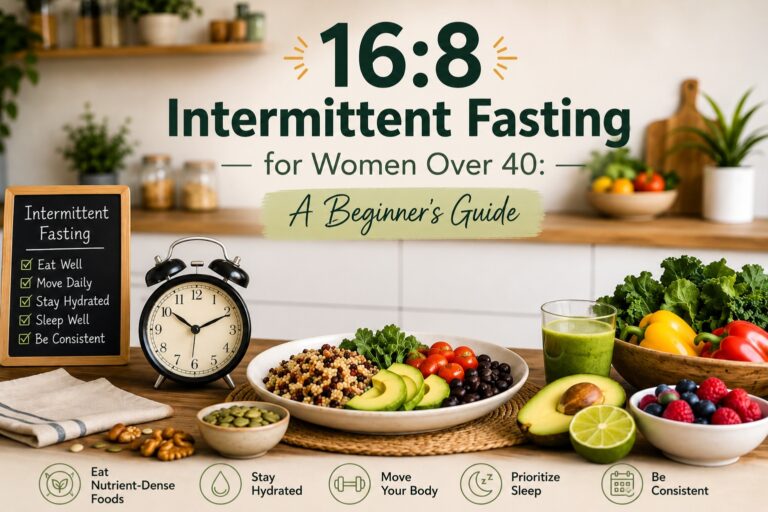
Intermittent Fasting for Women Over 40: A Smarter Way to Burn Fat
What exactly am I doing here?
I asked myself that one night, standing in my kitchen at nine o’clock, adding food to a body that clearly didn’t need it. Not because I was hungry. Because I was afraid of being hungry later, once the eating window closed and there’d be nothing I could do about it.
There is a study most people summarizing intermittent fasting never mention. Research on fasting protocols in perimenopausal women has found consistently that a 14-hour fasting window produces cortisol outcomes significantly better than the more popular 16:8, with comparable fat loss results. The explanation is hormonal: extended fasting is a physiological stressor, and in a body where estrogen is declining, that stressor no longer has the same buffer it once did. Sixteen hours, for many women over 40, crosses a line where fasting stops producing a fat-burning signal and starts producing a fat-storing one.
I wish I had known that before I started.
Intermittent fasting arrived in my life when everyone around me was doing it. Neighbors, friends, acquaintances: the protocol was everywhere, and the logic seemed almost too simple to question. Fast for sixteen hours, eat for eight, let the metabolic math do the rest. Eight hours of eating and the weight would take care of itself.
It sounded close enough to magic that I started the same week I heard about it. I even rearranged when I went to bed, going to sleep earlier than felt natural, so I could time the window correctly. I was going to do this right.
That was five months before I gained weight on it.
When the eating window finally opened each day, I wasn’t sitting down to a planned meal. I was eating from proximity. A boiled egg sitting on the counter, grabbed while still standing. A slice of bread. Some potato. Whatever was within arm’s reach went into my mouth before I’d even decided what I wanted for lunch. And then, an hour later, actual lunch. And then a snack. And then, in the part I still remember most clearly, I started watching the clock in reverse. Not counting down to when I could eat, but counting the time left before the window closed.
Two hours remaining. One hour. Thirty minutes.
By nine in the evening, that’s exactly where I’d land most nights, eating not because I was hungry but because I was afraid of being hungry at midnight. Filling space preemptively, watching myself do it with a kind of bewildered detachment I couldn’t quite explain at the time.
Five months of this. The scale moved the wrong direction. This post covers what I learned about intermittent fasting for women over 40 in the time that followed: why the standard protocol often produces the opposite result in a lower-estrogen body, what I changed, and what actually shifted.
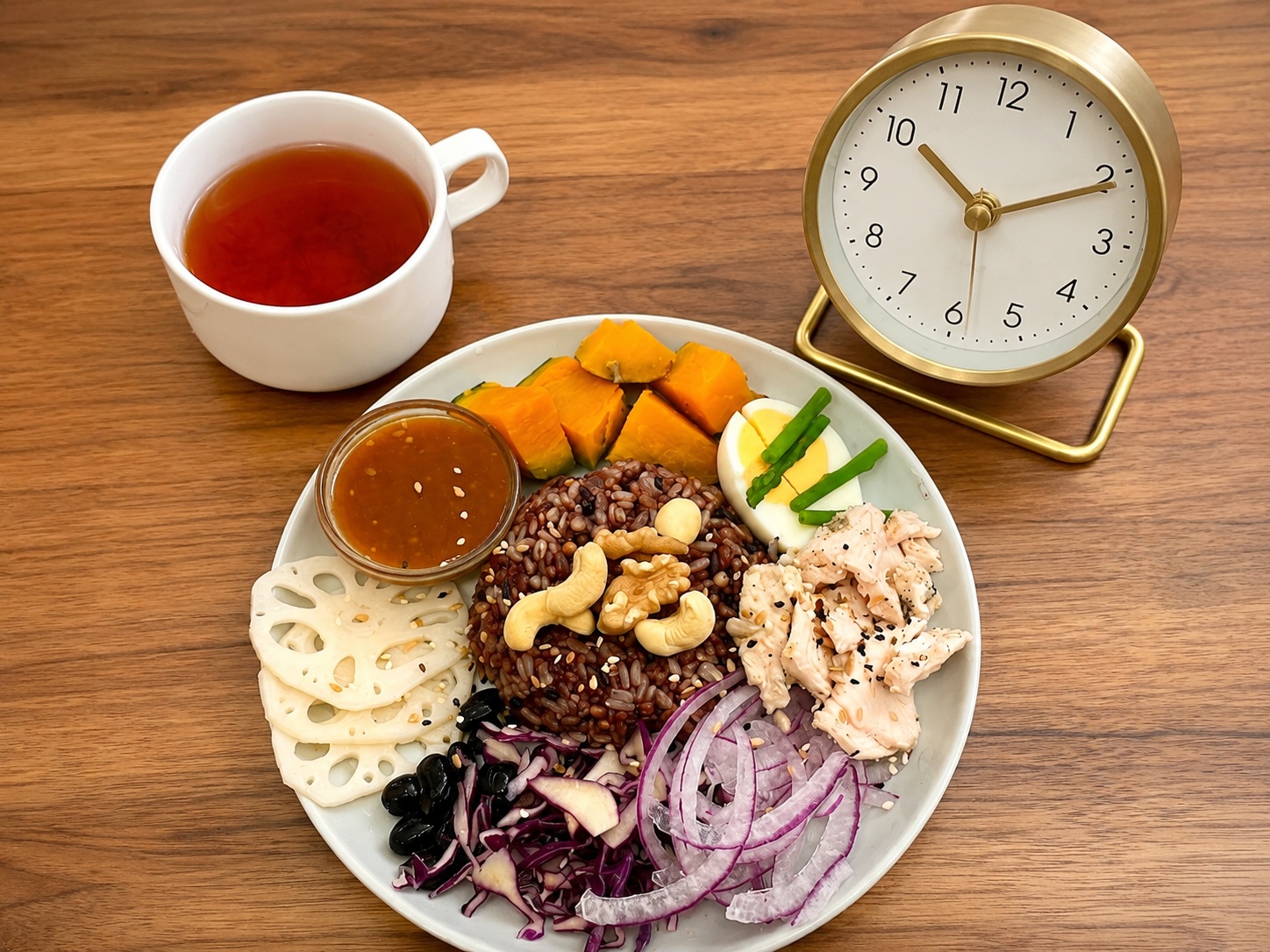
Why Intermittent Fasting for Women Over 40 Hits Differently
The mechanisms that make intermittent fasting work are real. Insulin drops during the fasting period. The body shifts toward fat oxidation. A cellular repair process called autophagy runs during the fasting hours as well. None of this is in question. What changes after 40 is the hormonal context those mechanisms are operating in, and that context changes everything about how the protocol feels and what it produces.
Before perimenopause, estrogen plays a moderating role in the body’s stress response. When you fast, cortisol rises to mobilize stored energy for the hours you’re not eating. In a hormonally balanced body, this cortisol response is proportionate: it rises, does its job, and drops. In women over 40, as estrogen declines and its cortisol-buffering influence weakens, the same fasting period can produce a stronger and more prolonged cortisol response than it would have a decade earlier.
In a low-estrogen environment, sustained cortisol elevation does something specific that runs directly counter to the goal: it promotes visceral fat storage. The hormonal system reads the elevated cortisol as a signal that resources need to be conserved and stored, particularly around the abdomen, where cortisol-sensitive fat cells are densest. The fat-burning signal the fasting was meant to create gets overridden by a fat-storing signal the prolonged cortisol creates.
This is also why the eating window feels chaotic when the cortisol response has been too high. It’s not a willpower problem. Cortisol-driven hunger isn’t negotiable. It arrives at full volume and it overrides planning. Women who describe feeling frantic and out of control when their eating window opens are describing a cortisol signal, not a character flaw.
The muscle dimension compounds this. Muscle mass declines by 3 to 5 percent per decade after 40, a process that the hormonal transition of perimenopause accelerates. Fasting without adequate protein in the eating window increases muscle protein breakdown. In an extended fast without enough dietary protein coming in, the body will draw on lean tissue for energy instead. Since muscle is the primary driver of resting metabolic rate, losing it makes every subsequent effort to lose fat harder. Women doing intermittent fasting without deliberately prioritizing protein are often losing the metabolic machinery that would have supported the fat loss they’re trying to achieve.
What the Research Shows: IF and Women Over 40
Five Months of Doing It Wrong: What It Actually Looked Like
The rearranged sleep schedule was the first signal I should have paid attention to. To hit the fasting window correctly, I was going to bed earlier than felt natural, creating a kind of low-level pressure around sleep that hadn’t been there before. I had turned sleeping into a tool for timing my fast, which says something about how rule-bound the whole thing had become before I’d even started.
But I kept going, because that’s what everyone said to do.
By month two, the eating window had developed a personality of its own. The moment it opened, something shifted: not calmly into hunger, but abruptly into urgency. The boiled egg grabbed standing at the counter. The bread. The potato. Not choices, exactly. More like a reflex. The rational part of my brain would observe this and register a confused kind of concern, but the body was already halfway through a second helping before the observation had any effect.
What I didn’t understand then was the cortisol explanation. A 16-hour fast in a lower-estrogen body drives cortisol high enough that by the time the eating window arrives, the body is in a state of genuine physiological urgency. The cortisol-driven appetite signal isn’t a preference. It doesn’t respond to reasoning. It shows up at full intensity and overrides intention. What I experienced as chaos in the eating window was, in retrospect, a predictable hormonal response to a fasting window that had become too long for my body at this stage.
The reverse countdown, watching the window close instead of watching it open, was the part that disturbed me most about my own behavior. By late evening I wasn’t eating because I was hungry. I was eating to preempt future hunger. Filling space that didn’t need to be filled, at nine in the evening, and feeling oddly distant from the whole thing. What exactly is this? What have I turned food into?
What the five months eventually produced was an answer: weight gain. Not stasis. An actual increase. The cortisol had been elevated. The visceral fat had been accumulating. The protocol had been working, just not in the direction I needed.
If This Pattern Sounds Familiar: Don’t Fast Longer
Frantic eating when the window opens, urgency and anxiety during fasting hours, weight that isn’t moving or is moving in the wrong direction despite strict adherence: none of these are signs of insufficient commitment. They are signs of a cortisol response that’s working against the protocol’s intended effect. Tightening the window or adding more fasting hours in response to these signals makes every one of them worse, not better.
The Cortisol Problem With 16:8 After 40
The reason 16:8 is the most commonly recommended intermittent fasting protocol is that it was developed and popularized based primarily on research in men and younger women, populations whose estrogen levels provide a cortisol-buffering function that women over 40 no longer have to the same degree. The protocol works differently in a different hormonal body. This isn’t a personal failure. It’s a mismatch between a protocol and the physiology it’s being applied to.
The mechanism is worth understanding clearly, because it explains why shorter windows work better rather than just asserting that they do. Fasting is a physiological stressor. Cortisol is the stress hormone the body uses to mobilize energy during that fast. A moderate cortisol response is exactly what produces the fat-burning benefit: it signals the body to access stored fat for fuel. The problem starts when the cortisol response becomes disproportionate to what the hormonal system can buffer.
In a lower-estrogen body, 16 hours regularly crosses that threshold. The cortisol doesn’t just rise and do its job; it stays elevated. And sustained cortisol in a low-estrogen environment activates cortisol receptors in visceral fat tissue, promoting fat storage in the abdominal area. The fasting period creates the conditions for fat burning; the cortisol response to that fasting period then overrides it. This is why women can follow 16:8 correctly for months and gain weight. The protocol and the hormones are working in opposite directions.
Fourteen hours avoids this. Research specific to perimenopausal women shows that 14:10 produces comparable fat loss outcomes with a cortisol response that stays in the productive rather than counterproductive range. The metabolic benefit difference between 14 and 16 hours of fasting is small. The cortisol difference is significant. That asymmetry is why 14:10 is where most women over 40 should start, not because 16:8 never works, but because it’s the place to begin before discovering what your particular body tolerates.
Eating window timing matters separately. Placing the window earlier, eating from 8am or 9am through 6pm or 7pm, aligns eating with the body’s peak insulin sensitivity in the morning and allows insulin to drop fully before sleep. IF structured around skipping breakfast and eating until 8pm means the body is handling significant insulin activity during the hours it should be recovering. The same 14-hour fast placed earlier in the day produces better outcomes than the same 14-hour fast placed later.
What I Changed Beyond the Clock
When I described what was happening to the neighbors and friends who were also doing IF, the answer was unanimous: give it time. The body adjusts. Just keep going.
Five months felt like time to me. I wasn’t looking for encouragement to continue. I was looking for an explanation: a reason why this particular approach was producing this particular result in my body. Not “push through it” but “here is the mechanism, and here is what to change.”
No one around me had that.
I made a decision that felt like an act of kindness toward myself. Slow down, I thought. Give more hours, not fewer. Not the rigid eight-hour window with sixteen hours of strict fasting: ten hours of eating time, fourteen without. Let the time between meals do the work, not the count.
The first shift was in the urgency. With ten hours available instead of eight, the countdown disappeared. I stopped eating from the counter before sitting down. The nine o’clock preemptive filling stopped, because there was no closing window to eat ahead of. The window no longer felt like a resource being rapidly depleted.
With the panic gone, I started noticing what I actually wanted. Vegetables first, not because I had decided to eat them first, but because there was time to think before eating. Protein started to feel important in a way it hadn’t when I was grabbing whatever was closest. The bread, the potato, the reflex eating: it all quieted down on its own, without a rule telling it to. The carbohydrates were still there, but they stopped being the first thing my hand reached for.
About three weeks in, I understood why. The cortisol was lower. The eating window wasn’t producing an urgency signal anymore. And without that constant hormonal pressure overriding intention, the food choices started shifting naturally toward what actually satisfied rather than what simply filled space.
The 14:10 Starting Point: What It Actually Looks Like
- Fasting window: 14 hours. Example: last meal by 7pm, first meal at 9am. Long enough to produce fat oxidation and meaningful autophagy; short enough to keep cortisol in the productive range for the lower-estrogen body
- Eating window: 10 hours. Enough time for three satisfying, protein-adequate meals without the urgency that compresses eating into a reactive rush
- Place the window earlier when possible. 8am–6pm or 9am–7pm aligns eating with the body’s peak insulin sensitivity and allows full insulin clearance before sleep
- On high-stress days or after poor sleep, shorten to 12 hours without guilt. A 12-hour fast still produces metabolic benefit. Adding the cortisol burden of a longer fast to an already-stressed system works against recovery
- 1–2 non-fasting days per week are not failures: they reduce the cumulative cortisol load of daily fasting and are a deliberate part of a sustainable approach
First Meal: The Order Matters More Than the Choice
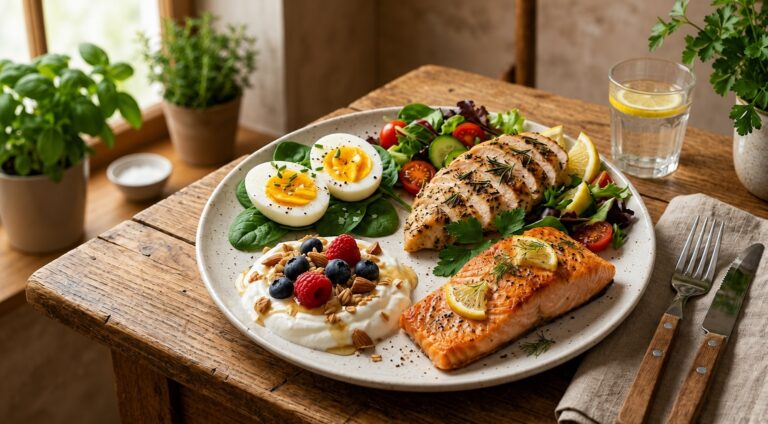
- 30–40g protein first, every time. This is the most impactful single variable. Protein at this level stimulates GLP-1 sufficiently to produce 3–4 hours of genuine satiety, which is what makes the rest of the window feel manageable rather than frantic
- Vegetables before carbohydrates. This sequence blunts blood sugar response and extends the feeling of fullness. It doesn’t require eliminating carbohydrates: it means they arrive after the fiber and protein, not before
- No juice, cereal, or bread as the first food. High-glycemic carbohydrates immediately after a fast spike insulin sharply, producing a blood sugar crash within 60 to 90 minutes that re-triggers hunger, erasing the low-insulin state the fast just created
- Wait 20 minutes before a second serving. Satiety signals from a protein-rich meal take 15 to 20 minutes to register fully. The urge to keep eating immediately is often a lag in signaling, not genuine ongoing hunger
Signs IF Is Working vs Hurting After 40
The difference between productive and counterproductive intermittent fasting is often visible in day-to-day experience before it shows up on a scale. These signals are worth paying attention to: they’re the body reporting what the protocol is actually doing, not what it’s supposed to do.
| IF Is Working | IF Is Working Against You |
|---|---|
| Stable, manageable energy during fasting hours | Hollow or shaky feeling most mornings that coffee doesn’t fix |
| Calm, genuine hunger when the window opens | Frantic, urgent eating the moment the window opens |
| First meal produces 3–4 hours of satiety | Hungry again within 60–90 minutes of the first meal |
| Sleep quality stable or improving since starting IF | Sleep getting noticeably worse since starting IF |
| Mood stable during fasting hours | Anxiety, irritability, or low-grade dread during the fast |
| Clothes fitting differently at 6–8 weeks | Weight unchanged or increasing with strict adherence |
| Food occupying normal mental space | Thinking about food more than before starting IF |
Three or more signals in the right column is not a reason to try harder or fast longer. It is a reason to shorten the window, restructure the first meal around protein, or take a deliberate break. A protocol that’s consistently producing the wrong signals doesn’t eventually produce the right results if you persist. The signals are information, not obstacles.
A Realistic IF Week for Women Over 40
What works isn’t a rigid daily protocol applied identically regardless of sleep, stress, or energy. It’s a flexible framework that adjusts to what the body is actually dealing with. This is what a realistic week looks like when the goal is sustainable practice rather than perfect adherence:
| Day | Window | Notes |
|---|---|---|
| Monday | 14:10 (9am–7pm) | Break fast with 30–40g protein. Vegetables before carbohydrates. Strength training within eating window if possible. |
| Tuesday | 13:11 (8am–7pm) | Slightly shorter window on more active days. Protein-forward first meal stays constant. |
| Wednesday | 14:10 (9am–7pm) | Electrolyte water first thing on waking (water + pinch of sea salt). Replaces sodium lost during the overnight fast and reduces morning fatigue. |
| Thursday | 13:11 (8am–7pm) | Strength or resistance training scheduled within eating window, not fasted. Hard exercise while fasted raises cortisol significantly. |
| Friday | 14:10 (9am–7pm) | Standard window. Check sleep quality: it’s the most reliable indicator of whether the week’s fasting has been within productive range or over it. |
| Saturday | Non-fasting | Eat at natural meal times without restriction. Social eating. This is not a cheat day: it’s a deliberate reduction in cortisol load and an important part of the long-term approach. |
| Sunday | 12:12 (8am–8pm) | Light window. Early dinner to support full insulin clearance before sleep. Preparation for a sustainable Monday. |
Frequently Asked Questions
Is 16:8 too aggressive for women over 40?
For many women in perimenopause or postmenopause, yes, not universally, but commonly enough that 16:8 should not be the default starting point. The 16-hour window produces a cortisol response that, without adequate estrogen to moderate it, can drive visceral fat storage rather than fat burning, disrupt sleep, and create the frantic eating pattern that makes the eating window feel impossible to manage calmly. Starting at 14:10 and assessing your cortisol signals (energy stability, sleep quality, hunger intensity when the window opens) before considering any extension is a more rational approach than jumping directly to 16:8 because it’s the most commonly cited protocol.
Why am I hungrier during IF than I was before I started?
Almost always, the fasting window is producing a cortisol response that’s driving appetite beyond genuine calorie need. Cortisol-driven hunger doesn’t reflect an actual energy deficit: it reflects the hormonal system responding to perceived physiological stress. The fix is not eating less or fasting through it. The fix is shortening the window to 13 or 14 hours, restructuring the first meal around 30 to 40 grams of protein (which stimulates GLP-1, the hormone that actually signals satiety), and assessing whether the hunger drops in the first two weeks. If it doesn’t, the window may still be too long for your current cortisol baseline.
Can I lose fat with only a 14-hour fasting window?
Yes. The research shows comparable fat loss outcomes between 14:10 and 16:8 in perimenopausal women, with significantly better cortisol outcomes for the shorter window. The mechanism that produces fat loss during IF (reduced insulin, increased fat oxidation, autophagy) operates meaningfully at 14 hours. The difference in metabolic effect between 14 and 16 hours is small. The cortisol difference is not. Chasing a longer window in the belief that more fasting hours produce proportionally more fat loss is not supported by what the research shows for this population.
What should I eat first when I break my fast?
Protein, in the range of 30 to 40 grams, before anything else. This is the most impactful single variable in determining whether the eating window feels calm and satisfying or urgent and chaotic. Protein at this level stimulates GLP-1 release, which produces genuine satiety that lasts 3 to 4 hours. High-glycemic carbohydrates as a first food (juice, cereal, bread, fruit) spike insulin immediately after the fasted low-insulin state, producing a blood sugar crash within 60 to 90 minutes that re-triggers hunger. The order matters as much as the choice: protein and vegetables first, carbohydrates later in the meal.
How long before IF produces visible results after 40?
IF works in layers, and they don’t all show up at once, they run in sequence. The first is the hunger hormone reset, ghrelin and cortisol settling into the new eating window. That’s usually two to three weeks in, and you’ll know it’s happening when the urgency at window-open starts to fade. The second layer is insulin sensitivity shifting, and it can’t really get going until the first one has settled, which puts it somewhere around four to six weeks. Fat oxidation, the actual metabolic shift IF is built to produce, is the third layer, and it depends on the first two being in place. Expecting visible fat loss before those earlier layers have stabilized is a bit like asking the third floor to hold weight before the foundation’s finished. If nothing’s shifted by eight weeks, the real question usually isn’t how much longer to wait, it’s which layer still hasn’t settled.
Food has been part of how most of us have connected with people our whole lives: with parents, with friends, with the families we’ve built. The way we eat carries a long history. Changing that relationship doesn’t happen in a few months, and eating perfectly every single day isn’t a realistic goal for any real person navigating a real life. The direction matters more than the perfection. If you’re somewhere on this path, still adjusting, still figuring out what your body responds to, I’d like to hear where you are. Leave a comment below.
Medical Disclaimer: This post is for informational purposes only and does not constitute medical advice. Intermittent fasting is not appropriate for everyone. Please consult your healthcare provider before beginning any fasting protocol, particularly if you have a history of disordered eating, thyroid conditions, diabetes, or adrenal dysfunction.

Grace Young is the founder of LoseFatAfter40Now.com. She spent five months following intermittent fasting correctly and gaining weight, before understanding that the protocol and the hormonal context it operates in are two entirely different variables. Everything on this blog comes from working through that the hard way. Read Grace’s full story →