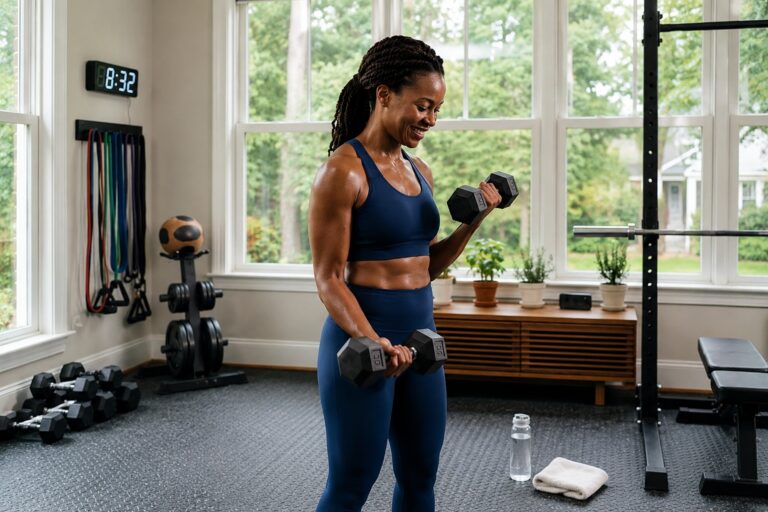
Strength Training vs Cardio for Women Over 40: Which Burns More Fat?
The morning after my first resistance band session (squats and hip hinges, nothing dramatic), I came downstairs holding the railing. Not from pain. My hamstrings registered every single step going down in a way they had never done after a walk or a cycling session.
Standing at the kitchen counter, I reached for a mug and noticed my upper back. Faintly. Still processing something from yesterday.
Three years of walking, cycling, and occasional jogging, and my body had never responded like this the morning after a session. I had expected the flat, finished exhaustion I associated with a good workout after 40. This was different. Not depleted. Closer to muscles being surprised they had been asked to do something at all, and still working through what that meant.
I had spent those three years treating cardio as my main strategy. More steps, more cycling, longer sessions. When I finally looked honestly at the research on strength training vs cardio for women over 40, I understood why the math had stopped working. I was asking one type of exercise to handle every metabolic job it was never designed to do alone.
This post works through that difference, from the science and from what I learned the hard way, not to declare a winner, but to explain why the two types of exercise do fundamentally different things inside a post-40 body — and why that changes everything about how to structure them.

Why Women Over 40 Keep Getting Half the Exercise Equation Wrong
The problem rarely starts with not exercising enough. Most women who aren’t seeing results from exercise are doing quite a lot: walking every day, cycling a few times a week, occasional jogging. By any reasonable definition, active. The results don’t match the effort, and that gap becomes confusing, sometimes demoralizing, because the logic of the approach seems completely sound.
The default assumption (that more exercise produces more results) comes from a time when it was more or less true. Before estrogen levels begin declining in perimenopause, the hormonal environment quietly supports fat distribution, insulin sensitivity, and stress recovery in ways that make standard cardio advice work reasonably well. Move more, the body responds.
After estrogen declines, that equation stops balancing. Fat storage shifts preferentially toward the abdomen. Insulin sensitivity decreases, so meals that were metabolically manageable at 35 produce larger blood sugar swings at 45. Cortisol, which estrogen used to moderate, runs with less regulation. And muscle mass, eroding quietly since the mid-30s, begins to affect resting metabolic rate in a way that makes caloric balance progressively harder to maintain.
None of this makes cardio wrong. It makes cardio insufficient on its own. It also makes resistance training not an optional upgrade but a metabolic necessity, because only one of these two approaches directly addresses muscle preservation, the variable that underlies almost everything else after 40.
What Changes After 40 That Shifts the Exercise Equation
- Estrogen declines: Fat storage moves from the lower body toward the abdomen; cortisol buffering weakens; bone density protection decreases
- Muscle loss accelerates: Without deliberate resistance stimulus, 3 to 5 percent of muscle per decade lowers resting metabolism steadily
- Insulin sensitivity shifts: The same meals that were metabolically routine at 35 may produce larger fat-storing insulin responses at 45
- Recovery changes: The body needs more time between intense sessions; long high-intensity cardio becomes a stress signal rather than a recovery tool
What Cardio Delivers, and Where the Research Stops Supporting It
Cardio deserves its reputation for specific things. The research on regular aerobic exercise and cardiovascular health is consistent and strong. Walking, cycling, swimming, and moderate jogging all reduce the risk of heart disease, support circulation and lung function, and have well-documented effects on mood and sleep quality. According to Mayo Clinic, regular aerobic activity also reduces blood pressure, improves blood sugar regulation, and contributes to longevity markers meaningfully. None of that changes after 40.
The issue is not what cardio does. It is what cardio is being asked to do alone, and where the evidence stops backing it up for body composition after 40.
Moderate steady-state cardio burns calories during the session. When the session ends, metabolism returns close to baseline within an hour or two. There is no meaningful post-exercise caloric elevation. For younger women with higher baseline muscle mass, this matters less because the resting metabolism is higher to begin with. For women over 40 who have been losing muscle for a decade, doing cardio without addressing muscle means burning calories at a rate that is already declining, and doing nothing to slow that decline.
Cardio produces essentially zero muscle hypertrophy. It is not designed to. But for women after 40 whose primary fat-management challenge is declining muscle mass and its metabolic consequences, cardio addresses a symptom without touching the mechanism underneath.
Long sessions (45 minutes or more at moderate-to-high intensity) also raise cortisol, the stress hormone that in a low-estrogen environment promotes visceral fat storage. Women doing daily long cardio faithfully and finding that belly fat is the last thing to change are often experiencing exactly this pattern, without knowing the mechanism behind it.
What Resistance Training Does That Cardio Simply Cannot
When the question of strength training vs cardio for women over 40 focuses only on calories burned per session, it misses the mechanisms that actually drive body composition change over months. Resistance training addresses those mechanisms at the source in a way cardio does not.
The effects that matter most for women after 40 are these.
Muscle preservation and growth. This is the most important metabolic intervention available after 40. Each pound of muscle maintained through strength training burns additional calories at rest. More critically, preserving muscle mass protects the resting metabolism from the decline that makes weight management progressively harder through the 40s and 50s. Cardio does not provide this protection.
Extended post-exercise metabolism. Unlike cardio, resistance training elevates resting metabolism for 24 to 48 hours after each session as the body repairs and rebuilds muscle tissue. With three sessions per week, that elevation is nearly continuous between sessions. The total caloric effect over a week frequently exceeds what the sessions themselves burn during training.
Superior insulin sensitivity improvement. Both exercise types improve insulin sensitivity, but resistance training produces larger and longer-lasting effects. Glucose uptake during and after muscle contractions provides a direct mechanism for blood sugar regulation, particularly relevant for the post-40 insulin resistance pattern that makes visceral fat harder to shift.
Bone density protection. Estrogen’s decline accelerates bone density loss significantly after menopause. Resistance training is the most effective exercise-based intervention for preserving bone mineral density, addressing a concern driven by the same hormonal changes that affect fat storage.
What the Research Shows
Strength Training vs Cardio: Same 40 Minutes, Opposite Metabolic Results
The strength training vs cardio comparison changes completely once single-session calorie burn is removed from the center of the analysis. The following table reflects what research in postmenopausal women actually shows across the outcomes that drive fat loss, muscle preservation, and metabolic health over time.
| Outcome | Cardio (40–45 min) | Resistance Training (35–40 min) |
|---|---|---|
| Calories burned during session | Higher (during only) | Lower during session |
| Post-exercise metabolic elevation (EPOC) | Minimal (1–2 hrs) | Elevated 24–48 hours |
| Muscle preservation or gain | None | Direct and significant |
| Visceral fat reduction (postmenopausal) | Moderate | 3x greater in RCTs |
| Insulin sensitivity improvement | Moderate | Superior and longer-lasting |
| Cortisol impact (long sessions) | Raises cortisol | Manageable in 35–40 min |
| Bone density protection | Minimal | Significant preservation |
| Resting metabolic rate (long-term) | No meaningful change | Increases with muscle maintenance |
The Cortisol Mechanism Most Fitness Articles Skip
This is the piece that explains why women who do cardio faithfully after 40 sometimes find that belly fat is the last thing to change, or that it stubbornly persists despite consistent exercise.
After estrogen declines, that cortisol buffer weakens — the mechanism is detailed in Cortisol and Belly Fat After 40 →. Cortisol spikes higher and stays elevated longer in response to the same stressors, including long cardio sessions.
The connection to abdominal fat is direct. Cortisol signals the body to store fat preferentially in the visceral area around the abdomen and internal organs. In a low-estrogen environment, a 45- to 60-minute moderate-intensity cardio session can produce a cortisol elevation that, repeated daily, tips the fat-storage balance in exactly the wrong direction. Women in this pattern are not doing anything logically wrong. They are working with an incomplete picture of what changed underneath the exercise.
Resistance training also raises cortisol temporarily during a session. But the acute cortisol of a 35-minute resistance session is followed by anabolic processes (muscle repair and growth) that produce net metabolic benefit. The extended moderate elevation from long daily cardio does not produce this recovery benefit in the same way.
Watch for This Pattern
If you are doing cardio five or more days per week for 45-plus minutes, consistently feeling depleted after sessions rather than energized, experiencing increased appetite especially in the hours after training, and not seeing body composition change despite consistent effort, the cortisol pattern may be the explanation. Reducing session duration and adding resistance work two or three times per week often shifts this within four to six weeks.
The First Change I Noticed Was Not My Weight
The year I was doing cardio consistently without meaningful body composition change, I was not exercising carelessly. I was walking 45 minutes most mornings, cycling twice a week, paying attention to what I ate. By any reasonable measure, I was doing the right things. The body was not cooperating.
When I added resistance band work (squats and hip hinges to start, twice a week, then three times), I did not expect a dramatic shift in how I felt day to day. I expected muscle soreness and longer recovery. What I did not expect was how different the day felt after a resistance session compared to after cardio.
After a cardio session, the feeling was a familiar flat finish. The session was over and the body knew it. Often hungry immediately. Energy that started okay and dropped by early afternoon. The workout had cost something, and the rest of the day ran slightly behind from it.
After a resistance session, something was still in motion. Coming downstairs the next morning with hamstrings that registered every step going down. Reaching for something overhead and noticing the shoulder blades briefly. Drying my hair and feeling the back of my arms — not the kind of awareness that has anything to do with appearance, only with activation. Not pain in any worrying sense. Closer to the difference between a room that had been used and a room that hadn’t been opened in a long time. Something was running in there again.
Six weeks in, two things shifted before the scale registered anything meaningful. First, the afternoon held better on days following a resistance session. Not every day, not dramatically, but consistently enough that I stopped dreading the 10 o’clock dip. Second (and this took a few weeks to name): the workout stopped taking from the rest of the day and started supporting it. That reversal came before any change in how clothes fit. It was the first real signal that something different was happening in my body.
The body composition changes came after. A waistband that had been consistently snug for two years started sitting differently. The first time I noticed, I thought I had washed the jeans differently. The second time, I understood. These were not the first changes. They were confirmation of changes the scale had not been measuring.
What to Expect in the First 6 to 8 Weeks
- Weeks 1 to 2: Muscle soreness after sessions is normal and confirms that muscles are being challenged. Energy may fluctuate as the body adapts to a new stimulus.
- Weeks 3 to 4: Recovery between sessions improves noticeably. Soreness becomes more specific rather than general. Functional changes (how stairs feel, how the body moves through a day) often appear before visual ones.
- Weeks 5 to 8: Metabolic benefits begin compounding. Insulin sensitivity improvements become consistent. Changes in how clothes fit often arrive before meaningful scale movement.
- What the scale may not show: Fat loss and muscle gain can occur simultaneously, producing little change in total weight while body composition shifts significantly. This is recomposition, not a plateau.
How to Combine Both Without Undermining Either
For women working through the strength training vs cardio question after 40, the evidence does not support eliminating cardio. It supports restructuring the roles each type of exercise plays. The structure the research consistently points to: resistance training as the metabolic foundation, cardio in a supporting role appropriate to its actual strengths.
Resistance training three times per week provides the muscle preservation signal, the insulin sensitivity improvement, and the bone density protection that the post-40 hormonal environment requires. Sessions do not need to be long. Thirty-five to forty-five minutes with adequate intensity and consistent progressive challenge is sufficient.
Daily walking (30 minutes or 7,000 to 10,000 steps) provides genuine cardiovascular and metabolic benefits of low-intensity aerobic activity without the cortisol burden of extended high-intensity sessions. This form of cardio is one of the most consistently supported interventions in the research on women over 40, and it belongs in the routine regardless of what else is happening.
Higher-intensity cardio (HIIT or brisk intervals) can be included once per week at 20 to 25 minutes. Short enough to produce the cardiorespiratory and EPOC benefits of high-intensity work without the extended cortisol elevation that longer steady-state sessions generate.
A Weekly Structure That Works
- Resistance training: 3 sessions per week, 35 to 45 minutes each. Compound movements covering lower body, upper body, and core. Increase resistance gradually over weeks as movements become consistent.
- Daily walking: 30 minutes or 7,000 to 10,000 steps. Low intensity, consistent, and cortisol-lowering rather than cortisol-raising.
- HIIT or intervals: 1 session per week, 20 to 25 minutes maximum. A complement to the resistance foundation, not a replacement for it.
- Long steady-state cardio: Optional. If you enjoy it, include it. Stop depending on it as the primary fat-loss tool.
- Recovery: At least one full rest day between resistance sessions. Sleep and recovery are not interruptions to the training plan. They are part of it.
Frequently Asked Questions
Should I stop doing cardio entirely after 40?
No. The evidence supports restructuring cardio’s role, not eliminating it. Daily walking is one of the most consistently beneficial activities for women over 40 and should be a baseline for everyone. The recommendation is to stop relying on long daily sessions as the primary fat-loss strategy. Build resistance training as the foundation, keep daily walking consistent, and add higher-intensity cardio sparingly as a complement.
Is strength training more important than cardio for women over 40?
For body composition specifically, yes. Strength training directly addresses the mechanisms that change after estrogen declines: muscle loss, insulin resistance, bone density, and resting metabolic rate. Cardio does not address these at the same level. For cardiovascular health and longevity broadly, both matter. The most practical framing: resistance training is the metabolic foundation after 40, and cardio fills a supporting role.
Which type of exercise is better for belly fat specifically?
Resistance training produces significantly greater visceral fat reduction in postmenopausal women than equivalent time in aerobic exercise, based on current research in this population. The mechanism is the combination of improved insulin sensitivity, lower cortisol burden relative to long cardio sessions, and the metabolic effect of preserving or building muscle tissue. Daily walking alongside strength training produces better outcomes than long cardio sessions alone.
What should I do if I consistently feel exhausted after workouts rather than energized?
Consistent exhaustion after exercise is worth paying attention to. It often indicates sessions are too long, too frequent, or too intense relative to current recovery capacity, which matters more after 40 than it did at 30. The most common fixes: reduce session duration before reducing frequency, ensure adequate protein in the hours around training, and treat sleep as a non-negotiable part of the training plan. Fatigue that does not improve with rest warrants a conversation with your healthcare provider.
Where should a complete beginner start with resistance training?
Start with resistance bands or bodyweight and focus on learning movement patterns before adding load. The foundational movements are squats, hip hinges, rows, push-ups (wall or modified), and a simple overhead press motion. Three sets of 10 to 12 repetitions, three times per week. The first four to six weeks are about establishing the habit and practicing form with control. The focus in those early weeks is consistency, not intensity. Progress follows from gradual overload added over months.
When you think about your own exercise history after 40, what was the first thing that actually changed when you shifted something? Share in the comments. Those observations are often more useful than anything in a study.
The Bottom Line
After 40, the problem is rarely that women are not exercising enough. More often, it is that they are asking one type of exercise to manage every metabolic job: burning calories, handling stress hormones, preserving muscle, protecting bone, and compensating for hormonal changes it was never designed to fix on its own.
Cardio does real things. But without resistance training as a foundation, the engine driving muscle loss and fat storage keeps running in the wrong direction regardless of how faithfully the cardio is done. Adding strength training three times per week, keeping daily walking as the low-intensity baseline, and treating long cardio sessions as optional rather than essential is the structural shift the research consistently supports for women comparing strength training vs cardio after 40.
The first change rarely shows up on a scale. It shows up in how the body handles a full day: the energy through the afternoon, the recovery, the sense that yesterday’s work is still doing something today. That shift comes before anything the tape measure confirms, and understanding it is what separates months of frustration from months of measurable progress.
Medical Disclaimer: This post is for informational purposes only and does not constitute medical advice. Consult your healthcare provider before beginning any new exercise program, particularly if you have existing health conditions or injuries.

Grace Young is the founder of LoseFatAfter40Now.com. With a Master’s in Education and doctoral coursework in health education, she spent years studying what actually changes in women’s bodies after 40, and what the research says about addressing it practically. Her goal: give women the real mechanism behind what is happening, not just another list of things to try. Read Grace’s full story →