Best Protein Powder for Women Over 40 (Honest Reviews)
I didn’t believe in protein powder for a long time. Not because I’d tried it and disliked it, but because I never thought I needed it. I ate what looked like a reasonable dinner most nights, and reasonable felt like enough. It wasn’t until I actually looked at what “reasonable” meant, one plate at a time, that I understood why I kept hearing the same advice about protein and kept ignoring it. Somewhere in that process I finally understood what the best protein powder women over 40 actually needs to do, and it isn’t what the tub labels promise.
This guide to the best protein powder women over 40 isn’t a ranked list of products with links to click. It’s what I actually learned about reading a label, what each type of protein powder is actually good for, and the exact evening that made me stop guessing and start counting.
The Signs You Might Be Short on Protein
I want to start here instead of with a product, because for years the signals were right in front of me and I filed every one of them under something else.
Afternoon hunger that shows up around 3pm no matter how much lunch I’d eaten. A grip that felt a little less certain opening jars. Recovery from a walk that took longer than it used to. None of these felt dramatic enough on their own to investigate. I blamed the afternoon slump on being busy, the jar thing on cheap lids, the slower recovery on getting older, full stop, no further questions.
Looking back, all three were pointing at the same thing. Protein does more than build muscle after 40. It steadies blood sugar between meals, it’s the raw material your body pulls from to maintain the muscle you already have, and a shortfall shows up first in small, easy to dismiss ways before it shows up anywhere you’d actually notice on a scale.
THREE NUMBERS THAT REFRAME THIS
Why “Eating Pretty Well” Still Leaves You Short
Here’s the evening that made this real for me instead of theoretical. I’d had a long day, wasn’t especially hungry, and put together what felt like a perfectly sensible dinner: a quarter block of tofu, one egg, fried in a little oil, with vegetables on the side. It looked like food. It looked like enough. I sat down, ate it, and didn’t think about it again until a few nights later when I actually added it up.
A quarter block of tofu is roughly 80 grams, which comes to about 7 grams of protein. One egg adds another 6 grams or so. That dinner, the one that felt entirely reasonable, had somewhere around 13 grams of protein in it. For a woman my age aiming for 90 to 100+ grams across the day, one meal had just used up roughly an eighth of the target, and it was supposed to be a full dinner.
Nobody eats badly on purpose. What actually happens is more specific and harder to catch: the volume of food matches how full you feel, but volume and protein content aren’t the same thing at all. Vegetables, rice, a modest piece of tofu, a single egg, all of that fills a plate without filling a protein requirement.
The Mechanism: Why the Bar Moves Up After 40
Muscle protein synthesis becomes less efficient with age, a phenomenon researchers call anabolic resistance. The same 20 grams of protein that triggered a strong muscle-building response at 25 produces a smaller response at 45. There’s also a leucine threshold involved: you generally need somewhere around 2.5 to 3 grams of leucine in a single meal to meaningfully trigger that response, and older muscle needs more of it, not less, to get the same signal. A 2018 study in Nutrients found that women meeting a higher protein threshold of about 1.1g per kg of bodyweight showed measurably better physical function than those at the standard RDA (source), a finding consistent with an earlier Nutrients review recommending 1.0-1.3g/kg/day for older adults (Nowson & O’Connell, 2015). This is a big part of why the daily target for women over 40 climbs above the standard RDA, and why spreading adequate protein across three or four meals matters as much as the daily total. I’ve written more about the mechanics of this in how much protein women over 40 really need, including the synthetic resistance research behind it.
This is where protein powder earns its place. Not as the main event, but as a fast way to close a 15 to 25 gram gap on a day when whole food alone isn’t going to get there, especially at breakfast when time is shortest.
How to Actually Read a Protein Powder Label
Before the tofu-and-egg dinner, I’d already had a separate lesson in a Costco aisle. I stood in front of the protein powder section for a good twenty minutes, looking at a wall of tubs, most of them promising something in bold letters on the front. I didn’t know what any of the words actually meant, so I picked the one I recognized, a blue tub with a cow printed on it, and put it in the cart without turning it around once.
That tub sat in my kitchen for weeks before I finally read the back instead of the front. Here’s what actually matters, in the order I check it now.
Protein Per Serving vs. Scoop Size
Look at how much of the scoop weight is actually protein. A 35 gram scoop that delivers 30 grams of protein is doing its job. A 40 gram scoop delivering 20 grams of protein is mostly filler, and the front of the tub will never tell you that directly.
Ingredient List Length
The first ingredient should be the protein source itself. A short list is a good sign. Twenty-plus ingredients, most of them stabilizers and flavor compounds, usually means the manufacturer is compensating for a lower-quality protein base with taste engineering.
Added Sugar
Under 5 grams per serving is a reasonable line. Some flavored powders carry 8 to 12 grams of added sugar, which quietly works against the blood sugar stability protein is supposed to help with in the first place.
Third-Party Testing
This is the one I skipped for the longest. NSF Certified for Sport or Informed Sport on the label means an independent lab has actually verified what’s in the tub matches what’s printed on it. Supplement labeling in general is lightly regulated, so this matters more than it sounds like it should.
“Proprietary Blend”
If a label lists a total blend weight with no individual amounts, that’s a red flag on its own. There’s no good reason a quality protein powder needs to hide its actual composition behind a combined number.
The Best Protein Powder Women Over 40 Should Try, by Situation
Once I understood what to look for, the category itself mattered less than matching the type to what I actually needed it for. There isn’t one single best protein powder women over 40 that works for everyone; there’s a right category for each situation.
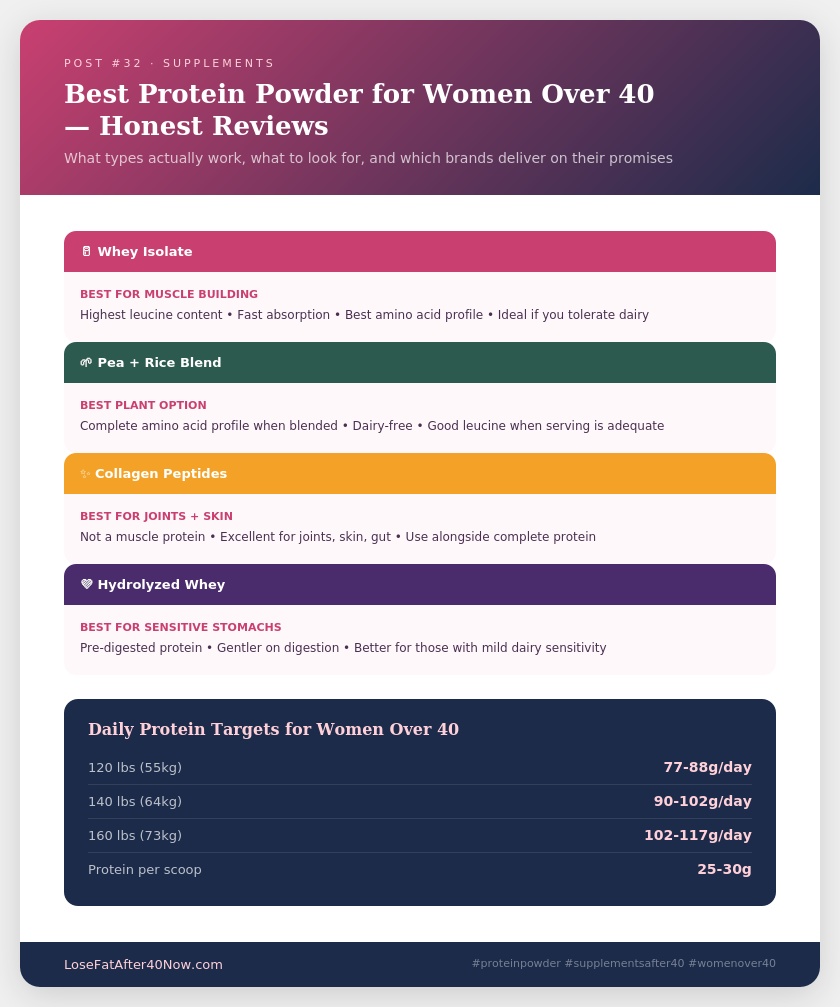
Whey Isolate — For Most Women Who Tolerate Dairy
Whey isolate is processed to strip out most of the lactose and fat, leaving something closer to 90% pure protein by weight. Look for 25 to 27 grams of protein per serving, under 130 calories, and under 3 grams of sugar. Isolate mixes cleanly into yogurt or oatmeal without the grainy texture that concentrate sometimes has, and the lower lactose load makes it the better starting point for anyone who’s had mild dairy sensitivity in the past.
Pea + Rice Blend — For Dairy-Free or Plant-Based
No single plant protein has a complete amino acid profile on its own. Pea protein runs low on methionine, rice protein runs low on lysine, so a blend of the two fills in what either one is missing alone. Look for at least 2.5 grams of leucine per serving; below that, the muscle protein synthesis response drops off noticeably regardless of the total protein number on the front.
Hydrolyzed Whey or Casein — For Sensitive Stomachs
If isolate still causes bloating, hydrolyzed whey has been pre-broken into smaller peptides that digest faster and gentler for most people. Casein sits at the opposite end: it digests slowly over several hours, which makes it a reasonable option before bed, though it’s a different tool than a fast-absorbing morning shake.
Collagen — A Supporting Player, Not a Substitute
Collagen is missing tryptophan entirely and doesn’t drive muscle protein synthesis the way whey or a good plant blend does, so it shouldn’t be anyone’s main protein source. What it does have is decent evidence for joint comfort and skin elasticity in women over 40 when taken consistently. I use it alongside a real protein source, not instead of one.
Comparison at a Glance
| Type | Protein/serving | Best for | Watch for |
|---|---|---|---|
| Whey isolate | 25-27g | Most women, fast morning routine | Mild dairy sensitivity |
| Pea + rice blend | 20-25g | Dairy-free, vegan | Leucine under 2.5g/serving |
| Hydrolyzed whey | 25-27g | Digestive sensitivity to regular whey | Higher price point |
| Casein | 24-25g | Slow overnight release | Not for fast post-meal use |
| Collagen | 9-11g | Joint/skin support only | Not a complete protein |
What I Actually Do Now
A few weeks after the tofu-and-egg dinner, I went back to that same Costco aisle. This time I didn’t reach for the blue tub out of familiarity. I turned three different tubs around, checked the protein-per-scoop math, checked for a certification mark, and compared sugar content between two of them. And then I put all three back and left without buying anything.
That’s the part I didn’t expect. The first time I actually knew what I was looking at, there wasn’t a clear winner in front of me yet, so I didn’t guess. I went home, planned my mornings for the week around real food first, and came back the following week once I knew exactly what gap I needed the powder to fill. That was the first time in years I’d trusted a number over a label instead of the other way around.
The routine that eventually stuck is plain: one scoop of whey isolate stirred into plain Greek yogurt most mornings, which gets me to roughly 42 to 45 grams of protein for breakfast in under three minutes. On days I want joint support, a scoop of collagen dissolves into my coffee with no taste change at all. That’s it. No shakes at every meal, no elaborate stacking of five different powders.
Mistakes I Made First
A few assumptions cost me time before I got here, and they’re common enough that naming them directly is probably more useful than another product description.
What Didn’t Actually Help
- Trusting the front of the tub. The cow on the blue container told me nothing about protein-per-serving or sugar content. Everything useful was on the back, in smaller print.
- Assuming “more protein” always means more benefit. Once you’re consistently hitting your daily target, extra powder mostly gets used as fuel or excreted. One or two scoops a day on top of food is enough for almost everyone.
- Thinking a full plate meant a full protein day. The tofu-and-egg dinner looked complete. It had roughly a third of what a single dinner should carry.
- Believing collagen could replace my main protein source. It’s a legitimately useful add-on for joints and skin. It isn’t a stand-in for whey or a plant blend.
Keeping the Gap From Coming Back
The habit that’s kept this from sliding back is small: I track what I eat for three days, maybe twice a year, nothing ongoing or obsessive about it. Three days is usually enough to see whether breakfast, lunch, or dinner is the meal quietly running low, and it’s the same three-day check that caught the tofu-and-egg dinner in the first place.
If a three-day check turns up a consistent 15 to 20 gram shortfall at one particular meal, that’s the meal to add powder to, not every meal by default. The goal isn’t to drink protein shakes constantly. It’s to notice which single meal keeps coming in low and fix that one.
Frequently Asked Questions
Do I actually need protein powder, or can I get enough from food alone?
Food alone is entirely possible if you’re consistently eating protein-dense meals like eggs, Greek yogurt, chicken, fish, or tofu in larger portions than a quarter block. Protein powder is a shortcut for the days real food doesn’t cover the gap, not a requirement.
Is whey isolate or whey concentrate better for women over 40?
Isolate is the better starting point for most people because it strips out most of the lactose that causes bloating in concentrate. If you have zero dairy sensitivity, concentrate is cheaper and works fine too.
How much protein powder is too much?
Once your total daily protein reaches your target, typically 90 to 100+ grams for most women over 40, additional powder adds little extra benefit. One to two scoops a day layered on top of food is the useful range for nearly everyone.
Can protein powder cause weight gain?
Protein itself doesn’t cause fat gain any more than the same protein from chicken would. Some flavored powders carry enough added sugar to matter over time, which is exactly why checking the sugar line on the label is worth the extra ten seconds.
Is collagen worth adding if I’m already using a protein powder?
If joint comfort or skin elasticity are goals, yes, collagen is a reasonable daily add-on. Just don’t let it replace your main protein source, since it lacks a complete amino acid profile on its own.
Have you ever added up a meal you thought was “healthy enough” and been surprised by the number? Tell me what you found in the comments.
The Bottom Line
If you take one thing from this guide to the best protein powder women over 40, let it be this: I spent years assuming a full-looking plate meant a full protein day. It took one specific dinner, tofu and an egg, to show me that volume and protein content aren’t the same measurement at all. Protein powder didn’t fix that by itself. Reading a label instead of trusting the front of the tub is what actually changed things, and the powder just made the fix easy to repeat.
Start by checking one meal for three days. If a gap shows up, whey isolate is the simplest place to close it for most women, a pea and rice blend if you’re dairy-free, and collagen as a genuine add-on rather than a main event. The number on the back of the tub matters more than the picture on the front.
Medical Disclaimer: This post is for informational purposes only and does not constitute medical advice. Consult your healthcare provider before making significant changes to your diet, especially if you have kidney concerns or another existing condition.