Best Dumbbells for Home Gym — Women Over 40 Guide
I didn’t read a single review before I bought my first dumbbells.
Ratings didn’t matter to me. Brand names didn’t matter either. I only wanted to know one thing, the same thing I think most women actually want answered when they search for the best dumbbells for women over 40: would I still be using them in three months. So for the first week I did something a little strange — I deliberately rotated between every type I could get my hands on. I pulled out adjustable dumbbells, then switched to fixed ones, changed the handle thickness, and forced myself to swap weights mid-workout just to see what that felt like in practice.
On paper, every option looked nearly identical. In my actual living room, they were nothing alike.
What surprised me wasn’t the weight itself. It was the process of getting the dumbbell into my hands. Twisting a dial, resetting a pin, putting the pieces back on a tray — those few seconds between sets felt bigger than they had any right to.
At first I brushed it off as nothing. But after a day, then a week, that small friction started turning into “maybe I’ll skip today.” That’s when I understood something no spec sheet had told me: the best dumbbells for women over 40 aren’t the heaviest ones on the shelf. They’re the ones you actually reach for.
This guide walks through exactly what happened when I compared adjustable, fixed, cast iron, and neoprene dumbbells side by side at home — including where I got it wrong, what weights actually held up under real sets, and the system I settled into after almost giving up on home strength training altogether.
Why “Best Dumbbell” Is the Wrong Question to Start With
Every guide to the best dumbbells for women over 40 starts with a spec comparison — weight range, material, price per pound. I started there too, and it told me almost nothing about whether I’d actually use the thing three months later.
What actually matters after 40 is different, and it has less to do with the dumbbell and more to do with what’s happening in your body. As estrogen declines, muscle mass drops at an accelerating rate, and that decline doesn’t wait for you to find the “right” equipment. The tool that gets picked up consistently beats the tool that scores highest on paper, every time.
Unilateral loading matters more than it looks. Dumbbells let each side of your body work independently, which matters because most women over 40 are carrying strength imbalances that built up slowly, often without ever noticing. A barbell or machine can hide that imbalance. A dumbbell in each hand exposes it immediately.
Range of motion is joint-friendlier. Without a fixed bar path, your shoulders and hips move the way they actually want to move, which reduces the joint strain that shows up with repetitive machine work.
Why Resistance Training Isn’t Optional After 40
What Happened When I Actually Compared Them
My first real mistake was assuming one adjustable dumbbell could solve everything. Light enough for shoulders, heavy enough for legs, small enough to tuck under the bed — it seemed like the obviously smart, economical choice.
It didn’t hold up the way I expected.
Upper body work felt right around 8 pounds. But the moment I moved into a lower body set, I needed something heavier, so I stopped mid-routine and re-dialed the weight. Once or twice, that was fine. Repeated four or five times inside a single workout, it broke everything. My heart rate dropped between sets. My focus went with it.
Fixed dumbbells did the opposite. I picked one up, used it, put it down, picked up the next pair. No pause, no recalibration. The rhythm stayed intact from the first set to the last.
The difference felt small on any single day. Stretched across a few weeks, it changed how often I actually trained — not because the adjustable dumbbell was a bad product, but because it was the wrong fit for how I move through a routine. That’s the point where I stopped asking which dumbbell adjusts to more weights, and started asking which one I could pick up without thinking.
Where the Adjustment Delay Actually Hurts
A dial or pin mechanism typically takes 5–15 seconds to reset. That sounds trivial until it happens four or five times inside one circuit — at which point it isn’t a minor pause, it’s the thing quietly ending your workout early.
What These Weights Actually Need to Do
The other mistake I made early on was buying weights that felt comfortable standing in a store. Comfortable in a showroom and challenging during an actual set of 12–15 reps are two completely different things.
Rough starting ranges that held up for me and for most women over 40 I’ve talked to:
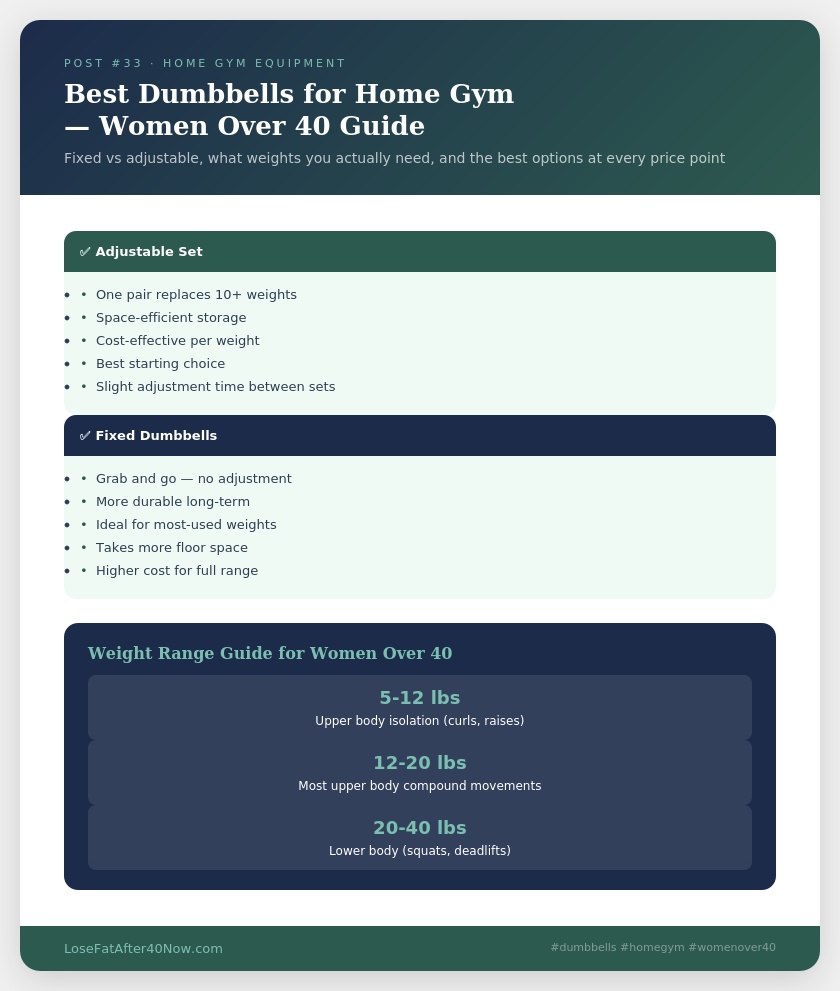
- Shoulders, biceps, triceps: 8–15 lbs to start, moving toward 15–25 lbs
- Chest and back rows: 12–20 lbs to start, moving toward 20–35 lbs
- Lower body (Romanian deadlift, goblet squat): 15–25 lbs to start, moving toward 30–50 lbs
The test that actually works: you should finish your target reps, but the final 2–3 reps should feel hard to complete. If a set of 15 finishes without any strain, the weight isn’t doing its job — it’s just movement, not muscle-building resistance.
The System I Actually Use Now
I stopped trying to solve every workout with one flexible piece of equipment. Instead, I figured out which weights I actually reach for most often, and I built my small home setup around that narrow range instead of chasing the widest possible spread.
Now, when I start a workout, the dumbbells are already sitting on the floor, ready. I’m not recalculating a weight or twisting a lock. If I need a different pair, I set one down and pick up the next — no delay in between.
What changed wasn’t how hard I trained. It was how fast I started. Where I used to spend a minute deciding whether today was really a workout day, I now pick up a dumbbell before that thought finishes forming.
The equipment that survived in my home gym wasn’t the most expensive or the most impressive on a spec sheet. It was the least annoying to use. When something new catches my eye now, I don’t check the reviews first. I ask myself one question: would I actually reach for this three times a week? Anything that doesn’t pass that test doesn’t last long in my living room, no matter how well it’s rated.
The Real Difference Between “Good” and “Used”
A dumbbell with a wider weight range isn’t automatically the better choice. The one that requires the fewest decisions between sets is usually the one still in rotation a year later.
Best Dumbbells for Women Over 40: Adjustable vs Fixed vs Cast Iron vs Neoprene
Once I understood what actually mattered to me, comparing categories got a lot easier. Here’s how the four common types held up, based on what I tested and what training style each one actually fits.
| Type | Best for | Real tradeoff |
|---|---|---|
| Adjustable (dial/pin) | Small spaces, wide weight range | 5–15 sec reset can break circuit flow |
| Fixed hex | Circuits, supersets, beginners | Needs a small rack for multiple pairs |
| Cast iron | Buy-once durability | Harder on floors, needs a mat |
| Neoprene-coated | Comfortable grip, learning form | Outgrown within 3–6 months of consistent training |
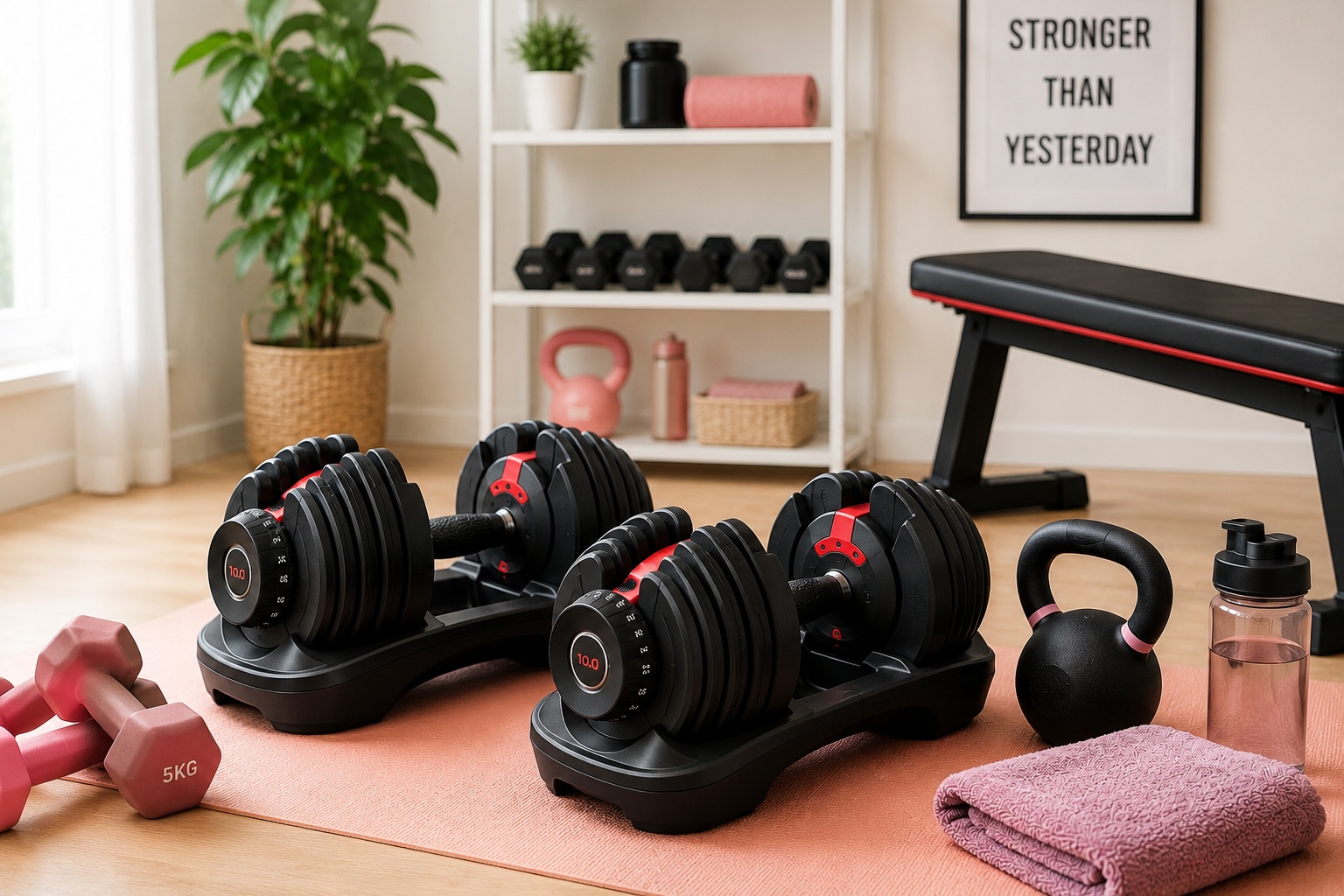
Adjustable Dumbbells (5–52.5 lb range)
A quality dial or pin-select adjustable dumbbell replaces an entire rack of fixed weights in the footprint of two dumbbells. For anyone working with a tight footprint, this is still the highest-value option — as long as you know the tradeoff going in. The mechanism should feel solid in hand. If it feels loose or flimsy before you’ve even bought it, it will fail faster under regular use.
Fixed Hex Dumbbell Set (5, 10, 15, 20, 25 lbs)
For most women over 40 starting home training, a simple five-piece fixed set covers the range needed for the first 6–12 months of consistent training. No mechanism, no adjusting, no thinking. The honest tradeoff is space — a five-piece set with a rack needs roughly 4 square feet of floor.
Cast Iron Hex Dumbbells
Cast iron has no coating to crack and no mechanism to fail. A well-maintained set will outlast almost anything else in a home gym, and the price per pound is usually the lowest of any type. The tradeoff is impact — cast iron is harder on floors, so a mat underneath is worth the extra step if you have hardwood or tile.
Neoprene-Coated Dumbbells (2–15 lbs)
Neoprene is the most comfortable option for lighter weights and works well for anyone just learning movement patterns — the coating won’t cause the grip fatigue that bare metal handles can. The honest limitation is that you’ll likely outgrow this range within 3–6 months of consistent training, so treat it as a starting point rather than a long-term system.
Mistakes That Cost Me Months, Not Just Money
Buying weights that felt “fine” in the store
A weight that feels comfortable standing in an aisle is almost never enough to challenge a muscle through 12–15 real reps. The last few reps of a set should feel hard, not manageable.
Matching the wrong type to my training style
I do circuits, not isolated sets with long rest. An adjustable dumbbell’s reset delay was fighting against exactly how I train — a mismatch I could have avoided by thinking about training style before price or space.
Buying too narrow a range
Legs can handle far more load than arms. A set that tops out around 15 lbs will feel limiting within a few months, especially for lower body work.
Storing dumbbells on the floor, out of sight
Equipment you have to search for or step around gets used less. A visible, low-effort storage spot made a bigger difference to consistency than I expected.
Essential Dumbbell Exercises for Women Over 40
These six movements, done consistently three times a week, cover the muscle groups that matter most after 40 — especially the posterior chain, which tends to weaken fastest without direct attention.
- Romanian deadlift — 3 sets × 10–12 reps, 20–35 lbs
- Goblet squat — 3 sets × 12 reps, 15–25 lbs
- Dumbbell row — 3 sets × 12 reps each side, 15–25 lbs
- Floor chest press — 3 sets × 12 reps, 15–25 lbs
- Overhead press — 3 sets × 12 reps, 10–15 lbs
- Hip hinge deadlift — 3 sets × 10 reps, 25–40 lbs
Frequently Asked Questions
How heavy should a beginner start?
Heavier than feels comfortable while standing in a store aisle. Most women over 40 can handle 15–20 lbs immediately for lower body movements, and 10–15 lbs for upper body. The real test is the last three reps of a 12-rep set — they should require genuine effort.
Are dumbbells safe for someone with osteoporosis or osteopenia?
Resistance training is one of the few interventions shown to meaningfully affect bone density after menopause, rather than something to avoid. A 2022 study in Sensors found that a structured resistance protocol increased lumbar spine bone mineral density by 1.82% over six months in postmenopausal women with osteopenia or osteoporosis, compared to a non-exercising control group. If you have significant bone loss, talk to your healthcare provider about starting loads before beginning.
Adjustable or fixed — which should I actually buy first?
If you do circuits or supersets, fixed dumbbells will serve you better because there’s no reset delay breaking your rhythm. If floor space is the real constraint, adjustable dumbbells cover more range in a smaller footprint — just know you’re trading convenience for compactness.
How much floor space does a home dumbbell setup actually need?
A compact five-piece fixed set with a rack fits in roughly 2 square feet. The workout area itself needs more — enough room to comfortably perform a lunge, a row, and a deadlift, which usually means about 6×6 feet total.
Can dumbbells alone build real strength, or do I eventually need a gym?
For one to two years of progressive training, dumbbells provide everything most people need for meaningful strength and body composition change. Barbells and machines only become necessary once you’ve progressed beyond what dumbbells can load — a point most home trainers never actually reach.
The Bottom Line
The best dumbbells for women over 40 aren’t the ones with the widest weight range or the most impressive reviews. They’re the ones that survive contact with an actual Tuesday evening — tired, short on time, not particularly motivated.
If your training style is circuits or supersets, start with a fixed hex set. If space is the real constraint, a quality adjustable system earns its complexity. If you want to buy once and never think about it again, cast iron. If you’re still learning the movements, neoprene buys you time to focus on form first.
What I’d tell myself at the very beginning: buy for how you actually train, not for the widest spec sheet. Start heavier than feels comfortable. And keep the dumbbells somewhere you’ll see them — equipment you have to go looking for is equipment you’ll quietly stop using.
What’s slowing you down more in your own home gym — the equipment itself, or the extra step it takes to use it? I’d like to know what you’re working with.

Grace Young is the founder of LoseFatAfter40Now.com, writing about practical, honest strength training and weight management for women over 40. Read Grace’s full story →
This post is for informational purposes only and does not constitute medical advice. Please consult a healthcare provider before beginning a new exercise program, especially if you have a bone density condition or joint concerns.