What to Eat on Intermittent Fasting Days (Over 40 Edition)
Why did some fasting days feel light, and others feel heavy — even when I’d eaten exactly the same things?
That was the question I sat with one morning in my eighth week of intermittent fasting. Same window. Same hours held. Same discipline with the protocol. But some days the fast ended and something felt clear and steady afterward, and other days I surfaced feeling dull and slightly slow, the kind of tired that a full night of sleep should have fixed but hadn’t. I kept telling myself it was probably cortisol, or stress, or just the ordinary variation of any given week. Then one morning I accidentally found the real answer by being too tired to think carefully about what to eat on intermittent fasting days.
The fast had ended, the window was open, and I reached for what I used to always reach for: banana, sliced thin into a bowl, granola scattered on top with a generous hand, a spoon of plain yogurt to hold it together. The same first meal I had eaten for months before I started paying attention to what I was breaking the fast with.
In the moment, it was exactly what I wanted. Sweet, crisp, easy. After 16 hours of fasting it tasted especially good, the kind of thing that feels like a reward for discipline.
About an hour later, the difference arrived. Not dramatically, but clearly. Instead of the clean, settled energy I had been getting from my new first meals, something familiar moved in: a slight heaviness, a dullness behind the eyes, the automatic thought of reaching for more coffee. And then, two to three hours after eating, the hunger came back. I had just broken a 16-hour fast. I had eaten a full first meal. My body was already looking for something else.
This day came about eight weeks into an intermittent fasting protocol I had followed carefully. Hours held, window maintained, not a single early break. But the results kept falling short of what I expected. My waist measurement barely moved. My afternoon energy still dropped on schedule. Around that eighth week, sitting with my log, I had thought honestly: is something wrong with me, or is this approach just not working for my body?
Looking back at eight weeks of first meals, the pattern was obvious once I saw it. Every morning when the window opened, I reached for something soft, sweet, and quick: banana, granola, fruit, yogurt. It looked like a sensible, healthy breakfast. For my body, it was a high-carbohydrate opening that pushed insulin up sharply at the exact moment when 16 hours of fasting had worked hardest to keep it down.
That tired morning, when I went back to the old way and felt the contrast so directly, turned out to be the most useful day in my entire fasting experiment. Not a failure. A measurement. The same fast, the same body, two completely different afternoons, because of what happened in the first meal.
If you have been following your eating window and still not seeing what you expected, this post covers exactly what to eat on intermittent fasting days over 40: why the first meal determines the rest of the day, how much protein you actually need inside an 8-hour window, and what a well-structured eating window looks like from first bite to last.
The Meal That Undoes 16 Hours of Fasting
Intermittent fasting works through two mechanisms that matter most for women over 40. First, it keeps insulin low for an extended period, creating conditions where the body can access stored fat rather than running exclusively on incoming glucose. Second, it gives the digestive system a meaningful rest that supports the metabolic recovery processes that are interrupted every time we eat.
After 14 to 16 hours of fasting, blood glucose is at its lowest point of the day. Insulin has dropped. The hormonal environment is the best it will be in any given 24-hour period.
The first meal ends all of that. How quickly depends entirely on what that meal contains.
After an extended fast, the insulin response to carbohydrates is amplified. The body’s insulin signaling has been quiet for hours and it responds sharply when a high-glycemic meal arrives. Refined carbohydrates, fruit sugar, granola, juice, even options that seem nutritionally reasonable, trigger a rapid blood sugar rise when consumed on a post-fast empty stomach. That spike is followed by a reactive drop: the fatigue, renewed hunger, and afternoon energy crash that many women on intermittent fasting keep experiencing despite following their timing protocol carefully.
The fasting hours built a low-insulin state. The wrong first meal dismantles it in under 30 minutes.
The Most Common First-Meal Mistake
Granola bowls, banana smoothies, fruit with yogurt, toast with jam: these are common “healthy breakfast” choices that carry a high glycemic load when consumed after an extended fast. The body’s amplified post-fast insulin response means even natural sugars spike harder than they would mid-day. For women over 40, where insulin sensitivity is already lower than it was at 35, this matters more, not less.
Why Insulin Controls Your Entire Eating Window
After 40, declining estrogen directly reduces insulin sensitivity. The same meal that produced a moderate blood sugar response at 32 produces a measurably larger one at 44, and takes longer to resolve. This is not a discipline problem. It is a hormonal shift with a clear physiological mechanism.
When estrogen falls, its buffering effect on insulin signaling weakens. The pancreas compensates by producing more insulin to achieve the same glucose clearance. Cells that repeatedly encounter high insulin loads gradually become less responsive to it, which is the insulin resistance pattern that makes weight loss after 40 feel stubbornly resistant to calorie-based effort.
Research: Insulin, Estrogen, and the Eating Window
- A 2019 review in Obesity Reviews found that time-restricted eating protocols reduced fasting insulin levels by 20 to 30 percent in adults following a consistent eating window over 8 to 12 weeks, with the strongest effect when the window was aligned with natural cortisol rhythms rather than pushed into evening hours.
- Research published in Climacteric (2018) confirmed that postmenopausal women show measurably reduced insulin sensitivity independent of body weight, meaning the hormonal change itself, not lifestyle choices alone, drives the metabolic shift.
Intermittent fasting addresses the insulin problem by creating regular extended periods of low insulin. But that benefit compounds only if the eating window does not immediately reverse it. The first meal needs to produce the smallest possible insulin response, which means protein and fat first, carbohydrates later, and in lower-glycemic forms when they do appear.
The Protein Gap That Is Costing You Results
Several weeks into consistent fasting, I still was not feeling what I expected. The window was clean. I was not breaking the fast early. But the muscle firmness and sustained energy I hoped for were not showing up.
I decided to spend one week actually counting the protein I consumed each day. Not estimating, but writing it down and adding it up.
My assumption was that I was eating reasonably well. The numbers corrected that quickly. On what I had considered a balanced, clean eating day, my total protein was 42 grams. Some days it was lower. My first meal was contributing almost none of it: banana, granola, and a spoon of yogurt added up to around 8 grams. The rest of the day, salad, a little chicken, some nuts, rarely got me above 50.
Fifty grams of protein might be sufficient for a sedentary woman in her 20s to maintain current muscle mass without noticing the deficit. At 40-plus, with estrogen-related muscle protection already declining and every pound of lean tissue becoming more metabolically relevant, 50 grams is a significant shortfall.
Protein Targets for Women Over 40 on IF Days
- Daily target: 90 to 130g (1.2 to 1.6g per kg of body weight)
- First meal: 35 to 40g, higher than a typical meal because the post-fast anabolic window is primed to respond
- Second meal: 30 to 35g
- Third meal or snack (if needed): 20 to 25g
After I changed my first meal, moving from banana and granola to eggs with Greek yogurt, the pattern shifted within the first week. The two-hour rebound hunger that had been following my first meal disappeared. My afternoon energy stabilized. The eating window started feeling like something I was maintaining rather than constantly fighting.
The protein was not the only variable. But it was the one I had been consistently overlooking.
Best Protein Sources for Your Eating Window
| Protein Source | Serving Size | Protein Content |
|---|---|---|
| Chicken breast (cooked) | 5 oz | ~38g |
| Canned wild salmon | 5 oz | ~32g |
| Canned tuna | 5 oz | ~35g |
| Cottage cheese (full-fat) | 1 cup | ~28g |
| Greek yogurt (plain, full-fat) | 1 cup | ~20g |
| Eggs (large) | 3 eggs | ~18g |
| Tempeh | 4 oz | ~22g |
| Lentils (cooked) | 1 cup | ~18g |
Why Meal Sequencing Changes How Your Body Handles Food
Once I had dealt with the protein problem, I tried one more experiment: changing only the order in which I ate, without changing the foods themselves.
For two weeks, I ate the same general foods I had been eating, but in a different sequence. Vegetables and salad first. Protein second: eggs, Greek yogurt, chicken, or fish. Fruit, granola, sweet potato, or any carbohydrate came last, if at all.
The meal I remember most clearly from that experiment: I had cucumber, colorful bell peppers, cauliflower, and a good handful of leafy greens, then two boiled eggs and a cup of Greek yogurt, then a small portion of banana and granola at the end. Almost identical ingredients to what I had been eating before. The order was the only real change.
Within the first week, the afternoon fatigue after my largest meal was noticeably less. By the end of the second week, the pattern was reliable: the days I ate vegetables and protein first were better afternoons than the days I did not. The craving for something sweet around 7 in the evening came later and felt less urgent. The post-meal heaviness I had attributed to eating too much was happening less, with the same quantity of food.
The Meal Sequencing Principle
Research published in Diabetes Care (2015) found that eating vegetables and protein before carbohydrates reduced peak postmeal blood glucose by up to 30 percent without changing total food consumed. Fiber from vegetables slows gastric emptying; protein triggers a hormonal response that blunts subsequent carbohydrate absorption. The result is a gentler glucose curve rather than a sharp spike-and-drop, which translates directly into steadier energy and delayed return of hunger. (Diabetes Care, 2015)
For women over 40, where insulin sensitivity is already lower than it was a decade ago, a 30 percent reduction in the blood sugar peak from each meal is a meaningful daily shift. Combined with a protein-anchored first meal, the sequencing approach becomes a practical tool that works within whatever foods you are already eating.
One additional note: a 10-minute walk within 60 minutes after your largest meal drives glucose uptake through muscle contraction, independently of insulin. Research suggests this reduces the postmeal glucose spike by a further 15 to 20 percent. No change to the meal required.
What I Actually Eat When I Break My Fast
After two months of logging, adjusting, and noticing what changed, my eating window settled into a pattern that works consistently. The structure is not complicated. The first meal is always protein and fat first. The second meal is protein anchored with vegetables and a moderate amount of carbohydrate. A third snack only if real hunger arrives, not out of habit or because the window is still open.

First Meal Options: 35g+ Protein Target
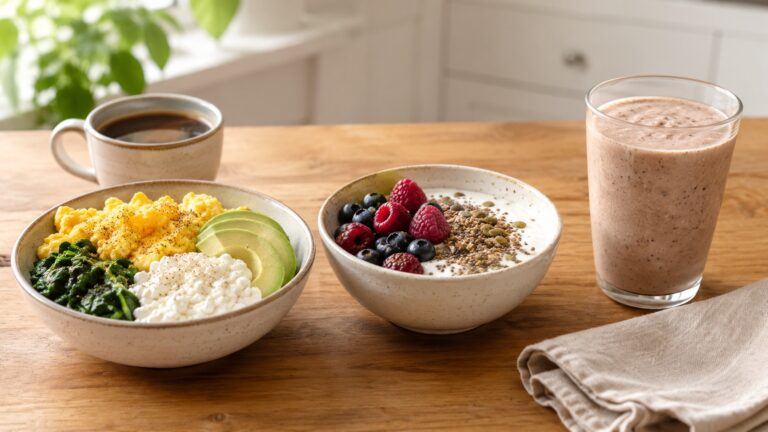
Option 1: Eggs and Greek Yogurt
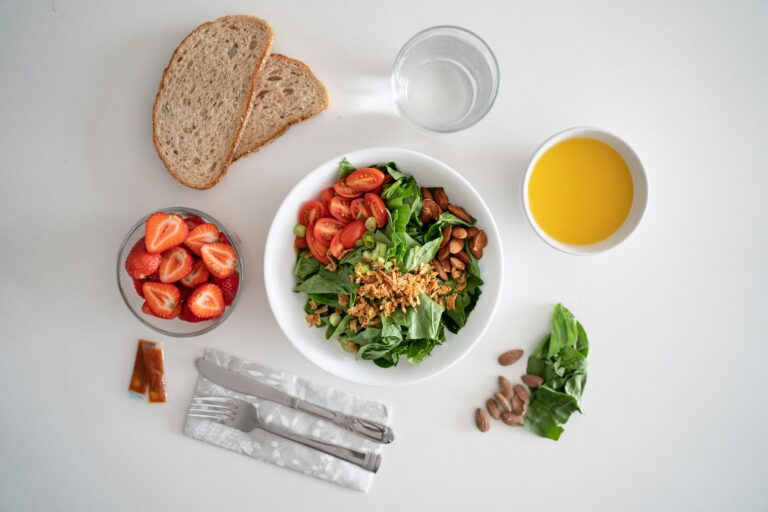
2 to 3 scrambled eggs cooked in a small amount of olive oil, plus 1 cup full-fat plain Greek yogurt with a handful of blueberries. Fast, filling, and hits the protein target before any carbohydrates enter the picture.
~35 to 38g proteinOption 2: Cottage Cheese Bowl
1 cup cottage cheese, a small handful of walnuts, half a cup of blueberries, 1 tablespoon ground flaxseed, cinnamon. A no-cook option that comes together in two minutes and provides casein protein that digests slowly through the morning.
~30 to 32g proteinOption 3: Smoked Salmon with Eggs and Avocado
2 eggs, 2 oz smoked salmon, half an avocado, a handful of cherry tomatoes. High protein, high healthy fat, and virtually no blood sugar response.
~30g proteinSecond Meal: 30 to 35g Protein
Big Salad with Protein
Large mixed greens with 5 oz canned wild salmon or grilled chicken, half an avocado, cherry tomatoes, cucumber, olive oil and lemon. Quinoa or sweet potato added on the side when more carbohydrate depth is needed.
~38 to 42g proteinGrain Bowl
5 oz grilled chicken breast, half a cup of cooked quinoa, roasted broccoli, olive oil drizzle. Vegetables first, protein second, the grain as a complement rather than the center of the meal.
~42g proteinThird Meal or Snack: When Hunger Actually Arrives
Tuna on Cucumber
1 can tuna, 1 tablespoon Greek yogurt, capers, lemon juice, on sliced cucumber rounds. Fast, high protein, and satisfying close to the end of the window without being heavy.
~28g proteinGreek Yogurt with Nuts
1 cup full-fat plain Greek yogurt with a mixed handful of walnuts and almonds. A clean protein top-up when the window is nearly closed and a full third meal is more than needed.
~22g proteinBest and Worst Foods to Break a Fast
| Best Foods to Break a Fast | Why It Works |
|---|---|
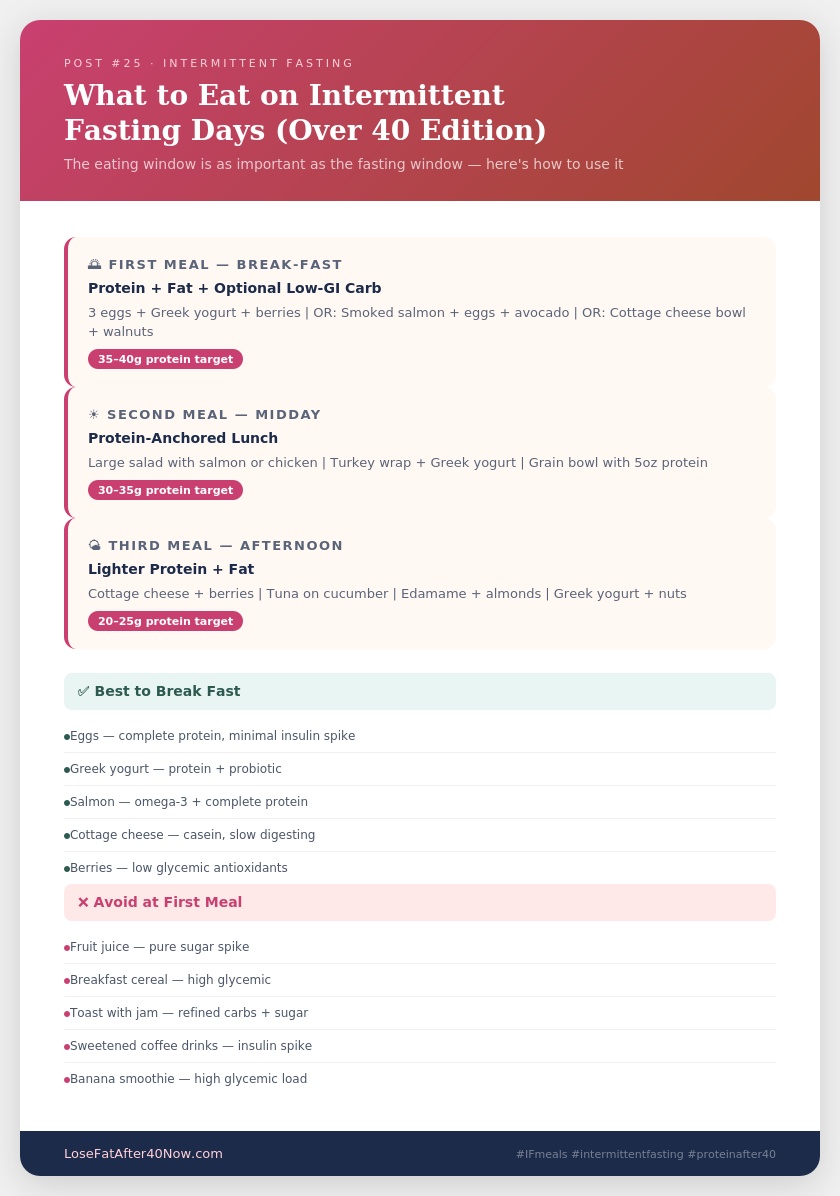
| Eggs | Complete protein, minimal insulin response, rich in choline and fat-soluble vitamins |
| Greek yogurt (plain, full-fat) | High protein, probiotic, low glycemic; pair with berries after protein, not before |
| Cottage cheese | Casein protein (slow-digesting) plus the highest protein-to-calorie ratio of common dairy foods |
| Canned salmon or sardines | Complete protein plus omega-3 anti-inflammatory effect; no cooking required |
| Avocado | Healthy fat, zero blood sugar impact, potassium for electrolyte balance |
| Leafy greens and raw vegetables | Fiber that slows gastric emptying and blunts subsequent carbohydrate absorption |
| Berries (especially frozen) | Low glycemic, antioxidant-dense; eat them after protein, not before |
| Worst Foods to Break a Fast | Why It Backfires |
|---|---|
| Fruit juice or high-fruit smoothies | Pure fructose spike that removes 14 to 16 hours of low-insulin benefit almost immediately |
| Banana and granola combination | High glycemic even without added sugar; hits significantly harder on a post-fast empty stomach |
| Toast, cereal, or white bread products | Refined carbohydrate, minimal protein, rapid blood sugar rise with no sustained satiety |
| Sweetened or low-fat yogurt | Often higher in added sugar than full-fat plain; provides little protein relative to carbohydrate load |
| Pastry, muffin, or sweetened coffee drinks | Sugar plus refined flour at the exact moment insulin sensitivity is at its daily peak |
Carbohydrate Quality During the Eating Window
Carbohydrates are not the problem inside a fasting eating window. Type and timing are what matter.
Carbohydrates to include: Sweet potato, oats, quinoa, lentils, brown rice, whole fruit, legumes. These provide steady fuel and fiber without triggering aggressive insulin responses when consumed after protein and vegetables.
Carbohydrates to minimize: White bread, white rice, white pasta, packaged crackers, granola bars, fruit juice, anything with added sugar listed in the first three ingredients. These spike blood sugar in any context and spike it harder after an extended fast.
Sample Weekly Eating Window Plans
| Day | First Meal (35g+ protein) | Second Meal | Third Meal / Snack |
|---|---|---|---|
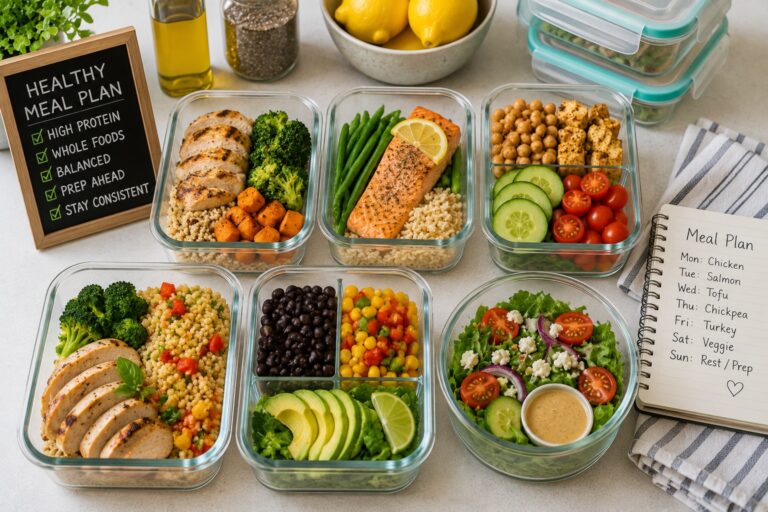
| Monday | Eggs + Greek yogurt + blueberries | Salmon salad + quinoa | Cottage cheese + walnuts |
| Tuesday | Cottage cheese bowl + flaxseed | Chicken breast + roasted broccoli | Tuna on cucumber |
| Wednesday | Non-fasting day: 3 regular meals, no window | ||
| Thursday | Smoked salmon + eggs + avocado | Lentil soup + boiled eggs | Greek yogurt + mixed nuts |
| Friday | Eggs + avocado + cherry tomatoes | Big salad + grilled chicken | Edamame or Greek yogurt |
| Saturday | Non-fasting day: 3 regular meals, no window | ||
| Sunday | Greek yogurt + berries + flaxseed | Large salad + canned salmon | Cottage cheese + blueberries |
The Structure Behind the Plan
- Non-fasting days are intentional rest, not failures. Two to three per week is standard in sustainable IF frameworks for women over 40.
- Every first meal on fasting days reaches 30g+ protein before any carbohydrate is added.
- Vegetables appear in both first and second meals, with fiber before carbohydrates every time.
- The third meal is optional. If the second meal was sufficient, skip it. Eat only when real hunger arrives, not because the window is still technically open.
Frequently Asked Questions
Can I have coffee with a splash of milk before my eating window opens?
A small amount of milk, 1 to 2 tablespoons, contains roughly 10 to 15 calories and produces a minor insulin response. If that splash is the difference between sustaining the protocol and abandoning it, the compromise is reasonable. Black coffee, plain tea, and water remain the cleanest options during the fast itself.
When should I take protein supplements during IF days?
Protein supplements contain calories and should be consumed inside the eating window. The most useful timing is within the first two hours of opening the window, alongside the first meal, or within an hour after strength training. A protein shake taken before the first food technically ends the fast, so treat it as a meal, not a supplement.
Is it okay to eat the same meals every day for simplicity?
Yes. Dietary predictability reduces decision fatigue and makes the protocol easier to sustain long term. Many women who maintain intermittent fasting successfully eat nearly identical meals each day. What matters nutritionally is that the repeated meals collectively provide adequate protein, varied vegetables, and enough micronutrients across the week, not necessarily within each individual meal.
I am consistently hungry as my eating window closes. What needs to change?
End-of-window hunger almost always points to one of two things: the second or final meal was too low in protein, or it ended with carbohydrate-heavy foods. Carbohydrates without adequate protein trigger a blood sugar cycle that brings hunger back 1 to 2 hours later. Ending the window with a protein-focused meal, such as cottage cheese, eggs, or tuna, tends to resolve this reliably within a few days of the change.
Does what to eat on intermittent fasting days change after menopause?
After menopause, the hormonal context shifts significantly. The protein requirements, the optimal fasting window length, and the foods that best support recovery all need recalibration. The 16:8 framework and meal structure that works in perimenopause is not always the right fit after menopause, and the adjustments are specific enough to deserve their own discussion.
What the Eating Window Is Actually For
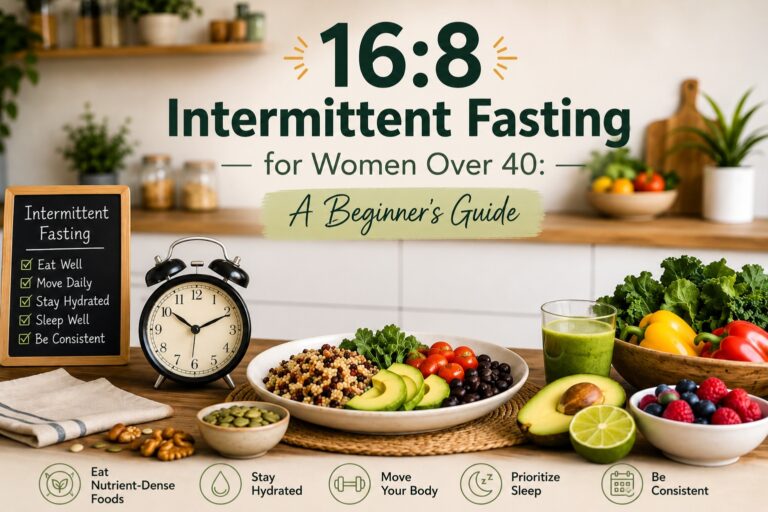
Intermittent fasting creates a metabolic opportunity: a period of low insulin, a chance for cellular recovery processes to run without interruption, a hormonal environment that is difficult to reproduce through any other dietary approach. For women over 40, that window matters more than it did a decade ago, not less.
What happens inside the eating window determines whether that opportunity is used or wasted.
The changes that made the real difference for me were not dramatic ones. Changing the first meal from banana and granola to eggs and Greek yogurt. Tracking actual protein for a week and realizing how consistently short I had been falling. Eating vegetables before carbohydrates instead of alongside them. None of these required a stricter schedule or a longer fast. They required paying attention to the half of intermittent fasting that most guides barely address.
The eating window is not a reward for fasting. For women over 40, it is the other half of the work, and it deserves as much deliberate thought as the hours spent without eating.
What has been the hardest part of eating well inside your eating window: the first meal, hitting protein targets, or something else entirely? Leave a comment below. I read every one.
Disclaimer: This post is for informational purposes only and does not constitute medical advice. Please consult with a registered dietitian or qualified healthcare provider before making significant changes to your diet, particularly if you have an existing health condition or are taking medication.

Grace Young is the founder of losefatafter40now.com and a health educator with a master’s degree in education and doctoral coursework in health education. After navigating her own weight and energy challenges through perimenopause, she writes about evidence-based approaches for women over 40 who want real answers, not generic advice.
Read Grace’s full story →