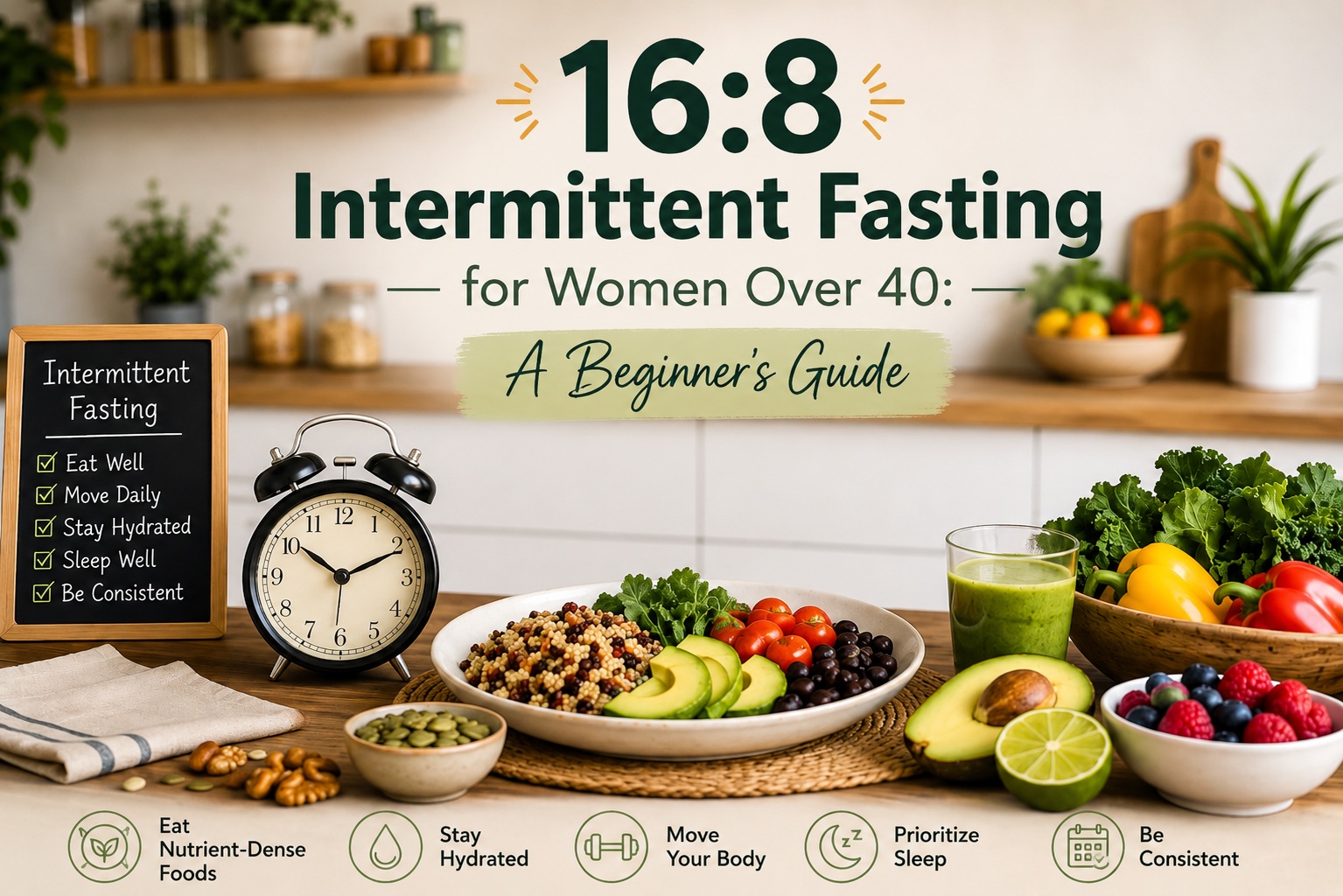
16:8 Intermittent Fasting for Women Over 40: A Complete Beginner’s Guide
The number on my health checkup report was 35.2%. That was my body fat percentage, flagged in bold with the words “early abdominal obesity” printed beside it.
I sat with that result for a moment, then thought about the past couple of months. There had been a small thing I’d noticed and then set aside: my watch had started feeling looser. One afternoon I had looked down at it and realized the buckle was sitting in a different hole from where I always wore it. Not a hole tighter — one hole looser. My wrist had changed, or something had redistributed, and I had registered it as an odd detail and moved on without asking what else might have shifted at the same time.
That checkup was what pushed me to seriously research 16:8 intermittent fasting for women over 40. I had seen it mentioned in articles, heard about it from women managing the same midlife metabolic shift. I decided to understand it properly before I tried it.
What followed was two weeks of getting it wrong, a pivot that changed everything, and a protocol that has been one of the most effective tools in my health practice since. This guide covers all of it: what I got wrong first, why the setup matters more than the duration, and exactly how to start if you’re considering 16:8 for the first time.

Why 16:8 Works Differently After 40
The underlying issue for most women in their 40s is insulin resistance: as estrogen declines, cells become less responsive to insulin and blood glucose spikes store preferentially as visceral fat.
This is the direct mechanism behind 16:8 intermittent fasting for women over 40. A 16-hour fasting window is long enough to allow insulin to drop fully, creating a low-insulin state that the body needs to actually access stored belly fat. Fat cells will not release stored fat while insulin is elevated. Extended fasting opens the window that dietary changes alone often cannot.
What 16:8 Does to Your Metabolism: By the Numbers
The challenge is that the standard 16:8 setup described in most guides was developed around younger male physiology. The most common recommendation is to fast from dinner to noon the next day, then eat from noon to 8 PM. That setup creates specific hormonal problems for women over 40 that general guides almost never address. I found this out the hard way.
What Happened When I Followed Standard Advice
I started with noon to 8 PM. It seemed like the obvious choice. Skip breakfast, which I was eating mostly out of habit. Eat a normal lunch, an afternoon snack if I needed one, dinner at a reasonable hour. The window closes at 8 PM. Clean and simple.
Day three is when things changed.
I woke up each morning not hungry exactly — but tense. A low-level edginess that was already present before I’d had coffee or checked anything on my phone. By 10 AM it had sharpened into genuine irritability. By 11, the hunger had a different quality to it: not the ordinary kind that passes if you stay busy, but something hollow and insistent that made concentrating on anything else harder. I told myself it was adaptation. I kept going.
Day five, six, and seven brought a new problem in the afternoon. I would eat lunch, feel stable for an hour, then hit a wall around 4:30 PM. Energy dropped sharply. Focus became effortful. By 6 PM I was hungry in a way that felt disproportionate, and dinner ended up larger than it was supposed to be. Sleep that week was restless, surfacing without fully waking, not resting deeply.
I stayed with that window for two weeks, giving it a fair trial. The morning tension and the afternoon crash continued. The pattern was consistent enough to tell me something: not that 16:8 didn’t work, but that this particular setup wasn’t compatible with how my body was running in the mornings.
Why Noon–8 PM Creates Problems for Women Over 40
Cortisol is naturally highest between 6 and 9 AM. Without food to signal to the body that the overnight fast has ended, cortisol stays elevated well into the morning. In women over 40, with declining estrogen no longer moderating the cortisol response, this extended morning fast amplifies the effect significantly. (Journal of Clinical Endocrinology and Metabolism, 2018)
- Elevated morning cortisol drives the mid-morning hunger and irritability many women experience
- A prolonged cortisol spike suppresses deep sleep quality that same night
- Late eating windows place the largest meals of the day when insulin sensitivity is at its lowest
The 4-Week Entry Plan: How to Start 16:8 After 40
The second common mistake is jumping straight to 16 hours on day one. The cortisol burden from going immediately to full 16:8 is what causes most women to abandon the protocol in the first two weeks and conclude the approach doesn’t work for them. The problem isn’t 16:8. The problem is the abrupt entry.
A gradual 4-week approach lets your appetite hormones, cortisol rhythm, and sleep adapt together at a pace your body can actually manage.
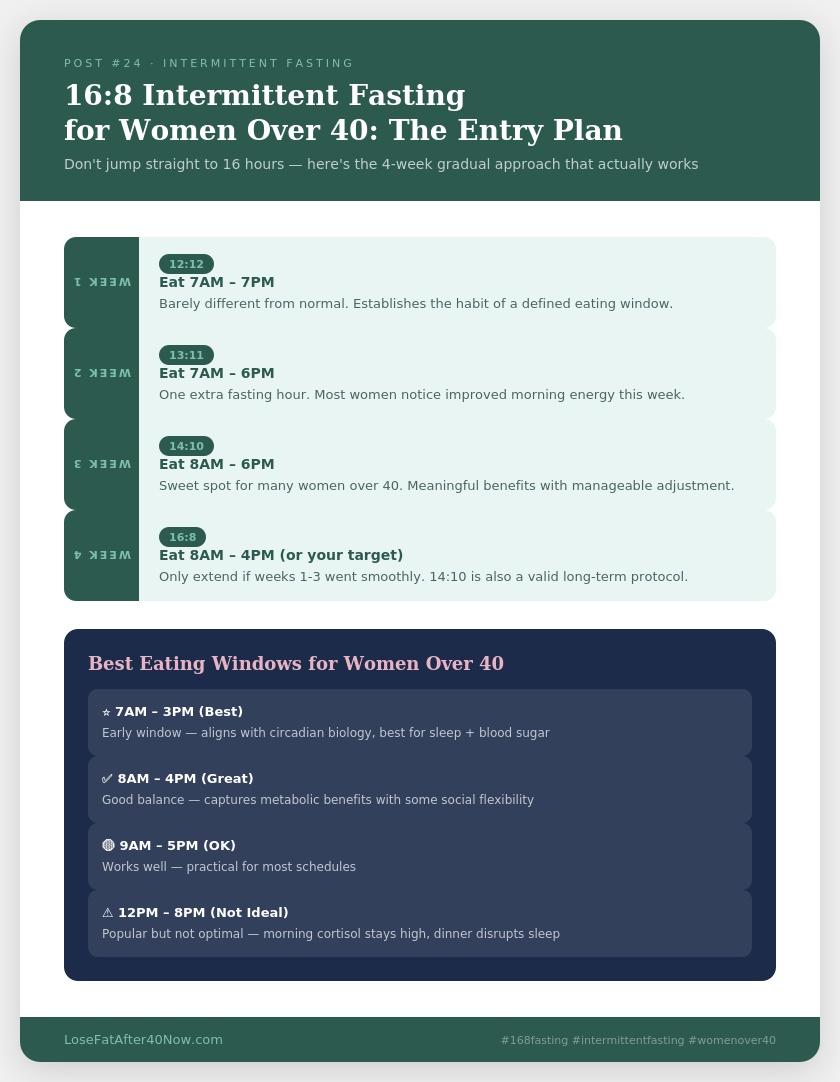
Week 1: 12:12
Close your eating window at 7 PM and open it at 7 AM. You’re likely already close to this pattern naturally. The goal at this stage is just to establish the habit of a defined window. Hormonal adaptation begins even at this gentle level, and starting here prevents the sharp cortisol shock that derails so many beginners.
Week 2: 13:11
Push one end of the window by one hour: either delay your first meal to 8 AM, or close the window at 6 PM. One extra hour. Many women notice slightly reduced morning hunger and steadier energy before lunch during week two. That steadiness is the insulin response beginning to shift.
Week 3: 14:10
Open the window at 8 AM and close it at 6 PM. A 14-hour fast produces meaningful metabolic benefits (insulin reduction, early autophagy, improved fat oxidation) with an adaptation challenge most women over 40 manage well. For many, this becomes the permanent protocol. 14:10 placed early in the day is not a lesser version of 16:8. It is a highly effective protocol.
Week 4: 15:9 or 16:8
Extend further only if weeks 1 through 3 have gone smoothly: sleep is stable, energy is consistent, and hunger is manageable. If 14:10 has been working well, there is no obligation to push to 16. Your target fasting duration should be determined by your body’s actual response, not by what a general guide says you should be aiming for.
The Window Placement Decision Nobody Talks About
After two weeks of noon to 8 PM, I changed one thing: I moved the entire window earlier. First meal at 8 AM. Last meal at 4 or 5 PM. The same total fasting duration, placed differently on the clock.
I expected the change to be minor. It was not.
Within a few days, something I hadn’t been tracking shifted: my ability to concentrate in the mid-morning improved noticeably. The morning work sessions that had been fractured and effortful became steadier. Around the same time, digestion became easier — less heaviness after lunch, less that vaguely uncomfortable full feeling that I had assumed was just how eating felt. The 10-to-11 AM irritability that had been a daily feature of my mornings was still there initially, but it had a different edge — less driven by something physiological, more like ordinary impatience that passes. A week in, mornings felt different in ways I hadn’t anticipated when I made what seemed like a minor scheduling adjustment.
The core insight for me was this: I had been thinking of intermittent fasting as a question of how long to go without eating. What matters as much, for women over 40, is when you place the eating window on the clock. The same fasting duration produces meaningfully different results depending on whether it’s aligned with or working against your hormonal rhythm.
Early vs. Late Eating Window: What the Research Shows
| Eating Window | Cortisol Alignment | Sleep Impact | Practical Note |
|---|---|---|---|
| Noon – 8 PM | Poor: long fast during morning cortisol peak | Late meals reduce sleep quality; cortisol suppresses deep sleep | Most common recommendation, but hardest for 40+ women |
| 8 AM – 4 PM | Good: eating starts as cortisol is already rising naturally | Fasting period overlaps cleanly with sleep window | Best metabolic outcomes; challenging with family dinners |
| 8 AM – 5 PM | Good: one extra hour of flexibility | Still 3+ hrs fasted before sleep | Best balance for most women over 40 with family commitments |
The right window is the earliest placement your daily life realistically allows. For most women over 40 with families, something between 8–9 AM and 4–6 PM captures most of the benefit while remaining sustainable long-term.
What to Eat During Your 8 Hours
The eating window is not a free pass. What you eat during those eight hours directly affects whether the fasting window produces the metabolic change you’re looking for. Three rules matter more than anything else.
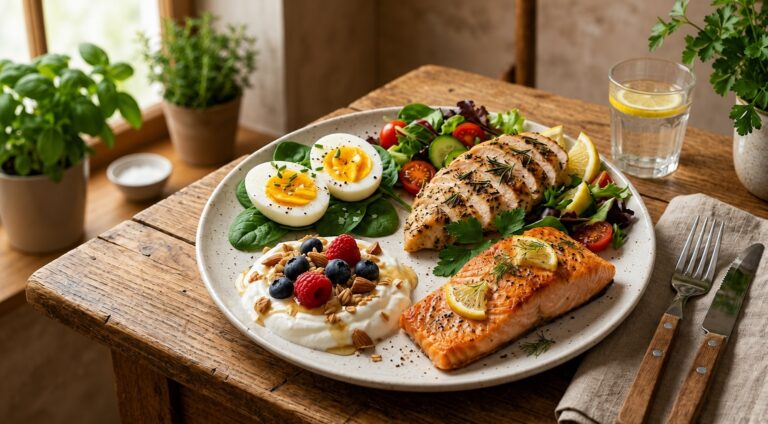
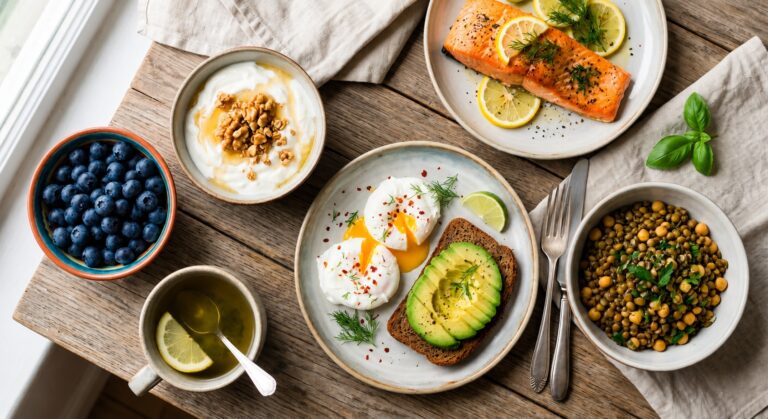
Protein first, at every meal. Break your fast with protein, not carbohydrates. The first thing you eat after an extended fast determines your blood glucose trajectory for the rest of the day. Aim for 30 to 35 grams at your first meal and at least 80 to 100 grams total across the window. Eggs, Greek yogurt, salmon, cottage cheese, edamame, and tofu are reliable anchors.
Do not undereat during the window. A calorie-restricted eating window elevates cortisol, accelerates muscle loss, and counteracts the metabolic work the fasting window is doing. Combining 16:8 with severe restriction is not twice the benefit. For most women over 40, 1,400 to 1,600 calories across the eating window is a reasonable floor. The goal is to feel satisfied, not depleted.
Break the fast with protein and fat, not sugar. Fruit juice, sweetened yogurt, or a high-carbohydrate breakfast immediately after a 16-hour fast produces a sharp glucose spike and a corresponding insulin surge that partially neutralizes what the fast achieved.
| Time | Meal (Sample, 8 AM – 4 PM Window) | Protein |
|---|---|---|
| 8:00 AM | 3 eggs with spinach + Greek yogurt + berries | ~35g |
| 12:00 PM | Large salad + 5 oz canned salmon + avocado + olive oil | ~30g |
| 3:30 PM | Cottage cheese + blueberries + walnuts | ~22g |

What You Can Have During the Fasting Window
- Water, as much as you want. A pinch of sea salt and lemon is fine.
- Black coffee: maximum 1 to 2 cups, ideally before 11 AM
- Plain herbal tea, no sweeteners, no milk
- Still or sparkling water, plain, no flavoring agents
Plain water, black coffee, and unsweetened herbal teas do not produce a meaningful insulin response and are safe during a fasting window. Milk in coffee, gum, flavored beverages, and artificial sweeteners all carry a risk of disrupting the fast. (Nutrients, 2020)
Signs You’re Pushing the Fast Too Hard
The goal of 16:8 is not to push through discomfort until your body gives up and adapts. It is to find the fasting duration that produces metabolic change without triggering a sustained stress response. If the fast is creating more cortisol burden than benefit, the protocol needs adjusting.
Warning Signs to Take Seriously
- Persistent morning tension or irritability that does not ease after mid-morning
- Waking at night or sleeping more shallowly than usual
- Energy dropping sharply between noon and 3 PM, regardless of what you eat
- Overeating consistently at dinner, even after a normal lunch
- Feeling worse, not more stable, after two full weeks on the protocol
If three or more of these sound familiar, shorten the fasting window by one to two hours or move the eating window earlier. A well-placed 14:10 protocol outperforms a stressed 16:8 placed at the wrong time of day. (Journal of Endocrinology, 2021)
Frequently Asked Questions
Should I exercise during the fasting window or the eating window?
For women over 40, training during or just after the eating window generally produces better results than intense fasted exercise. High-intensity work in a fasted state raises cortisol considerably. Light walking during the fasting window is fine and actively supports insulin sensitivity without the cortisol cost. Save strength training and higher-intensity cardio for after your first meal.
What about supplements during the fast?
Most supplements without caloric content (vitamin D, magnesium, zinc) won’t meaningfully break the fast. Protein supplements, by definition, do break it and should be taken during your eating window. If a supplement causes nausea on an empty stomach, take it with your first meal rather than forcing it during the fast.
I wake up at 5 or 6 AM. How do I structure the window?
Build the window around your actual waking time. If you’re reliably awake by 5:30 AM, a 6 AM to 2 PM or 6 AM to 3 PM window captures the early-TRE advantage without requiring you to wait hours before eating. The earlier the window, the better the alignment with your cortisol rhythm.
Is 16:8 appropriate if I have a history of eating disorders?
This decision should involve a healthcare provider. Time-restricted eating, with its defined windows and rules around when eating is and isn’t permitted, can activate restrictive patterns in people who have experienced them. If control around food has ever been a source of significant distress, approach 16:8 cautiously and with professional support rather than alone.
How long before I see results?
The protocol is built in four weeks for a reason — each week produces a different kind of signal, and learning to read those signals is most of what makes the difference. Week one (12:12) often brings a quieter after-dinner period. The late eating that kept cortisol elevated into the night has been removed, which the body registers quickly. That’s not a result yet. It’s the system starting to clear. Week two (13:11) tends to shift morning hunger patterns. The urgency on waking softens for many women as the cortisol-and-morning-fast cycle begins recalibrating. Weeks three and four (14:10 through 16:8) are when insulin is spending meaningfully longer at low levels between meals. That sustained low-insulin state is when fat access actually opens. Body composition changes follow those adaptations — typically four to six weeks in for women whose window is placed early and protein intake is adequate. The four-week build isn’t just for comfort. It’s pacing the adaptation in the right order.
The number on that health report was useful information, not a verdict. A 35.2% body fat reading and an “early abdominal obesity” flag told me something needed to change. Moving the eating window forward, starting at 12:12 and building slowly, and keeping protein high were the three changes that made 16:8 intermittent fasting for women over 40 actually work for my body.
Start with 12:12 this week. Place the window as early in the day as your schedule allows. Trust the first couple of weeks to be imperfect. The adaptation is real — it just has to happen on your body’s timeline, not the timeline a general guide sets for you.
If you’ve tried 16:8 before and it didn’t stick — was your eating window in the morning or the evening? Leave a comment. I’d like to know what the experience was like.
Medical Disclaimer: This post is for informational purposes only and does not constitute medical advice. Consult with a qualified healthcare provider before beginning any new dietary protocol, particularly if you have diabetes, a history of eating disorders, or any hormonal condition currently being managed medically.